
Farmers share challenges with Craig
U.S. Rep. holds roundtable discussion in Marshall
Trending
MARSHALL -- There's a lot on Minnesota farmers' minds.
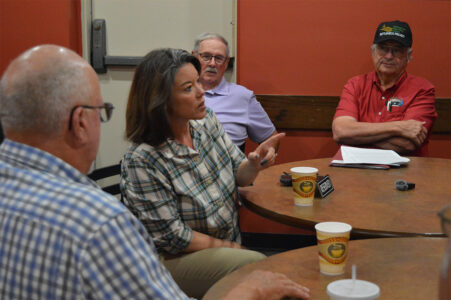
In a round-table discussion with U.S. Rep. Angie Craig this weekend, area farmers said some of the challenges facing agriculture range from tariffs and labor needs, to the cost of getting new generations into farming.
Craig said her stop in Marshall on Saturday was intended to be mainly a listening session. While Craig is running for Tina Smith's seat in the U.S. Senate, she is also currently ranking member of the House Agriculture Committee.
"I work very closely with Republican Chairman GT (Glenn) Thompson in my work on the (Agriculture) Committee, and of course we're in the middle of trying to figure out a path forward," Craig told the group.
The House passed a "skinny farm bill" earlier this spring, and the Senate is working on its version of the bill.
Craig said she didn't always agree with Thompson, but they could work together.
"That's how Washington used to work," she said. "GT and I, I'm sure we disagree a lot on certain issues, but with respect to supporting family farmers, we agree on a lot too."
Craig said hearing concerns from Minnesota farmers was an important part of her work with the Agriculture Committee.
One of the issues that came up during Saturday's discussion was the difficulties of getting younger generations into farming.
"There's so many barriers," said Lake Benton area farmer Bob Worth.
It took a lot of working capital to get into farming, especially with factors like land rent and high input costs, Worth said.
Ben Johnson, who grew up farming near Walnut Grove and is now a loan officer, said he saw similar issues for young farmers.
"From a young guy perspective, it's a lot of wheel-turning, and they're not really gaining a whole lot of equity," he said.
For example, many young farmers are dealing with the costs of machinery needed to farm rented land, he said. Johnson said from a lending perspective, he didn't know if he saw another farm crisis like the one in the 1980s coming.
But, he said, "The next 30 years doesn't look very promising. If mom and dad don't own a ton of land, it's going to be tough."
Other discussion participants said they wanted to see more support for scientific research in agriculture, and development of safety measures like vaccines for livestock.
"The turkey industry right now has had so many problems with avian influenza," said Paul Kvistad, who raises turkeys near Wood Lake. "We need that support for vaccines. It just seems like this administration right now is moving away from that," he said.
Immigration was another concern area farmers talked about. Labor was a key issue for both farmers and businesses like small meat processors, and immigrants played an important role in the workforce, they said.
"They're just critical," said Walnut Grove area farmer Arlen Knott.
"We do need the immigrant population to run these plants and do this farm work," Brian Johnson said. "We need the people."
"We're not going the right direction, and we just need some common sense here along the way," Johnson said of U.S. immigration policies.
Craig said she supported comprehensive immigration reform.
"We need to know who's coming across our southern border, she said. "But there ought to be a way for some of these individuals who have been here, who have obeyed the law, paid their taxes, worked on our farms, to earn legal status."
If Democrats can take back the House and Senate, they will be in a better negotiating position to make changes that benefit family farmers, Craig said.
"The tariffs have been bad for farmers. The war in Iran has been bad for farmers, and even conservative Republican voters will admit it and tell me that," Craig said. "The farmers here today, consistent with what I hear across political ideology, they want export markets, they want expansion of domestic markets, and my commitment is, whoever is in the White House, to continue to push for those things."