
Bringing Revolutionary history to light
Makela shares lesser-known stories from Revolutionary War
Trending
MARSHALL -- Discussions of the American Revolution often focus on the parts of the war where George Washington was. But that's not all that was going on, southwest Minnesota educator and author Erin Makela said.
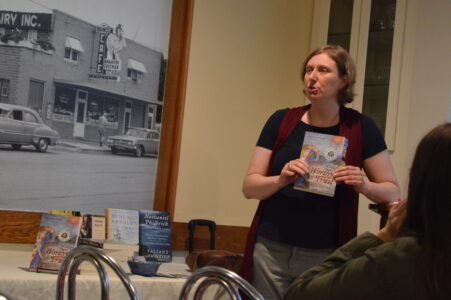
Last week, Makela visited the Lyon County Museum to share some of the lesser-known stories from the northern theater of the Revolutionary War. Makela said she learned about this part of history while researching her book series set during the fight for independence.
"I teach and live in Worthington," Makela said. "I wrote a young adult historical fiction novel, 'Worthy of Trust,' which is set during the American Revolution. It was a Minnesota Book Awards finalist for this last year, which was super exciting, and its sequel, 'Enterprising and Dangerous,' is coming out in June."
Makela said she got interested in the Revolution through teaching history, and trying to make the book 'Johnny Tremaine' more accessible for her middle-school students.
"That started me down the very, very deep rabbit hole of Revolution research," she said.
Makela's book, and her talk, focused on the Revolutionary War in the north, in the area around Fort Ticonderoga in New York state. Telling the story of the war at Fort Ticonderoga also meant talking about the role of Benedict Arnold, she said.
"Benedict Arnold plays a huge role in the Northern Department's war from 1775, up through 1777," Makela said. Today, Arnold is best known for defecting to the British side in the war. "But before he was America's first and greatest traitor, he was her first and greatest hero," Makela said.
Arnold led part of the American forces that captured Fort Ticonderoga from the British in 1775. The fort was located on Lake Champlain, and was strategically important, Makela said.
"It was known as the key to the continent. It was super important during the French and Indian Wars," she said. "It was thought of as the place to stop anyone going north or south - if they were trying to take control of the Hudson (River) going south, or trying to get to Canada going north."
After capturing the fort, American troops used it as a launching point to invade Canada, "Which goes terribly for the Americans," Makela said.
With a shortage of supplies and facing illnesses like smallpox, American troops had retreated back to Ticonderoga, where they hoped to hold off the British.
Arnold called for builders and sailors to come to the Lake Champlain area to build up a fleet of boats and ships, Makela said. In the Battle of Valcour Island in October 1776, the Americans were able to hold off the British fleet on Lake Champlain, and escape under the cover of night.
"This battle stops the British. The British did not expect any actual resistance on Lake Champlain," she said.
Arnold would go on to lead American troops at the Battle of Saratoga in 1777, and was wounded in the left leg. Makela said the only monument to Benedict Arnold that exists commemorates his service at Saratoga. Instead of Arnold's face, the monument has a carving of his injured left leg.
Makela said another little-known part of Revolutionary history was the Christmas riot of 1776, an incident she learned about on a research trip to Fort Ticonderoga. On Dec. 25, 1776, tensions between regiments from Massachusetts and Pennsylvania came to a boiling point, when a Pennsylvania colonel led an attack against the Massachusetts troops. A Massachusetts colonel was assaulted, and had part of his ear cut off, Makela said.
"It's mayhem, happening at night, on Christmas, at Fort Ticonderoga," she said. The riot was stopped, and the Pennsylvania colonel was called down to Albany.
"It's not actually clear if a court martial ever took place," Makela said. However, historical documents did show that General Philip Schuyler was trying to figure out what to do with the colonel after he was removed from the fort.
"They don't want this blowing up and destroying the morale of troops far and wide throughout the Continental Army," she said.
"I think it's fascinating, because I think we tend to think, when we're looking back on the Revolution, that all of these Continental soldiers were a band of brothers all fighting together for one thing, one cause," Makela said of the riot.
In reality, soldiers from different parts of the American colonies often didn't get along. "You had all of these colonial, and then soon state rivalries going on, and that kind of shows up here."
The Christmas riot was something that did not show up in the historical log book for Fort Ticonderoga, Makela said. The full story of the incident was uncovered by historian Dr. Matt Keagle, using sources like letters and affidavits from troops, Makela said.