Beef without the bull
Southwest MN farmers taking a chance with investing into a different way to sell their cattle — carving out the middle man with e-commerce startup
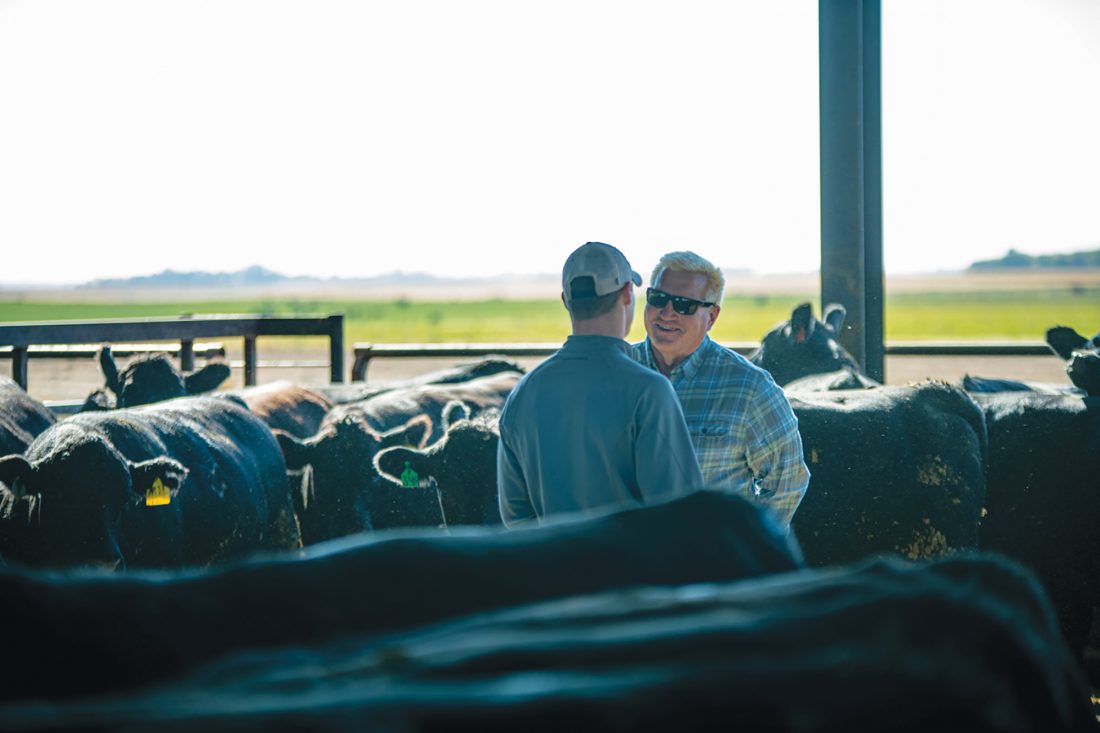
Photo courtesy of BetterFed Beef Wabasso farmer Cole Altermatt, left, performs a routine check of his cattle with nutritionist Dr. Tom Peters. Altermatt is one of 17 producer/owners in Minnesota raising cattle for BetterFed Beef e-commerce startup. Peters co-founded direct-to-consumer beef retail company with Max Winders
TAUNTON — Luke Gorecki moved from Sioux Falls back to Taunton to work on the family’s farm with his brother, Adam, seven years ago.
“Dad kind of wanted to slow down and started to retire, so he moved to town and then we (his family) moved on to the home farm,” Gorecki said.
Back then, Gorecki said, most of the farm’s cattle went to big companies like Cargill and Tyson. And the cattle had to be transported hundreds of miles to the large slaughterhouses.
“There’s only four meat packers and you have cattle to sell. ‘This is the price you get, like it or not.’ You have to sell them. Once they are ready, they gotta go. You can’t keep them for another six months until it gets better,” Gorecki said.
“The last few years of COVID and packing plants closing down, it’s really gotten bad to the point where the packing plants — these companies that own all the packing plants — they’re making 6 to 800 dollars per head profit. And the farmer is hoping to make 20 to 30 dollars a head. He (the farmer) did 99 percent of the work. It’s pretty frustrating,” Gorecki said.
But now Gorecki is seeing a shift in the cattle industry. The farm hasn’t sold any cattle to those big slaughter operations for few years now. The cattle are now going to smaller meat packing plants in Minnesota and Iowa. However, Gorecki decided to continue looking for other options.
He’s hoping his family found a viable option in a new e-commerce company called BetterFed Beef. It was launched last summer by two men in Paynesville who have worked in the beef industry for decades. Dr. Tom Peters has worked as a consulting beef cattle nutritionist for 35 years. Max Winders recently retired after 28 years in international agriculture.
The new company’s mission is to “simply bring a better beef product and a better experience” to families across the United States using an e-commerce platform — BetterFedBeef.com. The website allows consumers to shop for beef by the cut or by specially curated boxes. The beef is mailed directly to the customer’s home, packaged in dry ice. The launching of the company follows the success of now successful grocery platforms such as InstaCart.com, UberEats and DoorDash.
Cattle farmers become investors
According to the BetterFedBeef.com website, the idea of the e-commerce endeavor was hatched during fishing trips made by Dr. Peters and Winders. On these trips they kicked around the idea of bringing the best beef directly to consumers.
“The model, the vision that we could produce the highest quality of beef in the world, raising from birth to finish is a big portion,” Peters says in a website video. “Then after they are harvested and prepared, that is all part of a process that is very important for ensuring the best quality beef.”
To get business off the ground, Peters and Winders needed investors, cattle and locker plants. The Goreckis are among 17 investors in Minnesota.
Besides the Gorecki farm, four other investors also raise cattle on farms that are all located within a 30 mile radius from Marshall. The Hesse family farm is near Tyler and two other cattle operations are near Wabasso: The Eis family and Altermatt family.
“We have been working with Dr. Peters. My dad actually was working with him before I moved home,” Luke Gorecki said.
Dr. Peters and Winders invited the Gorecki family to become investors. Luke Gorecki recalls those conversations about BetterFed Beef with Dr. Peters
“Once they started talking to us about it — and to other family farms — ‘yeah, this sounds like a good idea. We’d definitely be interested in being part of it,’ ” Luke Gorecki said.
Besides being investors, the Gorecki farm recently sent six head of cattle to one of the meat locker plants that have been contracted to process the beef.
“It’s been good so far. It takes time to build a customer base,” Luke Gorecki said. “I think it’s growing and taking off and it’s kind of neat. When people eat the beef, they’ll come back and tell you, ‘boy, that’s the best beef I’ve had before.’ That kind of makes you feel good, because it’s a lot of work.”
Special-type of cattle
According to Winders, it’s not by accident that customers would believe what they are ordering is “the best beef” they ever had.
“They (participating farms) are all raising the special cattle — breed a special-type of cattle. That’s a breed that are crossbreed that my partner, Tom, has bee working on for more than a decade. And that’s a Jersey that come from Jersey mothers and dairy — famous Jersey dairy cow. Then they have Gelbvieh — which is a Bavarian European beef. Kind of like a serendipitous crossbreed,” Winders said.
“A big part of that comes because of genetics. But then the Jersey mothers are famous for the high butterfat for making cream and cheese and ice cream. These little Jersey cows, they’re very high in outer fat, kind like a Guernsey. But that same genetic ability to incorporate fat into butterfat onto milk, also allows them to put more intramuscular marbling into the meat.”
Winders said that’s key criteria for flavor and tenderness.
Besides the genetics, the cattle are raised in a particular environment with the best nutrition and health care. The environment in which they are raised is supposed to reduce stress on the animals.
“As you increase stress on the animal, you would reduce tenderness,” he said. “You get tough meat from stressed animals.”
Using small locker plants
When the cattle are ready, they are sent to smaller USDA inspected slaughterhouses.
“It’s all packaged from USDA locker plants, which are also in small towns. And that’s also a good story. Supporting small, rural, Midwest towns that have USDA locker plants,” Winders said.
One of those locker plants is located in the small southern Minnesota town of Conger, which is in Freeborn County.
“Max (Winders) found me. I didn’t find them. But there’s not a lot of smaller USDA plants to do what they want to. So they found me. Apparently, they found several of us. I think I’m one of the closer ones,” said Conger Meat Market owner Jeremy Johnson.
“What Max does, BetterFed Beef, is called private label. So we cut it, package it with their label,” he said.
Johnson said his locker plant processes five to six animals once a month for BetterFed Beef.
“It’s a good partnership. He’s got the online shipping business — which we also have that — so we’ve been able to learn from each other a little bit,” he said. “If everything goes to plan, it’ll probably be my largest customer this year.”
Besides BetterFed Beef, Johnson’s plant processes about 20 head of beef a week and 20-30 pigs a week. He anticipates more business being directed toward his plant because the USDA is making a push of less reliance on the large slaughterhouses and create a fair market again. Johnson said it also allows for more accountability of where the animal comes from.
“Every piece of meat we cut is traced back to the animal with the ear tags. Which, if you go to a processing plant where they are doing 1,500 (head) a shift, you know they’re not gonna be able to do that for you. So that’s what Max (Winders) wants,” Johnson said.
In fact, that’s one part of the farm to table process that Winders and Dr. Peters are setting up with BetterFed Beef.
Virtual relationship
“They (customers) can have this virtual relationship with the farm. All of our beef is bar coded,” Winders said. “Say you order from me a chuck roast, a brisket in that box. When I deliver to you, in that box, there’s the farm, the information about the Gorecki family, for example. That they produce those cattle and in that brochure about the Goreckis, there is a QR code and the customer can scan it, go to our website and learn about it. Then they can email the Goreckis directly. And they do. People are doing that.
“So for the first time, the consumer — say he’s sitting in Portland, Oregon — he gets his beef that night, they are going to grill something and they can see the Gorecki family produced this beef. They take a photo of the family eating it with their friends, or whatever, and then they email it to them (Goreckis) and say, ‘you know, can’t believe how good your beef is.’ They can ask some questions. We can use the internet for the first time to actually link people with real farms and families.”
Winders and Dr. Peters believe there is a demand for that type of relationship between farms and consumers, especially with cattle.
Not for everyone
“It’s not for everyone. But we believe that more and more consumers that are stuck in cities would like to have a connection,” Winders said. “They would like to know about the cattle and the people that produced them. So we believe that’s going to grow this whole sort of ethic around food. We want to be prepared. We want to be able to offer that up ahead of the curve.”
It’s that niche market that drew Dave Eis, who operates a fourth-generation farm with his father and son near Wabasso, to become an investor. He also got involved through a working relationship with Dr. Peters.
“He had this idea in his head and he had visited with us multiple times about it,” Eis said. “When they started out with this business and they just put it out to people, a certain amount of people that they know and had faith in him. And then we decided to invest.”
Eis also explained his frustration with dealing with the large meatpacking operations.
“We just want the opportunity for people to go basically from the farm, from the producer to the consumer. There is no middle people. People know exactly where it comes from and they can find out exactly how it was fed, where it was, from start to finish. From birth to the plate. There is a story and they can find out exactly what that story is,” he said.
“If you go to the website, it says ‘damn good American beef.’ ” And that is what we want. For people to enjoy it and have confidence in what they are putting on the table.”
Steve Hesse is a first-generation cattle farmer in Tyler and also an investor.
“I think the BetterFed Beef is kind of a dream that everybody in the cattle industry wants. To be able to sell their own product to the consumer without using the middle man. And that is what COVID has brought on. Farm to plate type sales — whether it is vegetables, beef or pork. I think there is going to be more of these small independent options,” he said.
Local News
Price quotes for Garvin Park updates rejected
MARSHALL — Lyon County Commissioners formally rejected price quotes for a new shower building and camper cabins ...
Shades of the Past, Bandwagon Days this weekend
The summer festival season ramps up this weekend with annual Shades of the Past car show and the Russell Bandwagon ...
Lynd school board chair charged with DWI
Lynd Public School Board Chair Suzie Rauch has been convicted of a third-degree DWI and has been placed on ...
Focusing on performing
Hwy. 23/Main Street crash in Marshall