
Utility fees explained — surface water management
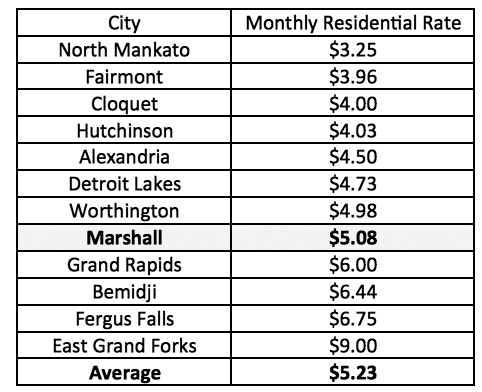
As part of your monthly utility bill, two charges relate to specific City of Marshall services, the surface water management utility fee and waste water (sewer) utility fee. This month’s article, an explanation of the surface water management fee.
The surface water management utility fee (or commonly referred to as stormwater fee) was implemented by the City of Marshall in 2004 as a method of financing the administration, planning, implementation, and maintenance of Marshall’s storm sewer system. The City of Marshall is required by the U.S. Environmental Protection Agency (EPA) and Minnesota Pollution Control Agency (MPCA) to reduce pollution from storm water to surface waters and groundwater, as such, the City is a designated municipal separate storm sewer system or MS4 by the MPCA. MS4’s designated by rule are cities and townships with a population of at least 10,000 and cities and townships with a population of 5,000 and discharging to valuable or polluted waters.
To be financially sustainable, stormwater programs must develop a stable long-term funding source. The activities common to most municipal stormwater programs: public education and outreach, public participation/involvement, illicit discharge detection and elimination, construction site storm water runoff control, post-construction storm water management in new development and redevelopment and pollution prevention/good housekeeping.
In the late 1990s many municipalities established stormwater fees to manage stormwater. User fees are established and set to have a close relationship to the cost of providing the service and, thus, are most commonly based on the amount of impervious surface, frequently measured in terms of equivalent residential unit. Stormwater management financed through general tax levy does not link financial obligation with services received. The absence of such links can reduce the ability of a municipality to adequately plan and meet basic stormwater management obligations. Second, when funded through general tax revenues, stormwater programs must compete with other municipal programs and funding obligations.
Finally, the stormwater fee applies to all property, taxable and non-taxable. If stormwater costs were only funded by property tax paying parcels, City taxes would increase. Applying a fee to all properties is a more reasonable and equitable way to collect the necessary revenue.
Municipalities have the legal authority to create stormwater utilities in most states. In Minnesota, Minnesota Statues 444.075 authorizes any municipality the authority to build, construct, reconstruct, repair, enlarge, improve, or in any other manner obtain facilities, and maintain and operate stormwater facilities. This includes financing projects through bonding and charging a fee. Bonds and grants can supplement the stormwater fees collected and tend to smooth payments over time for large up-front stormwater investments. One example of a project financed through the surface water fee was the Tiger Lake retention pond near the Fire Department that allows for greater capacity to take on water from surrounding streets.
The authority to maintain and operate means that activities such as dredging stormwater collection ponds and routine street sweeping operations including the equipment utilized for the operations are also authorized to be expended from surface water fees.
Why are surface water fees important?
Besides the fact that municipalities require funds to meet federal and state stormwater requirements, polluted stormwater runoff is the major cause of water pollution. When water is polluted, we all pay one way or another. Flooding, erosion and pollution impact food prices, drinking water, insurance rates, tourism, and many other areas of our lives. Ultimately, safe and clean conveyance of stormwater entering our lakes, rivers and streams is the goal we strive to achieve.
Community Voices
Mother’s Day without mom: one of life’s major turning points
Mother’s Day is different for me this year, altogether different from what I had known for a total of 58 ...
Nurses you don’t see often the ones who help you avoid bigger health crisis
When most of us think about nurses, we picture hospital hallways, clinics, and exam rooms. That image is real, and ...

Discovering the circle of real estate
Spring energy fills every corner of Marshall Public Schools
Spring is always an exciting and fastpaced time across Marshall Public Schools, and this year is no exception. As ...

Wacky weather
Your sleep can impact your mood
Everyone knows that we need sleep. If we do not get enough sleep, we also know that it can have a variety of ...