
A Vesta Boy – Dave Hansvick – Beginnings, immediate family, and home
Trending
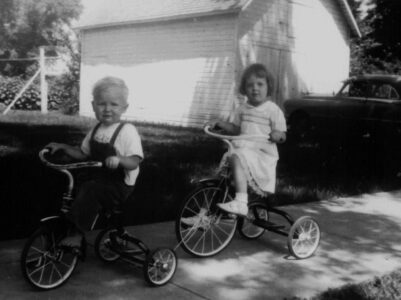
David Elwoood Hansvick was born Feb. 19, 1951, the second of three children born to Delphine (Dottie) Frances (Penske) Hansvick and John Elwood Hansvick.
Dave explained the circumstances of his birth and identified his siblings.
"I think I was born in Redwood Falls, but we lived in Vesta. (My sister) Christine Louise Hansvick is 14 months older than me. My brother is Vernon Charles Hansvick. He is maybe three years younger."
He described his parents' roles in the family.
"For as long as I remember my dad drove a gas truck, a bulk delivery guy for Standard Oil. I remember him gone in the morning and he'd be gone all day. He'd eat supper and he'd be off delivering at night sometimes. He really didn't do anything in and around the house. That was Mom's job. Mom was home basically all the time because she had to answer the phone for (fuel) orders."
Dave's mom had a career in education before marrying John Hansvick.
"She was a country school teacher before they met. (The school) was on the highway between Vesta and Redwood Falls and she was likely a country school teacher of eight grades. (She had attended) Lamberton Teacher's College, a small school in Lamberton, but it was always referred to as a Teacher's College."
He explained how his parents managed their kids' misbehavior.
"Mom would handle the small stuff, but if it was serious, my dad was the disciplinarian and you would be told, 'When your dad gets home.' It wasn't ever very severe. When growing up in Vesta they didn't have to see what you did, but everybody knew you in Vesta and if you were doing something at the river you shouldn't have, Wally Anderson would come back with his feed truck and tell Dad. They knew everything, you know? That's the way it was."
Dave's parents also had roles in the Vesta community.
"My dad was a member of the Commercial Club. That was kind of like the old Lion's Club. He had a role in that. Pretty much everybody in town would work doing something at the big (town) celebrations. I think he also took a role once and a while at church, the Presbyterian Church. My mom (was) active in the church. She was in charge of the Sunday school and taught Sunday school. I think she did go to Presbytery meetings where they'd do Synod-type stuff."
He remembered a time when his mom's church roles and his dad's role as family disciplinarian intersected to his great discomfort.
"(Our church) wasn't big, but you'd have get-togethers for songs at the end of Sunday school and then come home. I remember thinking it was funny to be tweeting like a bird when Mom was doing her whole group thing at the end of Sunday school. I thought this was cool, with friends laughing. I got home and Dad was reading the Sunday paper. I wanted to get changed and go play. Mom got home and said, 'This is what your son, David, did.' I thought, 'Oh, oh!' Dad was sitting there in his chair and I had to stand in front of him and repeat what I was doing with Mom in front of everybody, while Vern and Christine could go off (to play). I stood there for 40 minutes, pretending to be a bird and tweeting. I was getting tired, but he'd just keep reading his paper, saying, 'You're not done yet.' I finally thought, 'Boy, I'm not doing that again!' That was his lesson to me."
Dave described their family home and its rather unique lot on the edge of town.
"The house itself was a nice, old house. It was large with four bedrooms upstairs and a bathroom. It sat off by itself on the northeast edge of town. It had a field in front and a field behind. It was about 4 acres, which was great as a kid growing up because you had places to go. It was great for having dogs and cats. We had a grove of trees in the back and neighbors behind us. It probably was a farm once. I remember we had a chicken coop and a brooder house. So, we had some outbuildings and a white barn. Eventually Mom and Dad got rid of (the small outbuildings). We put our cars in the old, smaller kind of barn. It was actually set up with a garage extension on it."
He remembered the places in their house that were most special to him.
"It seems odd, but there was a (floor) vent that went from the upstairs down to the downstairs hallway. My brother and I remember spending lots of time looking down and playing around with that. We spent a lot of time in the basement. It was just an old, cement basement, but we played basketball down there. My dad built a ping-pong table and we played. My dad would come home off the truck and we'd be playing ping-pong every evening. (Back then) you didn't really have any TV to come in at all, so your evenings were doing something. It was ping-pong and we had a road-racing set that my brother and I would set up on that ping-pong table. We spent a lot of time in our basement, (Dave chuckled) especially in the wintertime. You had to go somewhere. That was probably our favorite part of the house, actually."
Dave's horizons grew beyond their home and acreage as he grew older.
©2026 William D. Palmer.