Small school in a big pond
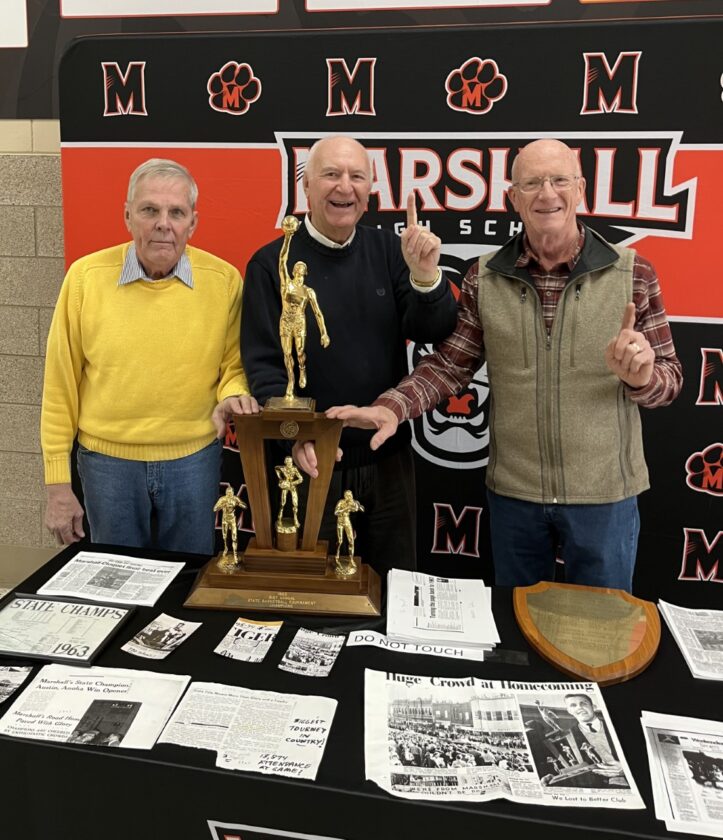
Photo courtesy of Dennis Schroeder (Left to right) John Nefstead, Terry Porter and Dennis “Red” Schroeder pose with the 1963 Minnesota State Basketball Tournament championship trophy at Marshall High School while being honored for the 60th anniversary of Marshall’s state title.
The Marshall boys basketball team won the Minnesota State Championship on March 23, 1963. What makes the title so special 60 years later isn’t just that it was the school’s first — and to date, only — boys basketball championship, but also that it came at a time when there was just one class for 420 schools.
“Our team was very fortunate to have only one class,” Terry Porter, a guard for the Tigers team, said of the title. “I think every athlete wants to know if they were really the best in the state. We knew that because we had 420 schools in our division and we came out on top. That’s something I’m very thankful for.”
Despite the larger field, the state tournament still only selected eight teams as it does now. As a result, the games packed the arena perhaps more than they do today.
“For four tournament sessions, that tournament drew 87,000 people. They used to sell out and 18,000 people would show up for those games,” Pat Reusse, a Star Tribune columnist who attended the 1963 championship game as a senior in high school, said. “It was a huge event in Minnesota. The hockey tournament is bigger than the basketball tournament now because they’ve got four classes and nobody knows who’s playing who.”
In the 1963 finals, Marshall beat Cloquet by one point, 75-74, back when high school games consisted of eight-minute quarters instead of 18-minute halves. The game, a back-and-forth affair that Reusse described as the greatest one-class championship game in his lifetime, was particularly impressive because of both teams’ shot-making ability.
“[They were making] jump shots, 20-footers,” Reusse said. “I’m not sure what range Porter was shooting in that tournament, but later on in college, I’d say 40% of the shots would have been threes… there were probably 15 baskets between the two teams that would have been 3-pointers… That was kind of a high-scoring game for our standards in Minnesota.”
Still, no shot was more important than the two Dennis “Red” Schroeder made from the charity stripe to put Marshall ahead.
“After [Schroeder] had corralled the missed shot, a guy on the Cloquet team just fouled him flagrantly. I don’t know why they picked on him, they didn’t know he was over an 80% shooter,” Porter said.
“As is what they’re called, they’re called free throws. We had always diligently practiced free throws every practice. We’d play hard and then we’d go shoot free throws, so free throws we knew would win games. Or you could lose them by not making them,” Schroeder said. “The thought was, hey, it’s a free throw. Let’s go make them.”
The free throws gave Marshall a lead with 15 seconds left, and while Cloquet had one last shot to take the lead, Mike Forest’s attempt fell short and the Tigers were champions.
“We were always taking each game at a time, but when we won the state championship, there was no other game. That was the end of the season,” Schroeder said. “‘Who do we play next?’ No, we won the state tournament… Coming back to Marshall and the support of the community was fantastic, you can’t beat that.”
The team had a three-hour drive back to Marshall where, upon its return, it was greeted with the cheers of what seemed like all of Southwest Minnesota.
“We had 6,000, 7,000 people depending on who you talk to on Main street, but the big surprise was well before we got to Marshall,” John Nefstead, the team’s captain and leading scorer on the season, said. “Martin, which was [head coach Glenn] Mattke’s hometown — and also his counterpart at Cloquet was also from there, so there’s an interesting little dialogue there — we got stopped there. We got stopped in Redwood Falls. We got stopped in numerous places, but my God, when we got to Marshall there wouldn’t have been a car that you could have had anywhere on the main drag of that town three or four blocks away.”
The team rode through town in convertibles. Despite being March in Marshall, the weather was uncharacteristically warm. Porter estimated it was nearly 70° as the team cruised through town.
“We looked up at the buildings and people were standing on top of the buildings. There was just that much support for us and, as everyone knows, nothing can unite a town better than a state championship as you can see the support that [Russell-Tyler-Ruthton] is getting now,” Porter said. “Then especially, when we won, we had people from all the surrounding towns come and visit us during that parade. It was phenomenal.
“We had anywhere from eight to 10 busloads of people coming to the game and they didn’t stay overnight. They came Thursday, we won. Friday, we won. Saturday, we won. They had to come up there, go back and back, then it was about a three, three-and-a-half hour trip just one way so you can imagine what all those people went through on those long trips. Luckily, we won because it’d be a terrible ride back if we lost.”
“We play because we love the game, but we also have the backing and support of the community and that’s very important,” Schroeder said. “That just gives you an extra boost of wanting to do your best.”
Part of the mythology surrounding Marshall’s championship run is the David versus Goliath wherein Marshall was largely viewed as the underdog. While Marshall had played strong all season, coming into the tournament at 25-1, Cloquet had beaten a much larger Bloomington team to establish itself as the favorite.
“I didn’t know that [Marshall] could match up with the athletic athletes that Cloquet had,” Reusse said. “That little guard [Dave] Meisner who was just a quick, great guard, but they had a wonderful athlete named Mike Forest who was the other guard and I never thought that they had an athlete like that.”
Forest scored a game-high 29 points, but Marshall’s four scorers in double-figures — Porter with 22, Nefstead with 21, Loren Johnson with 19 and Schroeder with 11 — pushed the Tigers over the top.
Still, not everyone viewed the championship as a mismatch in favor of the Lumberjacks going into the game.
“Cloquet was also a smaller school. They also were picked to probably win the tournament and since then we’ve kind of said that they were a David against the Goliath, but they were a David against David,” Schroeder said. “We knew they were tough, they had a couple of guards that were fast, but we just needed to play our game and we would have a chance at winning.”
Nefstead echoed the sentiment that, regardless of public opinion, the Tigers went up to Minneapolis with the expectation to win.
“It may sound a little brash, but we didn’t expect to lose,” Nefstead said. “We got our butt kicked in Luverne earlier in the year and I think we learned our lesson. Mattke was a pretty tough customer, and we knew that we were good, you just had to go out there and prove it…
We beat Rochester earlier in the year, which was a Big Eight school, and then of course in the tournament we beat Austin that first round and Anoka being a very large school. We expected it to be a lot tougher than it was and we got by pretty easily with that one. Then, of course, there was Cloquet. That was the dynamite one, they were awfully good.”
Despite 60 years having passed, the city of Marshall still celebrates the 1963 boys basketball championship. The Lyon County Museum has a display commemorating the title team, including players’ jackets, photos, original reports, and stats and figures from the game. Filmmaker and Cloquet Howard Lavick is working on a documentary on the championship game as well, although he is still looking for additional photos and videos of the game.
“I’m thinking it’s going to be More than Glory,” Schroeder said of the title. “Yes, we won, but Cloquet was a winner too. They had the support from their community and there’s a lot of similarities between the two. We just want to bring it out. The picture of John Nefstead hugging the Cloquet player at the end of the game, they know it’s about more than winning.”
Local Sports
MCC advances to state tourney for first time in 25 years, claims 3A title
Staab claims state shot put title
Foligno wins Clancy Trophy for leadership, service
NEW YORK (AP) — Minnesota Wild forward Marcus Foligno has received this season's King Clancy Memorial Trophy for ...
Sorenson fans 18 A’s in 7-1 Hadley win
Hadley 7, Pipestone 1 PIPESTONE — Tucker Sorenson struck out 18 batters in a complete-game effort for the ...
Twins fall shy of sweep with 8-0 loss to Sox