
Tree owners urged to come up with action plan against Emerald Ash Borer
Trending
MARSHALL -- Through his business Southwest Tree Treatment, Marshall resident Adam Rigge is on a mission to save Ash trees in southwest Minnesota from the Emerald Ash Borer.
According to his website, the invasive beetle has killed millions of ash trees. Unfortunately, the beetle has arrived in Marshall and has been attacking trees.
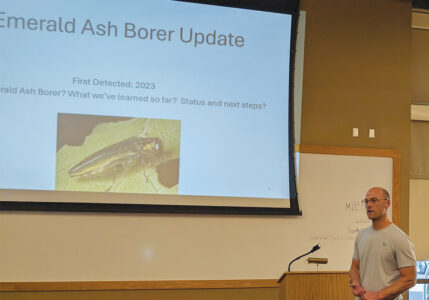
Rigge was invited by University of Minnesota Extension Master Gardeners program in Lyon County to give a presentation at the Marshall-Lyon County Library on April 16. His presentation described the beetle, where it came from, how it attacks trees and what can be done to save the trees -- or destroy them.
"The Emerald Ash Borer was first detected in Marshall in 2023. It was announced in the paper July or late June. But the fact is, it's been here longer than three years. I believe they first found it in Marshall because it has actually killed trees," Rigge told the audience. "It takes about five, six years to kill a tree. So you are probably looking at -- realistically -- close to a decade that it's been in Marshall."
Rigge explained that the beetle feeds underneath the bark of the ash tree and girdle the tree.
"They eat that layer, that membrane on the inside of the bark that helps transport nutrients. So essentially, it starves the tree, so it can't transport nutrients and moisture from the ground," he said.
Rigge said the infestation will eventually impact all ash species. There are three types of ash species in southwest Minnesota and North America -- Green Ash, White Ash and the Black Ash.
Rigge said infestation can go quickly if there are enough beetles in the area.
"Beetles fly. They have wings. So they spread out 2 miles just naturally throughout the summer. But more often they're transported by people. That's how they got into the United States in the first place. People moving firewood, taking logs from the tree to the tree dump, taking it back home, transport it around town. Take it to Cottonwood or Minneota, or whatever, you're potentially transporting that insect a lot faster than it would actually go," he said.
"The best thing you can do is early detection and coming up with a management plan, an action plan," Rigge said. "If you wait, just keep pushing it off a couple years, it's going to be too late."
One member asked why there would be new shoots on the trunk when the tree is dying.
"That's a good question. That's really common," Rigge told her. "The Ash Borer attacks the upper third of the canopy where the bark is the thinnest because that where they can get in easily into the tree that way. So what happens is they gird the top of the tree and the trees start to die from the top down. And so what happens is, the tree is trying to produce food for itself by putting out new shoots, creating more energy, more photosynthesis. So it sends out shoots lower down that are safe. So it's just trying to basically get by."
Where is the
Emerald Ash Borer from?
Rigge said the Emerald Ash Borer has been in eastern Asia for "thousands and thousands of years." But he said the trees there have developed resistance to the beetle and there also natural predators that keeps them at bay.
"It first came to the U.S. in shipping containers in the Great Lakes area," he said. "In 2002 they were first identified. So if you look over in Michigan, that area, Chicago, you're hard pressed to find an Ash tree up and down the Great Lakes. And slowly, I think, it got to Minnesota in 2009. It was first identified in the cities and then slowly made its way west toward us."
Rigge also talked about the life cycle of the Emerald Ash Borer.
"What happens is, they lay eggs on the bark, the eggs hatch and then the larvae bore into the underneath of the bark. And that's really where the damage occurs to the ash trees. The adults themselves don't really do much. They might nibble on the leaves here and there, but it's not going to impact the tree.
"When you get the larvae eating on the inside of that bark, that can be layered, and then they go metamorphic size and then they emerge through D shape exit holes. So if you see those D shaped exit holes, it means you have Emerald action."
He said there is no other type of insect that produces that type of exit hole on ash trees.
Master Gardener coordinator Ron Helgerson interjected that the beetle also lays eggs in the upper branches where the bark is tender and they have access. And they migrate from the upper canopy.
"If you think of an Ash tree, especially an old ash tree, the bark is pretty thick," Rigge said. "On top, the bark is a lot thinner, easier to be penetrated by these larvae and then they start to die. They start to kill their food source. So then, they keep moving down the tree.
"So if you see these D shaped exit holes at eye level or close to eye level, your tree is heavily invested."
Rigge also said the larvae essentially lives under the bark all year long.
Can you save your tree?
Rigge's Southwest Tree Treatment offers pesticide injection treatment for the Emerald Ash Borer
"This treatment works with a trees natural transportation to distribute the chemistry to every part of the tree providing full protection against EAB," his website states.
"We inject into the tree. Think of the tree as a giant straw. It's sucking in moisture and nutrients from the ground. That capillary action to the top of the branches and out through the leaves. So the leaves are always constantly evaporating and then the roots are sucking. So we tap into that straw and carries the chemical all the way up and out to the branches. So without the leaves on the tree, it can't drink. We have to wait until the middle of May, until the leaves emerge. And that's when we'll start," Rigge said.
He also believes that infestation in Marshall is at a point now that trees will be dying pretty quickly.
"That first year, the tree is not going to notice anything. The second year, the tree can handle a lot, still not going to see anything. But the third year -- maybe there's some woodpeckers on the tree that weren't there before. Or maybe the tree is starting to look a little bit thin on the canopy. Then it keeps going. In that fourth year, you really start to notice some dead branches. And then the fifth and sixth year, it's almost too late. It's too late at that point," Rigge said.
The Minnesota Department of Agriculture website lists the different types of chemicals that can be effective against the Emerald Ash Borer, according to Rigge. He said they are either proven insecticides or they're specific to that insect. Rigge said the website is a good resource for reviewing possible chemicals whether as a professional treatment or a home remedy. He said the website lists the timeline and frequency needed to get the job done.
"The chemistry I use is listed as the top one. It's called Emamectin Benzoate. It's been around for awhile. It wasn't developed for the Emerald Ash Borer. It was an existing product, but they found it was highly effective against the Emerald Ash Borer."
Ridge said there are only two methods to using the chemicals against the beetle -- tree injections and the soil drench method.
"The soil drench method, which homeowners tend do themselves. Both are effective. The soil drench method works better on trees that are about 15 inches in diameter or less. Once you get start getting so some of these big trees, like you see around town that are 20 inches -- even 30 inches -- or bigger, the root structures are just so big and expansive that dumping the chemical around the soil is really just a drop in the bucket." Whereas the injections get it right to the tree and carries it out where it needs to go," he said.
One of the clear signs of a dying tree, according to Rigge, is lots of bark falling off the tree. If you peel off some bark, you can see the shape marks underneath.
"So that one of the things about this insect it just goes so fast," he said. "When you see the dying is really the thinning of the canopy. So this is probably one of the last steps."
Rigge said you want to wait to the end of September to remove any trees. Before that, the beetle is reproducing.
"That's the time that you want to avoid cutting down ash trees, if you can help it," he said of the summertime time frame.
"If you want to do like aesthetic pruning or take down the tree, wait till that dormant time. Because what happens is, you transport and cut the tree down or prune or whatever, you're just going to agitate the tree and it's going to release more insects. They might be kind of in the canopy or something. You take the tree out and you're hauling it through town or to the dump, or to the other side of the property, you are just transporting that insect faster than it would naturally go. So make sure you do the pruning, the removal if you can help it in the wintertime from that October to April."