
The road to the Revolution
Talk outlines history behind the Declaration of Independence
Trending
MARSHALL -- In 1763, Great Britain had a strong relationship with its colonies in what is now the United States, Dr. Anita Gaul said. But in the space of 13 years, that partnership had deteriorated to the point where American colonists declared their independence, and the Revolutionary War began.
The reasons behind this split with Great Britain were complex, said Gaul, a history instructor at Minnesota West Community and Technical College.
"There was a whole series of events, all the steps that it took to get us through those 13 years, from best of friends to filing for divorce," Gaul said. Some of the steps along the way included the aftermath of the Seven Years' War, a series of taxes put in place by the British, and violent clashes between colonists and British troops.
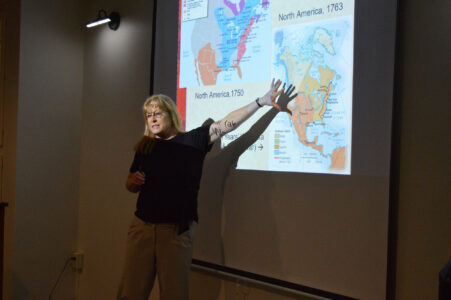
Last week, Gaul gave an overview of "The Road to 1776" for an audience at the Lyon County Museum, in honor of the United States' 250th anniversary. Gaul's talk was the keynote presentation at the Lyon County Historical Society's annual meeting. Gaul said her presentation was based on the history lectures about the American Revolution that she gives to her students.
"Where we really start on the road to 1776, and the Declaration of Independence and American independence, really starts at the Seven Years' War," Gaul said. "This is a really pivotal event in the relationship between Great Britain and its American colonies. That is the point where our paths diverged."
During the Seven Years' War, which in the U.S. has also been called the French and Indian War, American colonists helped the British drive French forces out of much of North America. In return, Great Britain said it would bear the cost of fighting the war, Gaul said.
By the end of the war in 1763, American colonists had a "great" relationship with Great Britain, she said. "But problems begin almost right away."
One of the first problems arose when colonists started moving into the Ohio Great Lakes region, leading to conflict with the Native Americans who lived there. Gaul said the British government did not have the resources to keep fighting west of the Appalachian Mountains, and put a halt to expansion.
"What did the American colonists hear? They hear, 'You are forbidden to go west.' There is a standing army that is threatening my liberty and blocking expansion," Gaul said.
Tensions grew as the British government looked for ways to try and pay the massive debts caused by the Seven Years' War. British citizens were already paying high taxes, and the government turned to starting new taxes in the American colonies.
"The first attempt was something called the Sugar Act in, 1764. That did not go down well," Gaul said.
The failed tax on imported molasses was followed by the Stamp Act, which was a tax on special stamped paper for official documents. Colonists responded with unrest, a boycott of British goods, and a statement saying Parliament did not have the right to tax them.
"Really what we have here are two different visions of the imperial relationship between the colonies and the mother country," Gaul said. "The colonists thought of themselves as British. We are British equals, and therefore we need elected representatives in Parliament."
Tensions continued to rise as the British government taxed English goods ranging from glass and paper to tea. The colonies were also required to bear the cost of housing British troops.
"Once again, the colonists get really upset," Gaul said.
One of Great Britain's responses to the unrest was to send 4,000 troops to Boston in 1768. At the time, Boston's population was only 16,000, Gaul said.
"The situation explodes one day in early March of 1770. That is when something called the Boston Massacre happened," Gaul said.
A clash between protestors and British troops outside of a British customs office killed five people and injured six more.
"That's a big step. Now, we're enemies," Gaul said.
In 1773, a crowd of people dumped 45 tons of tea into Boston Harbor. The British responded by closing down the harbor, and revoking Massachusetts' charter. "This is a devastating blow. You are taking away our elective legislative assembly."
In 1774, representatives of 12 of the British colonies met in a Continental Congress, and decided to petition King George III. In 1775, armed conflict with British troops erupted in the Battles of Lexington and Concord, and at the Battle of Bunker Hill, and King George declared the colonies in a state of rebellion.
In 1776, the Continental Congress forms a committee to draft a statement to justify separation from England. This statement was the Declaration of Independence.
The Declaration of Independence laid out the colonists' reasoning for splitting apart from Great Britain.
"Most of the Declaration of Independence is a laundry list of the ways in which King George has wronged the colonies," Gaul said. "It's a very efficient, reasonable document. This is what we're doing, and here's why we're doing it."
"So now you understand all the steps that it took, in those 13 years," Gaul said. She left audience members with questions to reflect on, like whether it was reasonable for Great Britain to ask American colonists to help pay for the Seven Years' War. "Another question is, could the Revolutionary War have been avoided? What was the point of no return?"
"There's no easy answers here," Gaul said. But, she said, being able to reflect on the events and questions of the past was one of the important things about history. "If you go home and these (questions) roll around in your head all night and you start talking to people about them, that's great."