
Possible shark tooth found on sand bar in Brown County
Trending
NEW ULM -- Bill Eibner and Brea Wear were on a gravel (sand) bar searching for fossils and artifacts on the Cottonwood River just east of the Brown County Highway 13 bridge April 10 when Eibner made another find.
"It was a total surprise. The first time I've ever found a cretaceous shark tooth. This is my 10th year of Cottonwood River exploring," he said.
Eibner has contacted Science Museum of Minnesota (SMM) Paleontology Chairman Dr. Alex Hastings for his artifact identification opinion and donation.
Cretaceous shark teeth are generally believed to be 66 to 145 million years old.
Eibner said he used online photos of extinct Ptychodus, giant, prehistoric shell crushing sharks, known for their more than 500 unique, pebble-like teeth adapted for crushing hard-shelled prey. The sharks could become up to 33 feet in length.
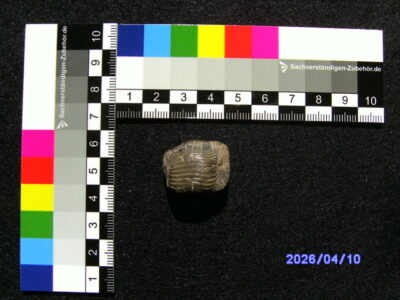
The artifact is slightly less than an inch wide, nearly three-fourths of an inch high and more than a half-inch thick. It is opaque, black and gray in color with 11 parallel ridges covering the top side, according to Eibner's description.
One corner appears to have a chip missing. No part of the surface is broken. The entire top surface fluoresces (glows) yellow under long wave UV light.
Eibner said he met Wear "randomly" on a Cottonwood River gravel bar several years ago and became friends.
"Now, we explore the river when we can," he said. "She recommended we go to this particular gravel bar to look for fossils when we found the shark tooth. We both have a very good eye for spotting fossils, artifacts, and semi-precious gemstones such as agates and jasper."
Eibner said he has found other cretaceous fossils, coral, leaves and fish vertebrae on Cottonwood River gravel bars between the Highway 13 bridge and Cottonwood River mouth several miles southeast of the bridge.
"There is an outcropping of cretaceous sandstone and shale west of the Highway 13 bridge, which must be the source of the cretaceous fossils we find there," he said.
Eibner has a permit to recover fossils for the SMM. Eibner said he also have permission to recover fossils from landowners along the Cottonwood River east of Flandrau State Park to the Cottonwood River mouth.
A number of times in recent years, he has displayed fossils and artifacts he found in the Cottonwood River at the Brown County Historical Society Museum and Riverside History & Nature Center in Lincoln Park.
"The ultimate goal is to advance scientific knowledge of prehistory (the vast period of history before written records) in this area," Eibner said. "We think this can be accomplished in part through collaboration between local amateur (fossil and artifact) hunters like us and SMM experts who can study them and report their findings."
He said select items he has found will be donated to the Riverside Nature Center and Brown County Historical Society for the purposes of public display and education.
In August 2024, Eibner donated a stone projectile artifact to the City of New Ulm that he and Wade Cordes found on a Cottonwood River gravel bar near the New Ulm wastewater treatment plant. The discovery happened after Cordes found a piece of petrified wood, called Eibner over to take a look before Eibner saw the projectile in the gravel.
Eibner sent a photo of the projectile to SMM Anthropology Department Director Ed Fleming who said based on the photo, he believed the artifact was 8,000 to 10,000 years old.
Because he found the projectile on city land, Eibner donated it to the city of New Ulm instead of adding it to his own collection.
New Ulm City Manager Chris Dalton formally accepted the artifact on behalf of the city of New Ulm, but said it would be given to the Brown County Historical Society because he felt they were more equipped to determine how to best handle it.
"We do not want to hoard artifacts," said Eibner. "I would rather help advance the knowledge about it for all people."
Submitted photo
Bill Eibner of New Ulm found a cretaceous shark tooth April 10 just east of the Brown County Highway 13 bridge on a Cottonwood River gravel (sand) bar just south of New Ulm. He plans to donate it to the Science Museum of Minnesota.