
‘Answered the call’
Fagen Fighters speaker presents historic overview
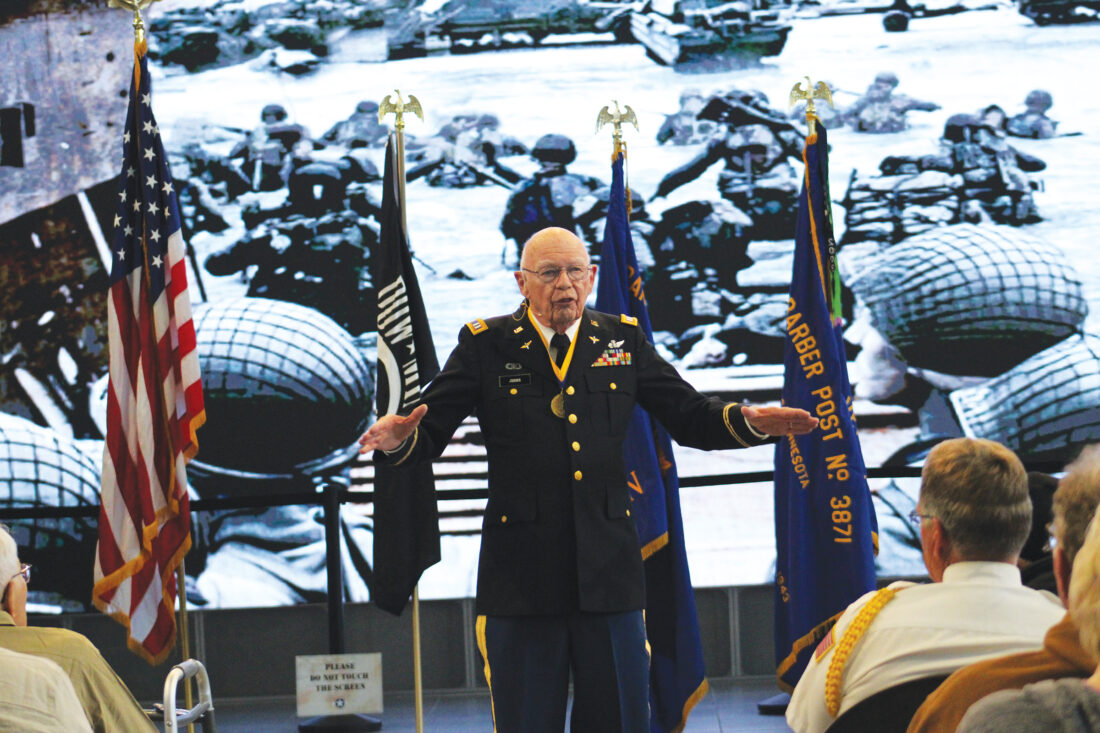
Photo by Jim Tate Capt. James “Jim” Johns, retired, from Minneapolis spoke at the 80th anniversary of D-Day event Thursday at the Fagen Fighters WWII Museum.
GRANITE FALLS — A huge crowd descended on the Fagen Fighters WWII Museum Thursday to mark the 80th anniversary of D-Day — June 6, 1944.
Keynote speaker Capt. James “Jim” Johns, retied, of Minneapolis, gave a historic overview of the event, when allied forces landed at one of five Normandy beaches on France’s west coast, thus beginning of the end of World War II.
Johns offered unique insights into the build-up to the invasion, the military tactics involved, and the mistakes made by the Germans that benefitted Allied forces on that day.
Johns said that German dictator Adolf Hitler and his generals knew an invasion was imminent, they just didn’t know when, or where. Hitler believed the invasion would come north of Normandy, at the closest point between France and England on the English Channel. Hitler’s generals — “to a man” — disagreed, but were overruled. That decision to fortify the area north of Normandy was a blessing for the Allied troops, he said.
“The element of surprise is the only (advantage) we had,” said Johns.
The U.S. went to extreme lengths to put up a smoke screen as to where the invasion would occur, to the point of creating a fictitious army, and naming George Patton its commander.
“The Germans held back 19 divisions because they thought the invasion was coming further north,” he said.
U.S. casualties on that day were 2,500. England lost 2,700 troops, and Canada, 2,000.
Johns noted that museum owner Ron Fagen’s father, Ray, was a member of the first invasion wave that hit Utah Beach.
The invasion was to have been on June 5 — a day earlier — but bad weather delayed it a day.
“Had it been delayed longer, it would have been weeks later,” he said.
The Germans had built weather stations in Iceland, Greenland and Norway prior to the invasion, but those were taken by U.S. forces.
“The only way for them to accurately forecasts the weather was to look out the window,” he quipped.
“Imagine when the sentries looked out on that day and saw 7,000 vessels of every size, shape and variety coming at them,” he said.
Johns compared then, and now, saying that Operation Overlord accomplished its objective that day, but “it’s still a mission that was not achieved,” noting that eastern Europe is still in flux today. “(Soviet President Vladimir) Putn and Iran have got to be stopped,” he said.
Two World War II veterans, Bill Woman, 97, of Montevideo and Bob Brix, 100, of Clara City were on hand for the program, which was held in the Navy Hangar, one of four hangars at the Fagen Museum.
A short video about D-Day preceded Johns’ talk, and the hangar was filled to capacity.
A large crowd was on hand, and vehicles were parked all the way to the Fagen Museum’s exit off Highway 23.
The day also included a WWII vehicle parade, along with several Warbird flights.
Local News

Cottonwood Coming Home Days

Fun for a cause at Coming Home Days

‘A heart rooted in the Minneapolis sound’
Filing period opens for local elections
MARSHALL — The filing period to run for city council, school board or township board in Minnesota communities ...

Photographing the ‘Big Five’
‘Little spike’ in Lyon Co. gun permits
MARSHALL — The number of Minnesotans applying to carry a handgun has been climbing over the past year, according ...