Keeping things moving
Transportation group hears regional freight plan
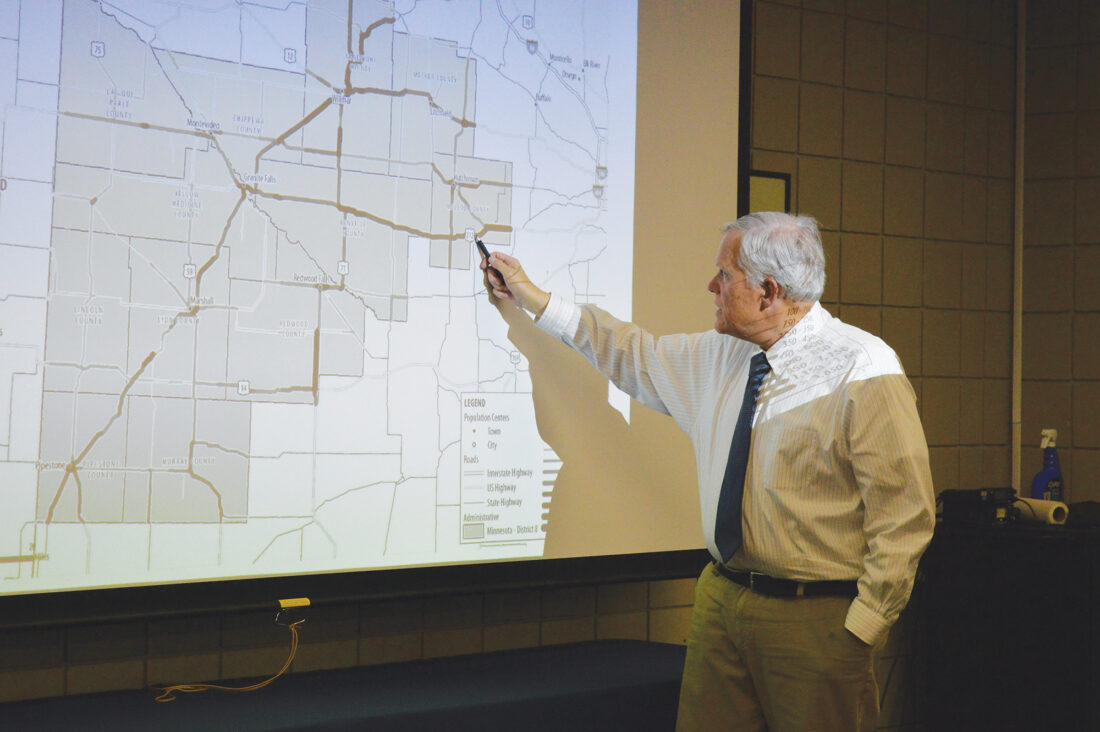
Photo by Deb Gau Marshall Area Transportation Group chairman David Sturrock pointed out a high volume of traffic on U.S. Highway 212, on a map from a regional freight study. The data from the MnDOT District 8 freight plan could help transportation advocates build support for road improvements like passing lanes on Highway 212, Sturrock said.
MARSHALL — A freight plan recently completed by the Minnesota Department of Transportation identified close to 180 places in southwest and west central Minnesota that had unaddressed transportation needs.
While funding will remain the challenge for addressing those needs, the data in the new freight plan could help build a case for improvement projects, Marshall Area Transportation Group members said Friday.
“It’s good to share the information MnDOT had from the study with stakeholders,” said Marshall Mayor Bob Byrnes. “These projects need advocacy, but advocacy is more effective if you have all the data.”
The Marshall Area Transportation Group invited local truckers and shippers to attend a Friday presentation on MnDOT District 8’s freight plan, which was completed in 2020. MnDOT District 8 includes 12 counties in southwest and west-central Minnesota.
People in attendance at the presentation also included Lyon County and Marshall city engineers. Members of the transportation group said the presentation helped give them ideas on how to pursue possible road improvement projects in the area.
Susann Karnowski, assistant district engineer for program delivery in MnDOT District 8, and Megan DeSchepper, acting planning director at District 8, said the 2020 freight plan was part of a bigger ongoing planning process.
District 8 reached out to area manufacturers to hear about their transportation needs back in 2014, Karnowski said. DeSchepper said MnDOT had also recommended that areas of the state create their own detailed freight plans to connect with the next statewide Freight System Plan. District 8’s plan was finished in 2020, but the COVID pandemic slowed down the process of sharing that with area transportation groups, DeSchepper and Karnowski said.
The movement of freight, whether by truck, train or plane is crucial to the economy in MnDOT District 8, DeSchepper said. The dozen counties in District 8 make up more than 10% of Minnesota’s land area, and have a total of more than 1,400 miles of highway and more than 400 miles of railroad.
The goal for the District 8 plan was to assess freight needs in the area, and come up with strategies to improve freight mobility in west central and southwest Minnesota, DeSchepper said. The study included both freight data analysis and stakeholder interviews.
“They completed 30 interviews with people in our region who deal with freight,” she said.
A study of District 8’s average daily truck traffic volume in 2017 also showed that some key truck routes in the region included U.S. Highway 212, Minnesota Highway 23, and U.S. Highway 71.
After that, the district analyzed what their priorities should be for investing in transportation projects.
MnDOT District 8 staff identified a total of 178 unaddressed transportation needs spread across the district’s 12-county area, and scored them according to factors like safety needs, freight mobility needs, and infrastructure condition.
Of the unaddressed needs, a total of 11 were narrowed down for a pre-feasibility assessment. According to the District 8 freight plan, the potential areas to address included intersection safety projects on Minnesota Highway 23 in Marshall, intersection projects on U.S. Highway 212, and railroad crossing projects near Granite Falls and Cottonwood, among others.
DeSchepper said District 8 had applied for Minnesota Highway Freight Program funds for several of the projects identified in their freight plan. Three projects were selected for MHFP funds: left turn lanes at the intersection of Highway 23 and Kandiyohi County Road 1 southwest of Willmar; a roundabout at the intersection of Highway 212 and Morningside Drive in Glencoe; and a roundabout at the intersection of Highway 212 and Highway 15 in McLeod County near Brownton.
Other projects, like shoulder widening on Highway 68 between Minneota and Taunton, and shoulder widening on Highway 59 in Yellow Medicine County, were not selected for MHFP funding.
“So, what next?” asked an audience member.
Karnowski and DeSchepper said next steps inlcuded identifying potential funding sources to address area highway needs.
“The funding is always the big question,” Karnowski said.
Transportation group chairman David Sturrock said the data collected for the freight plan could give some useful support when transportation groups apply for project funding. One example of a project that might benefit was building passing lanes along Highway 212, he said.
Based on the traffic volume data for Highway 212, he said, “You’ve got a pretty good case for it right here.”
More information on MnDOT district freight plans is available online at http://www.dot.state.mn.us/ofrw/district-freight-plans/index.html.
Local News
MN State OKs tuition increase across system
MARSHALL — The Minnesota State Board of Trustees recently approved a tuition increase across all colleges and ...
Aquatic Center taking concrete shape

Re-opening of intersection weeks away
Shades of the Past cruise
Photos by Griffin Peterson
Lyon Co. Sheriff’s Office gets boat safety grant
MARSHALL — Water safety is an area that the Lyon County Sheriff’s Office works with each summer, as people ...