Books and Beyond
We are in the season of schools winding down for the school year. I’ve been reading “Country School Memories,” c 1986, designed and compiled by Bonnie Hughes Falk and illustrated by Nancy Delage Huber. The front cover is a drawing of a country school building with a bell on top, an outhouse at the left, and a tree with a swing at the right. There are reports in the book from 73 teachers. Many of you, my readers, may have attended a country school. I don’t think there are many country schools left in the U.S.A., but there are families who do homeschooling.
The book has eight chapters, each one focusing on a different aspect of country schools. I will start with the last chapter, “A SPECIAL TOGETHERNESS.” On the first page there’s a drawing of the teacher holding a big quilt. It was made by the mothers of this teacher’s students. Here’s a good outlook to describe the book: a rural school was “like one big family” (p. 85).
The first chapter is THE ONE-ROOM SCHOOLHOUSE. In one school there was no electricity. The first Minnesota towns referred to are Waseca and Spencer. You can look up where in Minnesota these towns are. Shall I give you more assignments?
Descriptions that applied to many one-room schools: where the library was, the toilet could be in the building or outdoors, and a pledge to the flag would start the school day. One picture hung on the wall was the picture of Norman Rockwell on the cover of the Saturday Evening Post. I wish I had that issue of the Post. I do have the Sept. 8, 1934, issue, with a painting of sailboats on the cover. Some of the products advertised in this issue: Bisquick, Milky Way candy bars, and Meadow Gold Butter. An advertisement for Ticonderoga pencils has a color painting “Ethan Allen, Forerunner of Independence,” done by N.C. Wyeth. A reader of this 1934 magazine could send for a reproduction of this illustration! The ad has this photo, a picture of pencils, and some written history: “Ethan Allen, sword in hand, wrote a brave chapter in our history. Today, millions of Americans write the business of the nation with America’s favorite pencil.” I still use many pencils. Many of them have the advertiser’s name on the pencil. One example I have is a pencil with H.W. ROSS LUMBER CO PHONE 27 COTTONWOOD, MINN Happy New Year printed on the pencil.
In the second chapter, THE LONG WALK, I read about a girl and her brother who walked two miles to school. In the winter, another family took their children on a bobsled. Another child who walked told her friends about how she liked watching birds and seeing frogs and turtles in a pond. Now we are moving into future years: a mom or dad drive their children to school in their Model T Ford. The first year for that car was 1908.
THE SCHOOL DAY BEGINS, the next chapter, has a drawing of the children saluting the flag. Then we read about spelling contests and the traveling library. When the lessons for third graders were done, then they got to hear the lessons for the grades above them. That was a good learning experience, too. Sometimes a teacher brought a “wind-up phonograph and some good records” and they had “music appreciation hour” (p. 24). In another description of what goes on at school, the students memorized the poets Longfellow and Whittier.
In the chapter THE “SCHOOLMARM,”we read that the teacher Helen C. Williams graduated at Clarkfield High School in 1923, and her first school for teaching was in Minneota. The college she went to was Mankato State Teachers College.
A good conclusion for this book report is “The rural school added much to our heritage” (p. 86). Book reports are still a good assignment for me.
P.S. The school I went to in a town of 200 people in central Iowa was a three-story brick building. I would call it a country school because many K-12 students rode the bus from farm to school.
The Minnesota Room at your Marshall-Lyon County Library has many titles describing school buildings and school days. There are also many yearbooks from Marshall Public Schools and a few other area schools, marshalllyonlibrary.org
Local Columns
Like a river
A while ago I read a book that has always flowed through me. The name of the book is “A River Runs Through It” ...

Here and gone
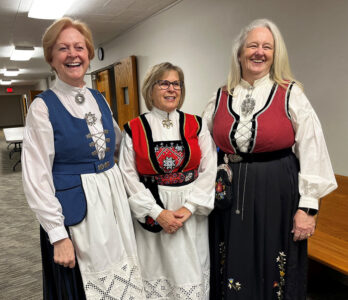
Addressing the Sons of Norway
Think twice, look twice for summer safety
The long-awaited summertime is here. We hope you are getting plenty of chances to get outside and enjoy the ...
Hospitals should continue to build strong community ties
Hospitals have been a major part of Minnesota’s statewide news in the past few weeks, as both large and small ...