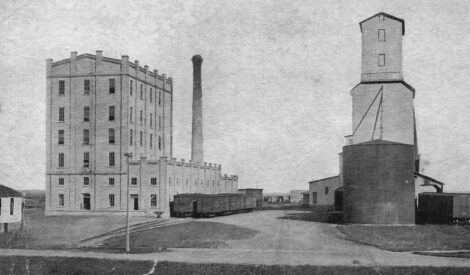
Mid-century modern takes on historic dimensions
Last week I enjoyed hearing an overview of all that goes into decisions for whether or not a property gets listed on the National Register of Historic Places.
Denis Gardner of the Minnesota Historical Society provided information to an audience at the Adult Community Center in Marshall. I was familiar with many of the particulars, having worked for two years at the Lyon County Museum and also because of my lifelong interest in historical topics.
Something I didn’t know about is the newfound nationwide 21st century popularity of mid-century modern architecture. It’s characterized by what started out as a desire to be modern, to create buildings that looked better and functioned better than “outdated” examples from the past.
Mid-century designs have several qualities that make them examples of their time period. They often feature flat roofs, geometric exterior patterns, and extra measures of natural light.
The trend played out right here in southwest Minnesota. It corresponded to the state’s decision in 1963 to locate the region’s four-year college on farmland outside of what was previously the Marshall city limits.
Many of the buildings on the Southwest Minnesota State University campus reflect a mid-century modern style. The same could be said for Marshall Middle School, built in 1968 as the new high school.
Around the same time First National Bank, now Wells Fargo, was built on the corner of West Main Street and North Fourth Street. The construction area was formerly the site of the city’s creamery and the Central Hotel (Marshall’s third downtown hotel along with the Atlantic Hotel and Marshall Hotel).
Also at almost the same time, the city’s former Carnegie Library at the corner of West Lyon Street and North Third Street was replaced with the late 1960s library building that now houses the Lyon County Museum.
In his presentation, Gardner pointed out how mid-century modern led to architectural qualities unusual enough to clearly place buildings within a short time period. That uniqueness is one of two main qualities that determine National Register potential, along with how much of a role the location played in historical events.
If someone new to Marshall only walked around the square block between North Third Street and North Fourth Street, just seeing both the library and bank buildings would be enough to know that something unusual probably took place in the mid-20th century to facilitate both projects in the downtown business district.
He or she probably wouldn’t consider how it might have been a combination of two things. That would only become clear after also seeing the SMSU campus and the Schwan’s headquarters.
Gardner said mid-century modern could go down in history as an architectural style as influential as earlier counterparts such as Jacobean Revival. He used a slide of the Watkins House in Winona (built by the pharmaceutical and spice manufacturing family) as an example of an ornate Jacobean Revival home.
He wouldn’t be surprised if at least two National Register proposals emerge from Marshall in the near future based on construction from a half century ago.
It wouldn’t be the first time a rural community gained attention because of a particular kind of building design. The Canby downtown business district has a turn-of-the-century appearance mainly as a result of rebuilding after a fire. The Lincoln County Courthouse, built in 1916, is a lasting example of courthouse architecture at a time when many other original courthouses; including those in Lyon, Yellow Medicine and Murray counties; have given way to government centers designed for modern county government needs.
The newfound attention for mid-century modern shows how rebuilding is not entirely bad. Gardner noted that even though he’s a professional with a strong commitment to preservation of the past, he recognizes that it’s not practical or financially feasible to preserve everything.
Many times structures that were at first showplaces, like Marshall’s North Fourth Street high school campus with a gym that was state of the art in 1930, outlived their usefulness and needed to be replaced with new ones that meet a different need several generations later.
Those new and improved concepts have a chance to at some point acquire their own historical context. Today’s latest trend could emerge as tomorrow’s newest chapter in history books.
Local Columns

Stocking up on fun
Why pay the price?
How would you handle the following situation? I wanted to buy a new pair of hiking boots, and went to a local ...
Timeless icons

Staying on track when markets feel uncertain

Country School Kids – Charlie Hettling – Minneota School years and beyond