
Dahms, Swedzinski talk fighting fraud
Legislators hold their final town halls in region
Trending
MARSHALL -- Fighting fraud, and softening the impact of Minnesota's new medical and family leave program, were still the big topics at a legislative town hall in Marshall this week.
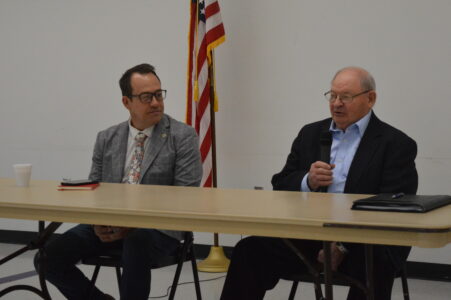
On Thursday morning, Minnesota state Rep. Chris Swedzinski and Sen. Gary Dahms said some of the big pushes to combat fraud in Minnesota included steps like updating technology and establishing an independent inspector general for the state.
"That takes power out of elected officials' hands, puts it in an unelected body, which will work independently to prosecute, investigate and go after fraudsters across the state," Swedzinski said.
"I do think the Office of Inspector General will make a major difference, because that office will not only have the right to stop the payments if they feel it's fraud . . . but also they will have the authority to press charges against the people that are committing the fraud," Dahms said.
Swedzinski, R-Ghent, and Dahms, R-Redwood Falls, held town hall meetings in communities including Marshall, Tracy, Minneota and Canby on Thursday. The events were part of the legislators' final series of post-session wrap-ups. Both Dahms and Swedzinski have said they will not seek re-election.
While this spring's legislative session had a slower start, state lawmakers did take action on things like passing a bonding bill.
"We had one of the largest bonding bills ever passed, $1.2 billion," Swedzinski said. "(It was) very focused on critical infrastructure -- a lot of water projects, a lot of PFA (Public Facilities Authority) stuff, a little bit of money for SMSU, among other things."
Swedzinski said Republican legislators were also able to do some "pullbacks" of items like increases in vehicle tab fees. "During the trifecta, we saw large increases in tab fees. And we were able to buy back just a one-year kind of a wait, kind of buy those tab fees back down," he said. "Everyone who renews their tabs past January 1 of this coming year will gain some of those benefits."
Dahms said there would be a $254 million reduction in fees to consumers in Minnesota, but it would not change the depreciation part of tab fees.
Area residents asked how fighting fraud in Minnesota was going to work going forward.
"One of the big pushes we've had is, first and foremost is the modernization of our computer programs," and updating the state computer technology used by counties, Swedzinski said. Newer technology would improve the ability to spot suspicious activity or people who shouldn't be approved for government services, he said.
Swedzinski said additional changes included development of an independent Office of Inspector General. Dahms said the inspector general would be selected through a process including a legislative committee, which will interview candidates and present finalists for the governor's approval.
"There will be some control of that, because the governor won't have the authority to appoint people like he does in so many other committees," Dahms said.
Dahms said more fraud investigation was going on in Minnesota than many members of the public probably knew.
"There's still a lot of investigations that are still open, and so a lot of that information is not being released, but there's over 600 people that have already been convicted and put in jail over various pieces of the fraud," Dahms added. "It's probably getting more attention than what you hear about, however it's probably not enough attention yet."
Dahms and Swedzinski said legislators weren't able to make inroads on changes to Minnesota's new paid family and medical leave program, which was passed under the Democratic "trifecta."
"We have spent hours and hours and hours putting legislation out there, negotiating," but to no avail, Dahms said. "They were dug in on that, and it was going nowhere."
However, Swedzinski thought that wouldn't be the end of the issue.
"We expect that fully to be part of the election process, a lot of discussion on those," he said.
Swedzinski said that the program already carries a cost.
"They're already estimating that you're going to have potentially 20 to 25% more employees in order to cover hours and wages when it comes to some of those things," he said.
Brad Gruhot of the Marshall Area Chamber of Commerce asked whether there was hope that the state legislature would act on tax conformity in the future.
Dahms said a tax conformity was "something that would be nice to see," but lot would depend on what happens in the legislature after this fall's elections.
"One, it just depends on where some of the power struggles are, where some of the power is, if there's going to be the votes to do that," he said. "Unfortunately, so many of the things that we wanted to get done boiled down to, if you can get the votes to do that."
"Most of the tax work that we were able to do was . . . more of a temporary fix or a one-time spend, because there is a lot of concern over what is the structural imbalance moving forward," Swedzinski said.
Swedzinski and Dahms thanked area residents for their support over the years.
"It's been an honor to serve you all in the Legislature," Swedzinski said.
"It's kind of bittersweet," Dahms said of coming to the end of his term. "I'm going to miss the people, but not the process."