
Lyon County families had Revolutionary War connections
Trending
MARSHALL -- The original 13 colonies that declared independence from Great Britain in 1776 were all on the east coast of what became the United States. But in the generations that followed the Revolutionary War, some of the veterans’ descendants headed west, and even settled in southwest Minnesota.
Arthur P. Rose's 1912 book, "An Illustrated History of Lyon County, Minnesota," includes biographies of some early Lyon County residents who descended from Revolutionary War veterans.
The bill that formally created Lyon County was passed by the Minnesota state legislature in 1869. The first meeting of the Lyon County Board of Commissioners was held on Aug. 12, 1870 - less than a century after the Declaration of Independence was signed.
Around this time period, there were a variety of factors that helped encourage settlers to come to southwest Minnesota, said Lyon County Museum director Jennifer Andries. There was the end of the Dakota War in 1862, as well as the passing of the Homestead Act, which allowed adult U.S. citizens to claim and farm surveyed government land. In 1872, the Soldiers and Sailors Homestead Act allowed Union veterans of the Civil War a faster path to acquiring land. Expansion of railroads also allowed settlers to come west.
"In this area, settlement increased greatly after the railroad lines were built," Andries said.
A large portion of Rose's history of Lyon County is made up of short biographies of area residents of the time. Many of the people featured came to Minnesota from East Coast states, often after the Civil War. The biographies include a few different references to the Revolutionary War in families' pasts.
One figure with a connection to the Revolutionary War was Walter R. Chittenden, a Marshall resident and businessman. Rose's biography said Chittenden was the son of pioneers of Lyon County, and was part of "an old colonial family with a Revolutionary War record." Andries said it was Chittenden's great-grandfather who served in the Revolutionary War.
Chittenden was born in Lyon County in 1880. Over the course of his life he traveled to North Dakota, Washington state, South Dakota, and Canby, Minnesota. He returned to Marshall and joined his father A.C. Chittenden in the real estate business.
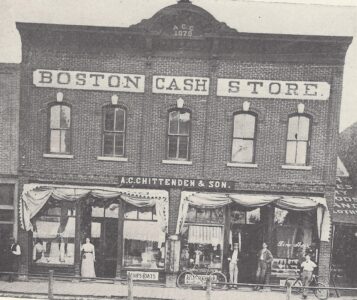
Andries said A.C. Chittenden was one of Marshall's earliest settlers, and had a business, the Boston Cash Store, on Marshall's Main Street. The store, located where the Last Stop CD Shop is today, also had Marshall's first performance hall on its upper story. The performance hall was known as the Marshall Opera House.
Another Marshall resident with family connections to the Revolutionary War was Myron W. Harden, who came to Lyon County in 1891. According to Rose's biography, Harden's great-grandfather was a Revolutionary War veteran. Myron Harden was born in Clinton County, New York, in 1851, and moved with his family to Burr Oak, Iowa, when he was 6 years old. As an adult, Harden served as a court clerk in Iowa. He came to Marshall in 1891, and organized the First National Bank of Marshall, in partnership with H. M. Langland and R. M. Addison.
Harden went on to become president of the First National Bank of Marshall, and served on the local Board of Education.
Charles W. Cady, a rural mail carrier from Lynd, had ancestors who served in the Revolutionary War and the War of 1812, according to Rose's biography. Cady was born in Vermont in 1860, and as an adult he moved west to New York, Pennsylvania and Ohio. In 1892, Cady moved to Lyon County, and purchased farmland in the Camden area.
The Illustrated History of Lyon County said Cyrus P. Shepard, who served as city recorder of Marshall in the 1890s, came from a family "well represented in the service of their country."
According to Rose's biography, Cyrus Shepard's great-grandfather was one of the first settlers of Liberty County, New York, and was a soldier in the Revolutionary War.
The biography said members of Shepard's family had handed down a tool -- a file - that was carried by family members during the French and Indian War, the Revolutionary War, and the War of 1812. Another Shepard family member carried the file during the Civil War, but the implement was lost during a battle, Rose's biography said.
Cyrus Shepard was born in New York state in 1839, moved west in the 1860s, and served with the Union during the Civil War. He moved to Stillwater, Minnesota, in 1868, and Worthington in 1877. He came to Marshall in 1894, where he served as the register for the U.S. Land Office for 10 years, and then became city recorder.