Legislators talk paid leave at town hall
Dahms, Swedzinski discuss upcoming session
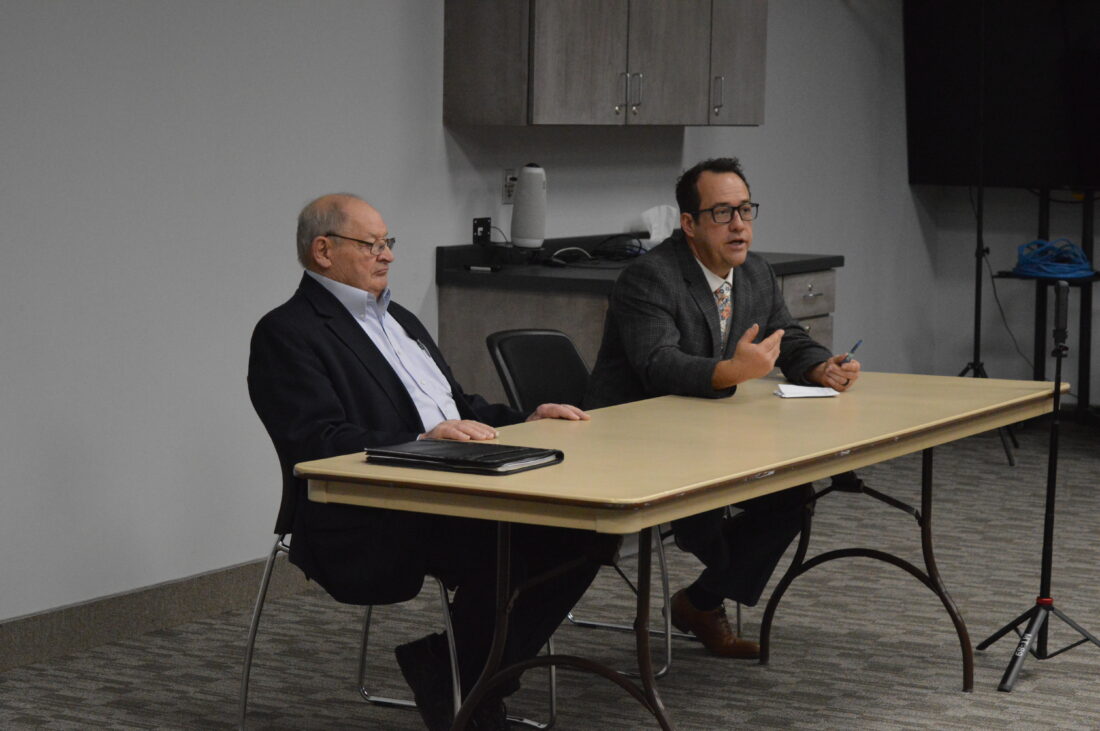
Photo by Deb Gau State Sen. Gary Dahms and Rep. Chris Swedzinski took questions from area residents during a town hall meeting Thursday in Marshall.
MARSHALL — Questions about paid family and medical leave, and about the possibility of a state bonding bill, were some of the big topics of discussion at a town hall meeting with state legislators on Thursday. A crowd of more than 50 people gathered at the Marshall Area YMCA to talk with state Rep. Chris Swedzinski, R-Ghent, and state Sen. Gary Dahms, R-Redwood Falls.
Swedzinski and Dahms were in Marshall, holding one of a series of town hall meetings in area communities.
The 2026 Minnesota legislative session starts on Feb. 17. Swedzinski said in this year of the biennium, the Legislature would primarily be looking at bonding and some policy work.
“Bonding committees, from that standpoint, have been traveling the state pretty extensively,” and hearing bonding requests from communities around Minnesota, Swedzinski said. “A lot of the work that we’ve heard from is water treatment projects, infrastructure projects and the rest, and so that will likely take up a lot of our work.”
“I do believe there will be a bonding bill. I’m not sure just how much that bonding bill will be, but I do think a lot of it is going to be looking at sewer and water, and those kinds of things,” Dahms said. “I don’t know if there will be a supplemental budget this year or not. I haven’t heard anything from the governor’s office, if that’s what his intentions are.”
Swedzinski said most of the policy work facing legislators this spring would be “really tying up loose ends,” or fixing issues with previously passed policies. Dahms said he thought addressing fraud was also likely going to be a major issue for lawmakers.
“I think an awful lot is going to be on the fraud and abuse that’s going on, that is getting quite rampant,” he said. “Right now, there’s 14 investigations going on, and when they go into those investigations, and they find that it brings in something else.”
Dahms and Swedzinski took questions from the audience, and several questions had to do with Minnesota’s Paid Family and Medical Leave program, which started Jan. 1.
Lyon County Commissioner Gary Crowley said one issue he had with the program was that elected officials had to pay into the program, but could not use it. “For the amount of wage I get, it’s not a big deal,” Crowley said. But not being able to use the PFML program would have a bigger impact for officials like the Lyon County sheriff and attorney, he said.
“It’s the same for medium-sized businesses,” another audience member said. “People who won’t use it are going to be paying in, and there are people that aren’t real happy about that.”
“That’s the way the bill was drawn up, and we’ve tried over the years to make several changes to that,” but were unsuccessful, Dahms said. “I can’t promise this, but this year, there might be some opportunities to make some changes.”
Area residents voiced other concerns about PFML as well. One resident said her business had a private insurance plan, but she was being contacted by the state about its program anyway. Crowley said he had concerns about what could happen to services like law enforcement or county jail staffing if two or three officers were on family leave at the same time.
“There is a lot of confusion on this,” Dahms said. “This bill was introduced and passed in 2023, but they didn’t put it into effect until 2026. That bill should have been worked on a lot more to get to the hard opening, in the start of that process.”
Dahms said he hoped it would be possible to negotiate for amendments to the PFML bill.
“I’m wondering from your perspective, how do you guys plan to make it better? And what don’t you like about it now?” one audience member asked Dahms and Swedzinski.
“I think my biggest hang-up is that it’s not optional,” Swedzinski said of the PFML program. “If I’m a business owner and I don’t want to participate with my business, I don’t have that right to say no.”
Swedzinski said the program also didn’t make sense for all jobs. “Then the third thing really is to limit the amount, and the potential for fraud,” he said.
“We need some exemptions as to who has to be part of this,” Dahms said. “The other thing is that I would much rather see this managed by an outside organization, versus the state of Minnesota.”
Swedzinski said changing the program would mean passing a bill amending the PFML program. That would take leverage or tradeoffs with Gov. Tim Walz about spending or policy priorities, he said. So far, he said, “We have yet to find something that Governor Walz would be willing to trade for to help make some of those policy decisions.”
Bonding bill projects were another topic of discussion during the town hall. “What’s your agenda going into this next session to make the quality of life better in our region?” one area resident asked. He brought up the examples of deteriorating facilities at Southwest Minnesota State University, and also asked what was being done to attract businesses to the region.
Dahms said SMSU did have projects like renovations for the university locker rooms on their list of funding needs. However, legislators didn’t have the authority to choose which Higher Education Asset Preservation and Replacement projects were funded.
“We decide how much we put into the HEAPR program,” Dahms said. Then, higher education systems like Minnesota State determine where the funding goes. “They’ve got a grading structure they use,” Dahms said. He said projects like renovations of the SMSU locker rooms rated “quite high” on the list of priorities.
Swedzinski said another area of focus for him and Dahms would be following up on discussions of finding replacement recreation land for the former Upper Sioux Agency State Park, which was transferred back to the Upper Sioux Community in 2024.
Local News
Legislators: ‘Let investigation play out’ on ICE shooting
MARSHALL — During a town hall meeting in Marshall, state legislators got a couple of questions from area ...
Legislators talk paid leave at town hall
Lyon Co. Board votes in new officers
MARSHALL — As part of their first meeting of 2026, Lyon County Commissioners voted in a new county board chairman ...
Fire destroys truck in Lyon Co. Tuesday
LYON COUNTY — A pickup truck that caught on fire west of Marshall on Tuesday was destroyed, Minneota Fire Chief ...
Board approves Lyon Co. fee schedule
MARSHALL — Fuel costs were part of the discussion about Lyon County’s 2026 fee schedule this week. Before ...