SMSU holds annual Agronomy Field Day
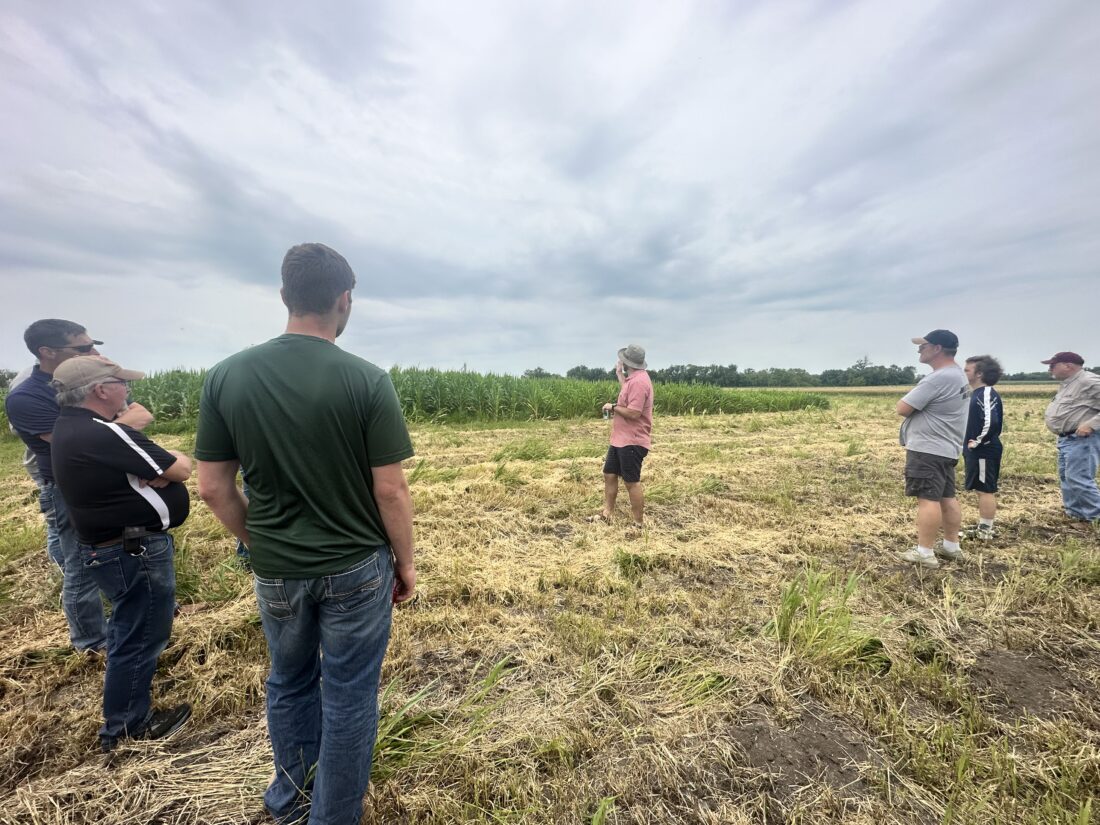
Photo by Samantha Davis. Agronomy associate professor Adam Alford shows attendees a nitrogen rate study on crops during a trial farm site tour at SMSU’s annual Agronomy Day. He is finding that crops not fertilized with nitrogen have more deficiencies.
MARSHALL – Southwest Minnesota State University held the sixth annual Agronomy Field Day at the Jon Knochenmus Center for Innovation and field trials farm site on Friday.
The event featured several presentations from SMSU staff, students, interns and outside business professionals to showcase field-trial research being conducted and other projects. Tours of the farm plots were also given to see the hands-on work being done.
“This is always an exciting event,” Dr. Gerald Toland, professor and chair of the Agriculture, Culinology and Hospitality Management department said. “We’re really proud of our students and they’ve been involved in internships, the research we’ve been doing, and it’s always good to get an update on what’s going on with agriculture and SMSU.”
Hands-on learning and cultivating edamame
Agronomy associate professor Adam Alford is heavily involved in the field trials, and uses them as demonstrations for his students. He manages the plots this summer with help from SMSU intern Dante Fertig.
“I’m actually originally from Arizona, and so coming up here and having nice soil to dig in is a new experience,” Fertig said. “Down there, our ground is so hard that it’s difficult to dig in your own backyard.”
Alford said a handful of classes are physically held out in the field plots.
“I’ve gotten a real deep appreciation for all the hard work that farmers and all do out here,” Fertig said. “I’ve driven past and seen a bunch of these large- scale industrial fields, and even the small field out here, the hours of work to maintain all the weeds … Keeping all those plants functioning and giving them the proper nutrition they need is a cool experience for me.”
Fertig mentioned he has helped in projects with wheat, corn, soy and edamame that Culinology assistant professor Soma Mukherjee has taken lead on.
In a new and ongoing food project development project, Mukherjee is working toward a goal of increasing protein content in chips with edamame, which is an edible soybean.
“Last summer in my lab, I brought it here, these are 25% emission of soybean flour,” Mukherjee said. “I used a simple technology, so that farmers and everyone can use it. I used just a small grinding mill and grinded those soybeans.”
Mukherjee also had samples of edamame directly from the field plot for attendees to try, and she aims to increase the protein to create a healthier form of chips. She has a protein science background previously working with whey protein, and made drinks out of it.
Impact of resistant soybean aphid populations on yield
Next Gen Ag, an independent agricultural contract research company based in Renville, shared information they found in a soybean aphid project, which are tiny insects that stick onto various plants and crops. They can multiply quickly and damage what they’re feeding on.
“It was a really great study last year,” owner of Next Gen Ag Andrew Lueck said. “We had 16 aphids on average per plant, prior to application or treatment, and 250 is your economic threshold.”
Untreated plants would range up to 1,200 aphids per plant. Lueck said to conduct the research, they would collect data on their crops the day before treatment application, six days after, then 14 days after to collectively compare.
Soybean research funding update
Director of research for Minnesota Soybean Research and Promotion Council David Kee reported on the 26 research projects they have funded in 2024, in topic areas of pest management, genetics and other agronomy strategies for soybean growers.
To help with pest control, Kee and his council evaluated control strategies for a new leaf-mining pest, looked at managing herbicide-resistant weeds and enhanced the control of soybean stem diseases.
Out of the projects the council funds, they are split into thirds of being designed to focus on problems in the current day, the next five years and six plus years.
Hemp erosion control
Project manager at the Agricultural Utilization Research Institute (AURI) Matthew Leiphon spoke about an ongoing hemp production project he is working on in partnership with the Minnesota Department of Transportation, to find a more biodegradable way for erosion control on construction sites.
“The current products that they’re using have plastics in them,” Leiphon said. “There’s pollution that’s left behind. You have to go clean them up afterwards, and you can also get microplastics into our waters and beyond that.”
With hemp, which was legalized in the 2018 Farm Bill for Minnesota according to Leiphon, it would just erode away into the soil and serve as a fertilizer.
“Hemp has a multitude of uses,” Leiphon said. “You can use it in fiber products, which is what we’re looking at here today, and can actually also be used for biofuels.”
Mindful Meals and composting
SMSU’s student-led faculty supported organization, Enactus, shared updates about its Mindful Meals project, which provides the community with meals with food they grow.
The project started in 2021, and stemmed from the idea of food insecurity in the area. Since the start, they have delivered 2,552 meals to a 27 mile county radius and they plan to deliver more than 2,000 meals this upcoming school year.
In addition to Mindful Meals, the group also figured out a way to stay resourceful in doing so, and created a compost project called Eco (Enactus Compost Operations).
“One thing we do is focus on reusable waste within our community. Not just food scraps and other things, but also paper, paper bags and other things that can be reused,” Enactus President Sam Lund said. “We thought about repurposing food and finding ways to cut back on waste, but ultimately we came up with the idea of a simple project that can be implemented, basically anywhere where there’s food, paper and stuff like that, and that was compost.”
Farm plot tours
Alford escorted the group on field tours to see the various plots he and students are working on.
Attendees got a close look at a nitrogen rate study. Stocks of corn that did not have nitrogen fertilization appeared to be smaller and have visible deficiencies, compared to the stock that had nitrogen. Alford said it’s planted in a gradual way up from zero up to 250 pounds of nitrogen, so students can observe how the crop gets taller and stronger along the way.
Also shown on the tour were the edamame, pest management, zucchini and new garden plots.
Most presenters said their research from this summer’s farming season will be published in reports during the fall.