
Lyon Co. landfill eyes proposed PFAS study
More than 40 MN solid waste facilities may participate
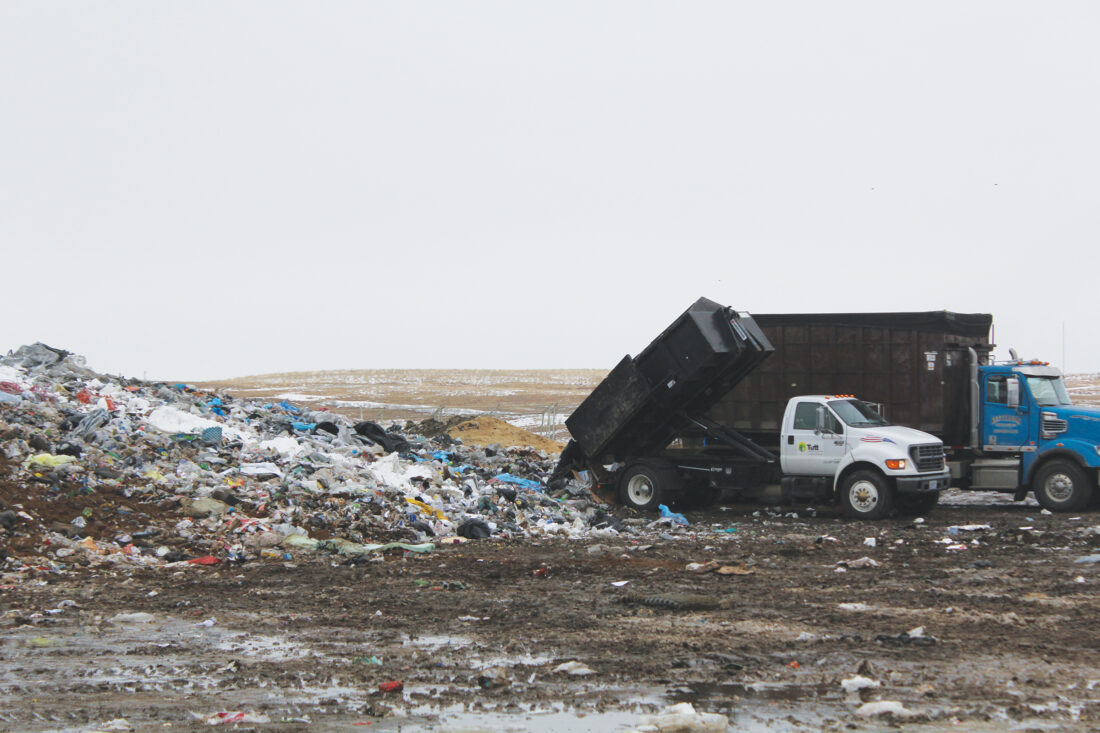
Photo by Deb Gau Trash is dumped at the Lyon County landfill in 2022. Earlier this week, Lyon County Environmental Administrator Roger Schroeder spoke to county commissioners about a study being proposed to look at levels of “forever chemicals” near Minnesota landfills.
MARSHALL — Lyon County’s landfill is seeking to be part of a study looking at possible levels of “forever chemicals” near waste facilities across the state, Lyon County Environmental Administrator Roger Schroeder said this week.
“I think this is a very good study for us to participate in,” Schroeder told Lyon County commissioners on Tuesday.
He said a group of more than 40 solid waste facilities in Minnesota were interested in having the firm of Barr Engineering take samples and conduct a study on potentially hazardous chemicals known as PFAS. Schroeder said the cost for Lyon County to participate in the study would be $4,000.
Schroeder said the idea for the study came as a possible solution for an impasse between waste facilities and the Minnesota Pollution Control Agency over PFAS testing.
“At some point, there’s going to be some monitoring that takes place specifically for PFAS. We have not been monitoring for that in the past, but the MPCA has been been pushing for us to do that,” Schroeder told commissioners.
While the commissioners didn’t take specific action on the proposed PFAS study on Tuesday, they asked Schroeder to keep the board informed.
“PFAS,” short for per- and polyfluoroalkyl substances, are a group of manmade chemicals that have been used in products ranging from non-stick pans to cosmetics, food packaging and firefighting foam, Schroeder said.
“These are items that have been thrown away in landfills for over half a century,” he said.
Because PFAS don’t break down in the environment over time, they can end up in groundwater and drinking water.
“There are connections being made to human health with regards to PFAS,” Schroeder said.
Some specific PFAS have been associated with risks of immune suppression, changes in liver function, or cancer. Which PFAS chemicals cause negative health effects is a topic that is still being studied, he said.
Substances like PFAS can leach out of trash at landfills as it decomposes and is exposed to rainwater, Schroeder said. However, the current Lyon County landfill uses different measures to help keep the leachate out of groundwater. Schroeder said the landfill cells are lined, and a collection system gathers leachate liquid in ponds to be collected and hauled to a wastewater facility.
Schroeder said the Lyon County landfill site also has several wells used for monitoring groundwater underneath the landfill, although they have not monitored for PFAS in the past.
Schroeder said there are six specific PFAS chemicals that have health limits placed on how much of the chemical can be allowed in drinking water. The limits he shared with commissioners were small, measured in parts per trillion.
Schroeder said what the landfill pays attention to is the “intervention level,” the amount of a chemical in groundwater where the landfill would need to take action. The intervention level is lower than health risk limits placed on the chemical.
“There’s some concerns with how we’re moving forward in monitoring,” Schroeder said.
One of the PFAS chemicals with health limits has an intervention level of 3.75 parts per trillion, Schroeder said.
“Some labs in Minnesota cannot detect down to that level,” he said. “So they would report it as less than four parts per trillion. And if we reported to the state four parts per trillion, technically we’d be out of compliance.”
In Schroeder’s presentation, he shared a map of closed landfills in Minnesota, and the level of PFAS detected there. There were closed landfills in Pipestone County, Murray County and Yellow Medicine County where PFAS levels exceeded health standards. A closed landfill site in Redwood County also had PFAS detected, and a closed landfill in Lincoln County had no PFAS detected.
The Minnesota Department of Health also has an interactive online dashboard showing results from PFAS testing in community water systems. Results from the dashboard show that PFAS have not been detected in water systems in Taunton, Minneota, Ghent, Fairview Township, Lynd, Russell and Florence. The dashboard said PFAS were detected in Marshall’s community water system, but not at levels that are considered unsafe.
So far, communities in Minnesota with potential PFAS health concerns in their water include St. Paul Park, Sauk Rapids, Waite Park, Swanville, and a mobile home court in Bemidji, the dashboard said.
In 2021, the MPCA unveiled a blueprint for dealing with PFAS in Minnesota, Schroeder said. Later that year, the agency announced a plan for voluntary PFAS monitoring for facilities like landfills and wastewater plants, he said.
However, Schroeder said, “We have some concerns with the original plan for the MPCA to collect the data and write the report.” In addition, solid waste facilities were concerned about how “voluntary” the PFAS monitoring would be, and how the results would be presented.
“We’re concerned that if the MPCA forges ahead and does all this testing without providing some of the context — about how humans are exposed to PFAS through cosmetics and sandwich wrappers and so on and so forth — that it’s being presented in kind of an alarmist fashion,” Schroeder said. Schroeder said landfills are concerned about being called generators of PFAS, when they’ve really been receiving PFAS in household garbage for decades.
In July, a coalition of Minnesota landfills tried to work with the state to create a memorandum of understanding about PFAS testing, Schroeder said. However, the language the MPCA included in the memorandum “was not very well received,” he said.
“In December of 2022 the MPCA discontinued talks with us about the MOU language,” Schroeder said.
The group of Minnesota landfills has been working on hiring a more neutral third party to do a PFAS study instead, he said.
“It would be funded by participating facilities. Lyon County wants to be one of those participating facilities,” he said. “To date, we have 46 solid waste facilities that are committed to participating in a study.”
The group was looking at having the firm of Barr Engineering study samples from landfill facilities around Minnesota, and release a final report on PFAS levels sometime next year.
Local News
Middle school parking lot bid approved
MARSHALL — The Marshall Public School District school board this week approved one of the four bids for the ...

Stressing bike safety

Moorse, Thordson named MEA Teacher, Friend of the Year
Dahms, Swedzinski talk fighting fraud

MPS Board presents final Tiger Spotlight of year
Variety of Memorial Day programs scheduled
MARSHALL — On Monday, residents of area communities will be pausing to remember the sacrifices of U.S. military ...