Marshall Council approves police body cameras
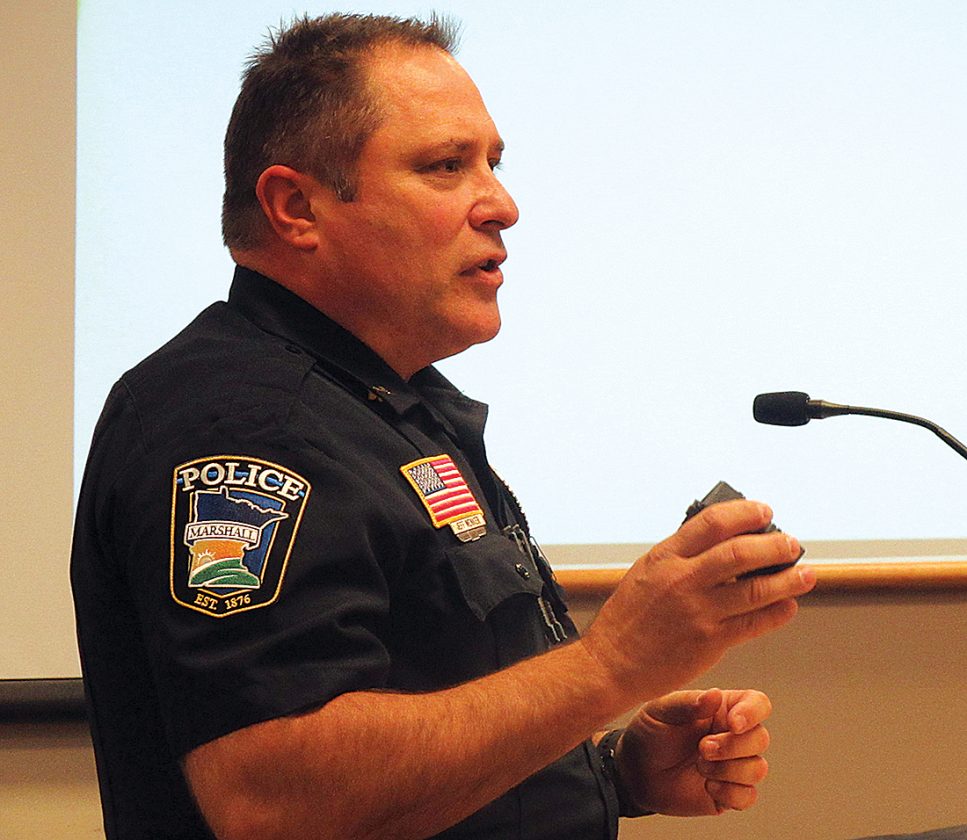
Photo by Deb Gau Jeff Wenker, of the Marshall Police Department, held up an example of the type of body camera the MPD was proposing to buy for its officers.
MARSHALL — Wearing body cameras is becoming more common for police officers around the country. The Marshall Police Department will be joining that trend, after action by the Marshall City Council on Tuesday night. Council members voted to approve policies for a body-worn camera program, and the purchase of about $50,000 worth of equipment to get the program started.
“It’s going to help us in so many ways,” said Marshall Public Safety Director Jim Marshall.
“It’s one more tool to give you a better view of exactly what’s happening,” when police have contact with the public, said Capt. Jeff Wenker of the Marshall Police Department.
Marshall said the money for the purchase would come from funds from the sale of forfeited property.
Marshall and Wenker brought a proposal for a body-worn camera program to the city council at its regular meeting Tuesday. They talked about the policies for how the body cameras would be used, as well as how the cameras worked, and a cost estimate for cameras and additional equipment.
Council members voted to approve the policies and the purchase of about $50,000 worth of equipment to get the body camera program started.
The discussion about Marshall police using body cameras is something that’s been going on for years, Jim Marshall said. He said he thought the policies the MPD were bringing to the council were strong and clear on how the cameras should be used.
Wenker said the MPD has also been testing out a sample body camera from a company called WatchGuard.
“We’re looking at purchasing 22 of these cameras,” Wenker said. There would be one camera for each uniformed police officer, and cameras for non-uniformed and administrative officers could also help serve as backups.
WatchGuard’s VISTA camera can be worn and activated by a police officer, but it can also work with the camera systems that are already in the MPD’s squad cars. Wenker said police officers can manually activate the body cameras, or they can be activated whenever the squad car’s lights are turned on.
“It’s basically a tiny computer,” Wenker said. He handed the sample camera around so council members could take a closer look. MPD officers had taken about 50 videos with the body camera so far, he said.
Wenker gave council members a short summary of the proposed body-worn camera policies. The body cameras should be turned on for traffic stops, enforcement and investigative situations like field interviews, and contacts that become adversarial, he said. Once activated, cameras should stay on until the officer reasonably believes their participation in an incident is over. The cameras can be turned off while officers are writing reports or taking breaks, he said.
The video recorded by the body cameras would be considered private, with some exceptions under Minnesota data practices law, Wenker said. People who are in a recording can have access to it, as long as it’s not part of an active investigation, is confidential, or if the officer involved in the footage is protected under state law. The police department would also have access to video recordings to investigate conduct of officers.
Wenker said the video recorded by body cameras would be kept for at least 180 days. People who are in a recording can submit a written request that the police department keep the video on file for a longer period of time.
Marshall and Wenker said the body camera program would be a positive thing. The video footage recorded by the body cameras would supplement the video taken by squad car cameras, and could also be used to shed light on any possible wrongdoing by a police officer.
WatchGuard provided the MPD with a quote of $49,750 for the body cameras, as well as software and additional equipment like servers and computer hard drives to handle the video recorded by the cameras. Installation of equipment in eight squad cars would cost an additional $1,200.
Marshall said the money for the cameras and equipment wouldn’t come from the city levy. Instead, the police department would use money from its forfeiture fund. The forfeiture fund is a reserve of money from the sale of forfeited property. Marshall said the camera program was a good use for some of the funds.
Council members said they appreciated the work that went into the proposal, and developing the body camera program.
“You’ve done a very thorough job on this,” said Marshall Mayor Bob Byrnes.
Council members voted to approve the program and the purchase of equipment for the police department for $50,950.
Local News

MPS Board presents final Tiger Spotlight of year
Variety of Memorial Day programs scheduled
MARSHALL — On Monday, residents of area communities will be pausing to remember the sacrifices of U.S. military ...
Lyon Co. Board OKs 2 swine barn permits
MARSHALL — Lyon County commissioners approved permit requests for a pair of swine barns this week. One request ...

Getting into the spirit of things

Dancers showcase spring recital