
Area officials, MnDOT staff talk transportation funding
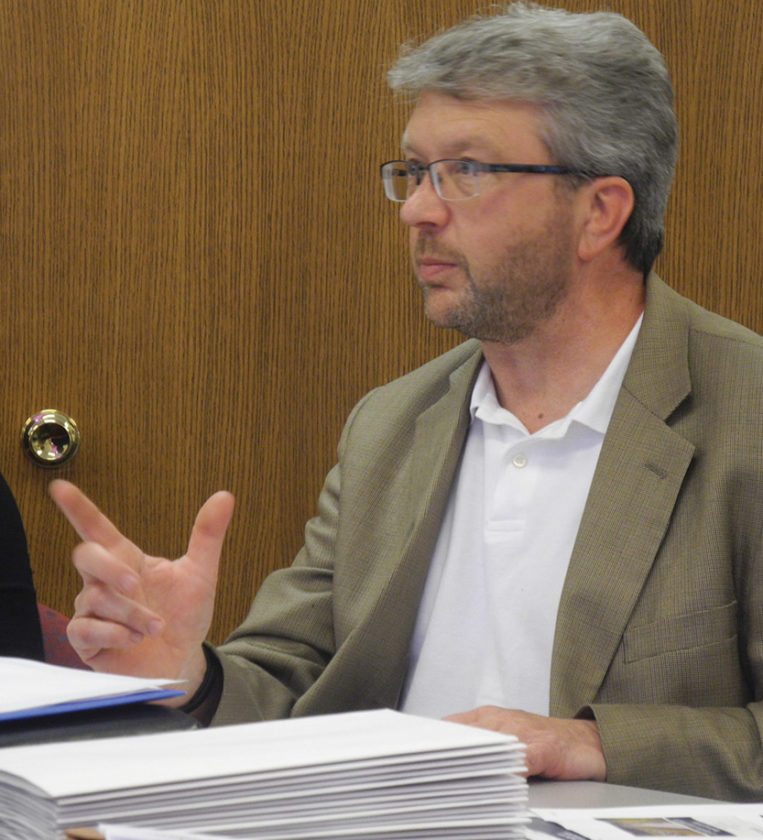
Photo by Deb Gau MnDOT District 8 engineer Jon Huseby spoke about transportation funding and planning, during the annual meeting of the Southwest Regional Development Commission’s Transportation Committee.
SLAYTON — While there are still uncertainties to work out, it looks like there were some positive results for transportation funding that came out of this spring’s legislative session, Minnesota Department of Transportation staff said Wednesday.
“Overall, it was a fairly good year for transportation,” said MnDOT District 8 engineer Jon Huseby. Huseby gave an overview of 2017 legislative funding during the Southwest Regional Development Commission Transportation Committee’s annual meeting.
Officials from several counties in southwest Minnesota met with MnDOT engineers and staff to talk about transportation issues in the region. MnDOT representatives from the District 8 office in Willmar and the District 7 office in Mankato were present at the meeting.
The issues discussed Wednesday covered a wide variety of topics, from the development of regional bicycle route plans, to strategies for finding local interpreters to help community outreach and education about transportation. However, a lot of the discussion focused on the outcome of the 2017 Minnesota legislative session and what it could mean for road and bridge projects in southwest Minnesota.
Huseby said there was some new legislative funding that will be available for transportation projects over the next four years, in the form of trunk highway bonds, and both bonds and trunk highway funds for the Corridors of Commerce program. Corridors of Commerce provides funding for road improvements that help support regional commerce and economic development.
“Most of the new funds were not constitutionally dedicated,” Huseby said, but they still represented an opportunity for road and bridge improvements from fiscal years 2018 to 2021.
“What the new funding helps us do is improve some of those projects,” he said.
Huseby said the new trunk highway bonds were “pretty substantial,” with more than $600 million in funding available over four years. He said MnDOT’s priorities for use of the trunk highway bonds include advancing pavement projects and delayed bridge projects, and enhancing pavement preservation work, so road surfaces last longer. The trunk highway bonds could also help with funding “mega projects” like improvements on Interstate 94 in the Twin Cities and the Twin Ports project in Duluth.
In the Corridors of Commerce program, there will be a total of $50 million in trunk highway funds available over the next two years, and a total of $300 million in Corridors of Commerce bonds available over the next four years. However, Huseby said there are some new added criteria for projects to receive Corridors of Commerce funding, which a MnDOT work group will have to refine.
Some of the new criteria for Corridors of Commerce projects include improving safety, connecting to regional centers, and “regional balance,” which Huseby said likely means making sure funding goes toward a mix of Twin Cities and Greater Minnesota projects. Other criteria, like having a good return on investment, might be more challenging for rural projects to meet.
“That one always makes me a little nervous,” Huseby said, because it’s often linked to traffic volumes. Rural highways aren’t going to have the same traffic volumes as urban ones, he said.
Huseby said more details on the new Corridors of Commerce criteria will hopefully be worked out by this fall.
District engineers also shared capital highway investment plans for Districts 7 and 8. The plans outline the road and bridge projects tentatively scheduled over the next 10 years. However, MnDOT engineers said projects scheduled in the first four years of the plans were much more definite than projects further out.
In the Marshall area, a few projects were planned for fiscal year 2018, including construction of J-turns at the intersections of Minnesota Highway 23 and County Road 7, and Highway 23 and Lyon Street. Resurfacing on U.S. Highway 212 between Granite Falls and Montevideo is also planned for 2018.
In 2019, planned projects include resurfacing on U.S. Highway 75 between Canby and Ivanhoe, and resurfacing on Highway 91 between Russell and Lake Wilson. Planned projects in 2020 include resurfacing on Highway 23 between Cottonwood and Granite Falls, and building left turn lanes at the intersections of Highway 23 and Lyon County Roads 9 and 10. Planned projects in 2021 include widening the shoulders of Minnesota Highway 68 between Marshall and Minneota, and resurfacing work on Minnesota Highway 30 in Murray County.
Local News
Sewage testing program helps track COVID
MARSHALL — The city's sewage plant is helping the Minnesota Department of Health monitor respiratory diseases in ...
New street closure ahead
Marshall awards $1M bid for drainage project
MARSHALL — It’s been a long time in the making, but a planned drainage improvement project in the area around ...

‘Dutchmen on Parade’
Police report rising concerns over scooters
MARSHALL — Bikes and scooters with electric motors are becoming a more popular way to get around. But at the same ...
Learning drone technology
MARSHALL - The Lyon County 4-H hosted a drone program for youths in grades fifth through eighth to teach skills in ...