Showing what they know
SMSU students take part in annual Undergraduate Research Conference
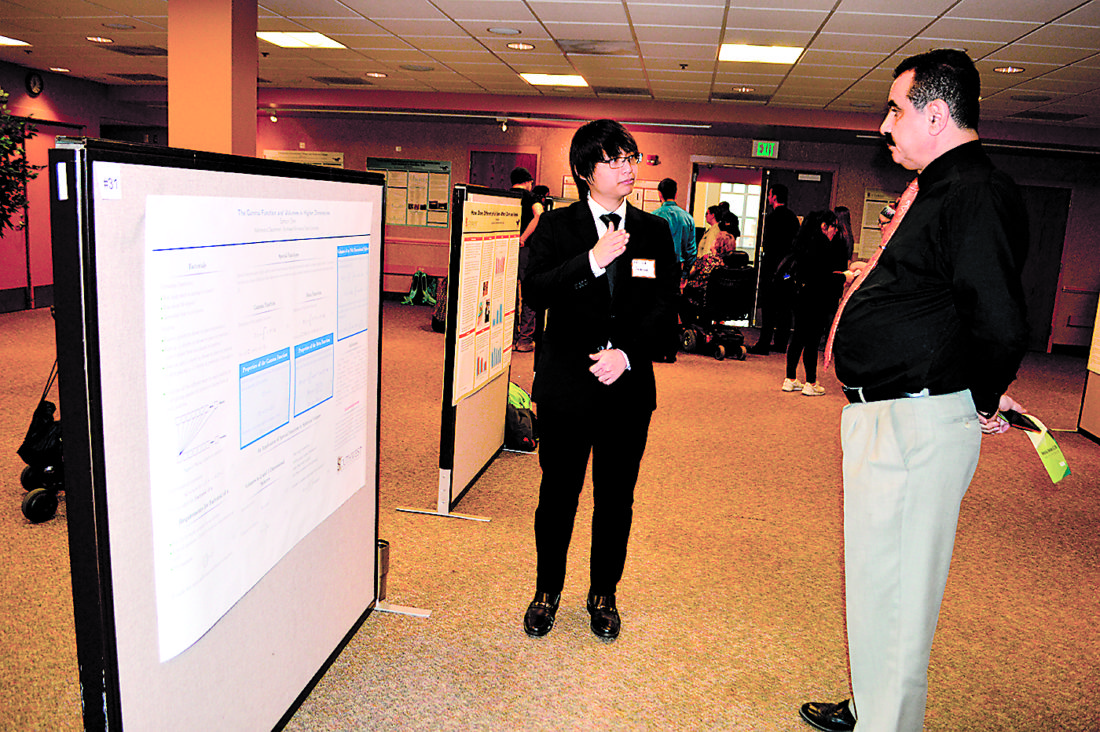
Photo by Jenny Kirk SMSU senior Samson Chen, left, answers questions regarding his research project — The Gamma Function and Volumes in Higher Dimensions — during the 2016 Undergraduate Research Conference on Wednesday.
MARSHALL — Nearly 300 undergraduate students took part in the 11th annual Undergraduate Research Conference on Wednesday at Southwest Minnesota State University.
The SMSU student presenters represented 22 different academic programs, participating with the cooperation of 33 different faculty advisers.
“Two-hundred-eighty-five different students will be presenting results of research they have done — either as oral presentations or posters,” event coordinator Dr. Emily Deaver said. “There are 124 posters and 45 student oral presentations this year.”
After Deaver and fellow environmental science professor Dr. Thomas Dilley conducted a program review in 2005-06, it became clear that their science students needed more experience conducting research in addition to communicating the results of that research to the broader community. So in 2006, the first conference was initiated by Deaver. There were 21 oral and 27 poster presentation from science students (environmental science, biology, physics and chemistry) the first year, with the conference swelling every year since.
“I am thrilled to see that so many programs across campus are now requiring their students to participate in this event,” Deaver said. “We have 22 different programs participating this year. Conducting research is a very different kind of learning experience that benefits students from every major. It is a huge amount of work for the faculty members who are supervising student research, so it is really clear that we have a dedicated faculty who are really interested in helping our students grow and learn.”
Deaver pointed out that the SMSU Undergraduate Research Conference provides a professional setting for students to present their research.
Jakob Hicks, a junior from Milroy, conducted his research project with SMSU seniors Deanna Honnold, Ashley Clement and Bradley Jansma.
“It was a great experience,” Hicks said “The biggest thing I learned is how to actually perform an experiment — what to look for and what things to control when conducting an experiment. Our experiment was testing if coffee had allelopathic effects on the growth of corn.”
The group found that the trend seems to indicate that it does have an effect, but they couldn’t find any statistical proof that it did.
“So further experiments need to be done to see if there is any statistical relevance,” Hicks said. “What we were looking for here was to see if coffee could be a more natural herbicide to use in our fields in agriculture.”
Jansma, a Worthington native, said though he had never done a project like this before, he enjoyed it.
“I thought it was interesting seeing the allelopathic effect on the corn,” he said. “There was a difference, but it wasn’t significant enough to tell. I think if I were to do it again, I would have another three weeks of testing and then do a tea test, as Dr. (Betsy) Desy recommended. From that, we’d have better results, maybe a better way of explaining it and seeing the future of it in agriculture.”
While Hicks and Jansma primarily measured and drained the coffee grounds in addition to watering and measuring, their two other group members had other roles.
“The girls did a lot of thinking of what we’d do, like the idea of it — the materials and methods — and they put the discussion together,” Jansma said. “We worked together as a group real well.”
Melissa Kiecker, an environmental science major, was knowledgeable about her project, which was called “Riparian Wetland Monitoring in Marshall Minnesota Fall 2016.”
The results of Kiecker’s study showed that street and field agricultural run-off impacted the water quality of this riparian wetland.
“Every Thursday, I’d be out there taking results,” Kiecker said. “I enjoyed doing the project.”
With students Andrea Fuerstenberg and Braden Sommervold engaging in conversation as well, exercise science professor Kris Cleveland asked Kiecker what she wanted to do with her major. Kiecker replied that she would most likely work with the DNR.
“I had an internship this summer up by Silver Bay, Minnesota,” Kiecker said. “I got a lot of experience with that. Some day, I would like to be a park ranger. With the environment changing so much, they’re going to be looking to environmentalists to help provide direction with everything.”
Freshmen Nydak Kur, Ayan Nur and Samuel Wreh provided unique insight relating to their project called “Interdisciplinary, Summer Bridge and the Traveling Classroom: Examples of On-Site Research Conducted in Kansas City.”
“This was basically learning about segregation in Kansas City (Missouri),” Wreh said. “We did the Summer Bridge program — it’s like a three-week program for incoming freshmen. You get eight credits.”
There to support the trio were Michele Knife Sterner, associate director of Access, Opportunity and Success, and Cassie Williams, AOS specialist, who both assist with the Bridge program.
“We operate the Bridge program,” Sterner said “The students have to be enrolled and accepted at SMSU for the fall. This year, it ran from July 25-Aug. 13 — for three weeks. During the second week, we visited Kansas City. We took 36 students with us.”
In addition to the trip, each student was required to do a paper and a speech. Three groups of students, including Kur, Nur and Wreh, also took part in the conference on Wednesday.
“As soon as we were in Kansas City, we went to several places that we talked about in class and that had to do with racial issues — about the history of Kansas City and all that,” Wreh said. “We went to the Jazz Museum. We saw the Negro League. We met with people that explained the stories to us. It was a great experience overall.”
Kansas City community members even invited the SMSU students to paint a mural with them.
“It was so awesome,” Wreh said.
In the 1930s especially, Kansas City was a crossroad of the nation, resulting in a mix of cultures.
“Our topic was racial segregation,” Nur said. “We learned what the difference was between segregation and Jim Crow laws. Segregation is just the separation between blacks and whites and Jim Crow laws are actually the laws and rules that put them away from each other.”
Jazz music, however, brought people together.
“There’s actually nightclubs which brought in African Americans, Asian Americans, white people — people from every background — together,” Nur said. “So it was just like the sound of music that filled the air and brought everyone together.”
Nydak said that she wasn’t necessarily a fan of jazz until she went to the American Jazz Museum, where tour docent Karen Griffin spoke to the group of students.
“She talked about Ella Fitzgerald, Charles Parker and Duke Ellington,” Nydak said. “Some of the students, like Sam, got to dress up. He was Charles Parker and had a little hat. So when she told us about these musicians, that’s when I was like, ‘Hey, I should probably start listening to it.'”
Nydak said she wanted to get to know more about the iconic musicians.
“I felt it more,” she said. “I wanted to cry because (Griffin) started tearing up. It was really amazing for us.”
One of the other things that Nydak learned was that the phrase “Uncle Tom” was not a compliment.
“If someone were to walk up to you and say you’re acting like an ‘Uncle Tom,’ it basically means you’re acting like a slave,” she said.
During class time, Wreh said he learned about the city’s racial history, hate crimes and social control. People of color had restrictions back in the day, he added.
“If you were a person of color, there were certain things and certain places you could not go,” he said. “It has to do with 18th and Vine within Kansas City. The displacement helped to bring the racial color together because you had the foundation of the jazz music on 18th and Vine.”
After the trip, the students were asked to reflect on their experiences.
“We were asked about the things we learned and how it impacted our lives,” Wreh said. “I’m going to be honest with you, as a person of color being in Kansas City, talking to all the people and learning about the things that happened, it was a really awesome experience. I really, really liked it.”
Local News

‘Riding a tornado’
Celebrating Bandwagon Days
‘America 250’ series to continue at museum
MARSHALL — A series of speakers and reflections on the United States’ 250th anniversary will continue in July ...
One dead, one injured in Hwy. 68 crash
MINNEOTA — A Minneota man was killed and an Echo woman was injured in a two-vehicle crash Friday afternoon on ...
Mylan Ray says this is the last one