
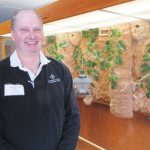
Mark King — social worker
Helps nursing home residents with aging process
Trending
MINNEOTA -- The transition process from independent living to nursing home care is almost always a challenge, and no one knows that better than nursing home social workers like Mark King.
As the social worker for the Minneota Manor Nursing Home for almost 30 years, King helps to guide nursing home residents and their families through the many concerns that go with decreased ability to perform most types of daily tasks.
When possible, he helps to find strategies that allow a resident to handle daily needs with a small amount of help. If that's not an option, he's part of the process of making sure that staff provide whatever assistance is needed to guarantee a comfortable life.
"I've always wanted a career path that keeps me out in the field, that lets me work with people directly and find ways to help them," King said. "As I went through college, I decided senior citizens would be a good age group. I knew that many of them need help, so I wanted to be someone who provides it."
As a 1990 graduate of Southwest Minnesota State University, King majored in sociology with a social work emphasis. He's been part of the Minneota Manor service team ever since; first as a college intern, then through a part-time staff position that became full-time. He lives on an acreage near Canby with his wife, Bobbi, and their son Kelton.
He hasn't seen a need to seek employment in a larger care facility or a public agency because of how his duties at the Minneota Manor have always suited his career needs and goals.
"It's always been a people-oriented place," King said. "That's produced a good, caring atmosphere and a positive work environment. It had a very good reputation when I started here, and we've kept that going."
On a frequent basis King meets a new Minneota Manor resident who remembers parents living at the nursing home in the past.
They notice that some of its familiar features, such as the aviary with colorful birds in the front lobby and the combination of indoor and outdoor fish ponds, still make the facility seem more like home. At the same time amenities such as more television channels and wireless Internet offer a way to remain connected to the 21st century world.
"Residents have more ways to stay busy within their rooms because of technology," King said. "Some of them like to spend a good percentage of their time doing things on their own. Up to a point that's OK, as long as they also take some interest in their surroundings."
He's found that residents in the 21st century tend to divide time effectively in ways that allow for social interaction. Opportunities include eating in the dining room, attending programs, being involved in activities, and enjoying visits from relatives and friends.
Some even volunteer to be group leaders. By doing that, they encourage others to share their interests. Often Minneota Manor residents interact with neighbors from the Madison Avenue Apartments, which are connected by interior corridors.
King has witnessed a gradual long-term transformation in the care provided to elderly residents who can no longer live on their own. He said it's proven responsive to changes in both medical technology and in the varied needs of different families.
"It used to be that their choices were either family care or the nursing home, so some nursing home residents still had much of their health," he said. "Gradually new options became available like congregate apartments, assisted living, home health care and respite care. Those who need a nursing home instead of another option usually require a wide range of assistance."
He noted that the tradition of family care has recently started to show signs of making a comeback. Some of it is due to new medical technology and care strategies that allow relatives to handle many basic caregiving duties with little or no experience. In some instances, it's possible since many adults stay highly active past middle age and therefore still have enough energy to be a caregiver when they're at or near retirement.
No matter what option a family chooses, the aging process for parents or grandparents is at least in some ways diffcult for entire families.
"It's a real struggle, one that takes its toll on everyone," King said. "It's hard to believe how much it sometimes changes the lives of everyone in a family. We look for ways to help people adjust."
He said that process of finding new opportunities can extend to many parts of care facility operations. One example of a successful new method of networking with families is the use of interactive technology for care conferences. It allows relatives in distant locations to participate as though they're sitting at the same table.
Other ideas often relate to daily care center routines. A recently launched activity at the Manor is a men's social time called Pies for Guys, a chance to regularly enjoy a piece of pie and have conversations about any subject from the past or present.
It's led to some interesting, previously unheard personal stories. One man told the group this winter about a work experience as a fuel delivery man. It included getting stranded five times in one particularly severe winter.
"It all comes down to the need for handling changes that occur in an elderly person's health, changes that are beyond anyone's control," King said. "Sometimes it can include experiences that are enjoyable."
Minneota Manor Administrator Kathy Johnson said having a fully qualified social worker on staff is not only a regulation, but a valuable component in the overall delivery of resident care. King is part of interdisciplinary care teams formed for each resident.
She said he also acts as an advocate, doing what's needed to guarantee that care needs are met with input from both staff and family members. In the process, he often becomes a source of support for spouses, sons, daughters and other loved ones.
"Having good communication is very important," Johnson said. "Mark has a skill for facilitating that. He's a very open person who knows how to help residents and families whenever there's a need."