
Deutz wins trip to Washington, D.C. for ag visit
Trending
MARSHALL -- Marshall farmer Allen Deutz took a pivot in his farming operation when he switched from dairy to beef cattle and went back to college for economics at South Dakota State University in Brookings, S.D. As a student, he earned a trip to Washington, D.C. Feb. 22-23.
"I'm a second-year graduate student in the Economics Department at SDSU," Deutz said. "I also work at SDSU part-time as a graduate research assistant for Dr. Deepthi Kolady. She encouraged me to submit an essay for the USDA Agricultural Outlook Forum Student Diversity Program. The essay topic was on 'The Greatest Challenge Facing Agriculture Over the Next 5 Years.'"
He submitted his essay, and it was selected along with nine other graduate and Ph.D. students from around the United States.
While in Washington, D.C., Deutz had the opportunity to meet with legislators and/or government officials regarding agriculture issues.
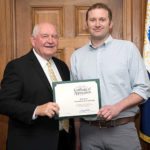
"We were able to meet with the Secretary of Agriculture Sonny Perdue and his under-secretary Steve Censky, who is a Jackson, Minnesota, native and an SDSU alumnus," Deutz said. "Many issues were discussed, particularly the 199a tax issue, some conservation topics, and dairy."
Perdue congratulated Deutz on being selected for the Washington, D.C. trip, Deutz said.
With his dairy background, Deutz was vocal on the issues going on in the dairy sector, particularly for the small and midsize dairies, he said.
"Agriculture is a tough business to be in right now, but it is particularly tough on smaller family dairy farms," Deutz said. "The real costs of production are nowhere near break-even for most producers right now and times are tough. I made sure I told my story of getting out of dairy and going back to graduate school.
"I was fortunate to have an exit strategy, but many producers don't have many options," he said. "I also pointed out the MPP (Margin Protection Program) has not worked for producers, and even their recent fix might not be the answer."
The real problem will be the loss of these small farmers who have a large economic impact on their local communities that the larger ones don't have, Deutz said.
His group also met with staff from the House and Senate Agriculture Committee, and again voiced these concerns.
Deutz said it was great to be able to see USDA from that level. Being able to hear these top officials at USDA and from the agricultural industry in Washington, D.C. speak gave him a better perspective on where agriculture will be heading in the next decade and the potential pitfalls we may encounter.
"Some other highlights for me were the USDA Chief Economist Robert Johansson presentation about the current state of U.S. and global agriculture, with outlooks on commodities and farm income for 2018," Deutz said. "I also enjoyed the sessions on developing local food systems, an interest of mine, and the sessions on U.S. farm financials, also an interest of mine."
Deutz farms with his parents.
"I farm with my parents, Paul and Fran, and together we farm around 900 acres of corn, soybeans, alfalfa, and barley," he said. "I also raise antibiotic-free niche market outdoor pork for direct market and wholesale and started raising grass fed beef this year, also for direct market and wholesale, pivoting from dairy. The beef will be used to expand my use of cover crops and livestock integration on our farm."
Deutz is into conservation farming to preserve the soil and save money on added steps that came into existence with mechanized farming.
"We started using cover crops and livestock integration on some of our land and plan to continue using these practices going forward," Deutz said. "I have been a part of a cover crop and livestock integration study for the last several years through the Sustainable Farmers Association of Minnesota and some of my research at SDSU is focusing on conservation practice adoption. I've seen the benefits, both from a soil health and financial perspective and believe there is a lot of potential for these practices."
In time, Deutz believes they will be an important aspect to the profitability of small to midsize farms.
"We also have been using buffer strips prior to the buffer law and started planting pollinator plots on our farms as a refuge and extended food source for pollinators," he said. "I also am a supervisor on the Lyon County Soil and Water Board, where our office does an excellent job of getting conservation practices implemented in Lyon County."
Deutz's wife, Kathleen, is an early childhood special education teacher for the Marshall Public Schools District.
"However, she has helped me with some of our direct marketing sales," Allen Deutz said. "We have four children, Samuel, Autumn, Elsie, and William. My son, Samuel, is interested in farming and started raising chickens last year. He takes care of a flock of about 40 hens and sells the eggs."
Allen Deutz is the fourth generation on their family farm that will be a Century Farm in 2020.