
UK's Conservative Party leader torpedoes defection of chief rival by firing him first
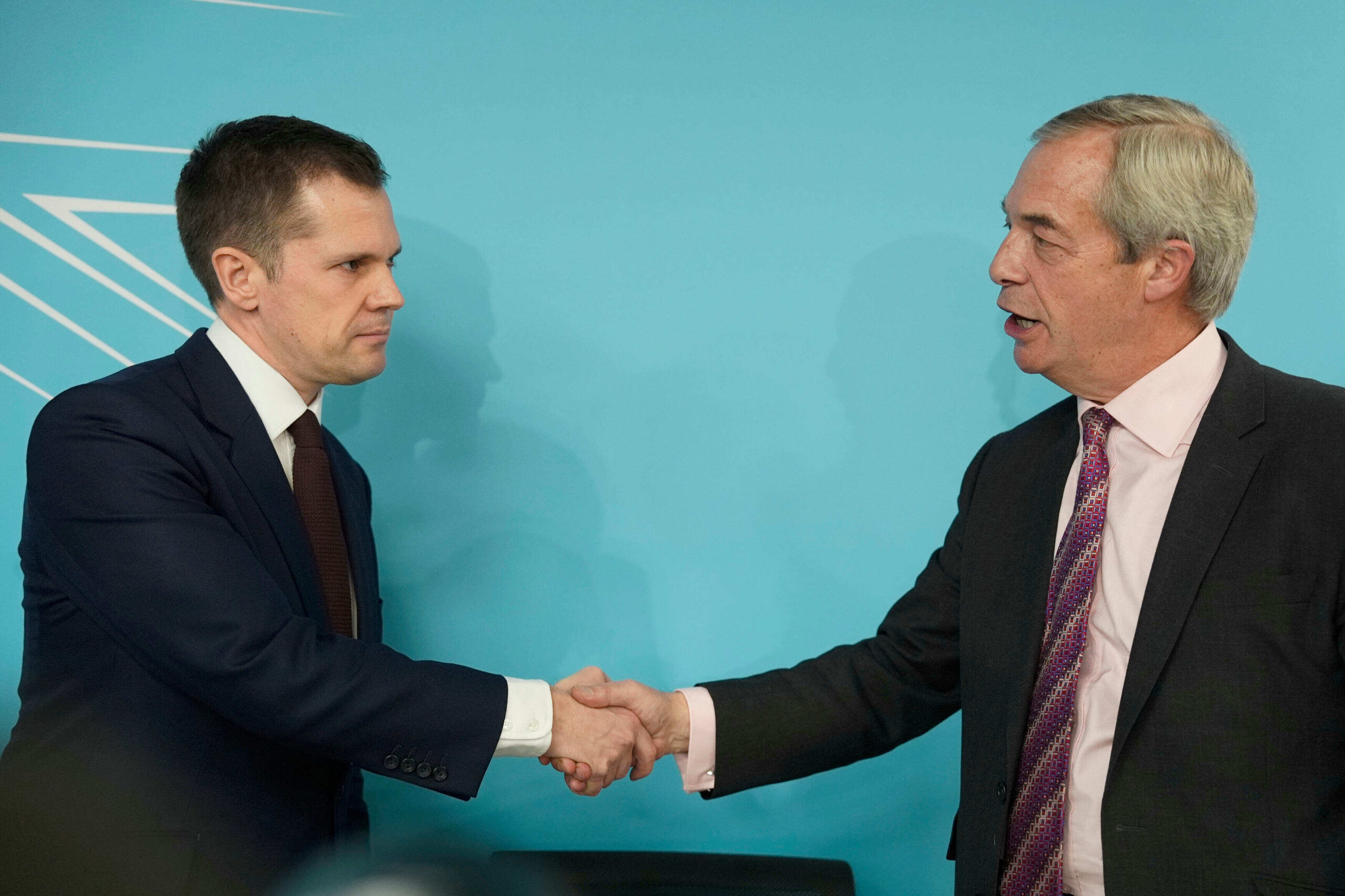
Robert Jenrick with Reform UK leader Nigel Farage at a Reform UK press conference in Westminster, London, where it was announced the former Conservative MP has joined Reform UK, Thursday, Jan. 15, 2026. (Jordan Pettitt/PA via AP)
By PAN PYLAS Associated Press
LONDON (AP) — Britain’s Conservative Party, which governed the country from 2010 until it suffered its worst-ever electoral defeat two years ago, was plunged into fresh turmoil Thursday after its leader sacked the man widely seen as her greatest rival for apparently plotting to defect to a rival right-wing party. He then defected.
Robert Jenrick, the Conservative Party’s justice spokesperson, later confirmed his defection at a press briefing by Reform UK, the upstart hard-right party led by Nigel Farage.
Jenrick said the Conservative Party had “betrayed its voters and members” and was “in denial, or being dishonest” about what it had done on an array of issues, including the economy and immigration.
“After the election, I hoped the Conservative Party would change, reckon with our mistakes with humility, repent,” he said. “I said this after the election, fought for it, hoped it would be possible. But over the last year, I’ve realized this was naive. It hasn’t happened.”
Reform lifeboat
Jenrick joins a string of Conservative politicians to jump ship for Reform UK, a party that has put clamping down on immigration at the heart of its agenda for government.
Unlike previous Tory defectors who lost their seats in Parliament in the 2024 election, Jenrick remains a lawmaker. His defection means Reform now has six of the 650 seats in the House of Commons and the Conservatives 118.
Opponents, including Labour Prime Minister Keir Starmer, argue that Reform UK is becoming a lifeboat for failed Conservative politicians who have concluded they have no future in the party. Starmer refers to the Conservative Party as a “sinking ship.”
Though Reform UK only has a handful of lawmakers in the House of Commons, it is leading both the governing Labour Party and the Conservatives in opinion polls ahead of a raft of elections on May 7, including for the parliaments in Scotland and Wales.
Farage said the door to further Conservative defections was open but would close on that election day, Britain’s equivalent to the U.S. midterms.
The right is split
A day of high drama on the right of British politics started when Conservative leader Kemi Badenoch said she had fired Jenrick due to “irrefutable evidence that he was plotting in secret to defect” in a way that was “designed to be as damaging as possible” to the party.
Badenoch will be hoping her abrupt and straightforward dismissal of Jenrick will help bolster her position as the leader of the Conservatives and regain supporters lost to Reform UK. She added that Farage won’t find it easy keeping Jenrick onside.
“All I would say to Nigel is, Rob’s not my problem anymore,” she said. “He’s your problem.”
By ejecting Jenrick, Badenoch turns an internal party rival into an external opponent. Some Conservatives were glad to see him go, accusing Jenrick of plotting against the party leader and of pushing the Conservatives to the hard right.
Since losing out on the party leadership, Jenrick has become one of the party’s loudest anti-immigration voices, and has worked hard to build his online brand with eye-catching videos, including one showing him confronting subway fare-dodgers.
The Conservative Party is no stranger to turmoil, having gone through six leaders in 10 years, five of them serving as prime minister. Widespread anger at the turmoil led to their heavy election defeat in 2024, their worst since the modern party was created nearly 200 years ago.
Badenoch, a small-state, low-tax advocate, has not made much of a mark in the country since she beat Jenrick to become leader of the Conservatives in late 2024. However, she has been making a better impression in recent weeks, particularly during her weekly questioning of Starmer in the House of Commons.
Respite for Starmer
For Starmer, Jenrick’s defection provided a distraction from the grind of government. Starmer, whose favorability ratings have fallen sharply since the general election following a series of missteps, questioned why it took Badenoch “so long” to sack Jenrick given all the speculation that he was looking to either challenge her or to defect
Thursday’s tussle between the Conservatives and Reform UK appears to have put to rest to any idea that the two parties will form an alliance of the right ahead of the next general election, which has to take place by 2029. That means the vote on the right would remain split, potentially helping Labour.