
Fischbach, Osberg discuss Ag issues at Farmfest
Trending
MORGAN - Tariffs, immigrant labor, and E15 ethanol blends were among the top topics during Farmfest's U.S. Congressional District 7 candidate forum.
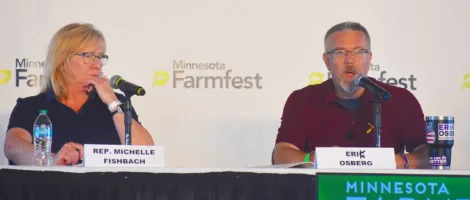
Incumbent Representative Michelle Fischbach and DFL challenger Erik Osberg participated in the forum, answering questions on a variety of agriculture topics.
At the start of the forum, the candidates were asked to name their top two Ag priorities if elected to Congress.
Fischbach cited E15 and other bio-based fuel materials as a top priority. She said the E15 would benefit farmers by adding new domestic markets.
She also wanted to see changes to the H-2A visas that allow U.S. employers to bring foreign nationals into the country for temporary agricultural jobs. She believed this would help secure needed farm labor.
Osberg said health care was a top issue. In touring the district, he heard from multiple farmers that the current health care system is broken.
"We have people who are working off the farm, just for the insurance," he said. "We need to make sure that every single American has access to healthcare regardless of their insurance status and regardless of their wealth."
He also cited the need to get input costs and commodity prices in order.
The candidates were asked how Congress should balance the need for economic assistance in the Farm Bill and the ongoing need for ad hoc assistance.
Fischbach said there needed to better clarity and stability in the market, which is why she believed the year-round E15 legislation was important as it would create a steady market stream for farmers.
"That's how we balance it, by making sure they have markets for their profits," she said.
Osberg countered saying "the fact that we need to talk about ad hoc assistance is a problem."
He said a bad plan is better than no plan at all, but was against throwing billion in dollars at a problem in the hope that it would be fixed.
"What we need to do is take a long-term look at what our farmers need," Osberg said, "and we need to do it on a two-track system. There are big corporate farms and small family farms. We need to level the playing field to make sure the family farm has as much opportunity as the big corporate farm."
Osberg said another way to create stability would be to have Congress stand up to the Trump Administration’s tariffs, which he called unconstitutional.
Osberg again criticized the Trump administration regarding the USDA's reorganization plan to relocate staff to hubs across the country.
He said the administrations "gut and cut" model pushed by DOGE has not worked and the federal government is not functioning as it should. The paperwork on food stamps is not getting done because of the cuts.
"What we're experiencing is chaos, uncertainty and dysfunction," Osberg said. He did not believe USDA could be reorganized until the cuts were fixed.
Fischbach disagreed that the reorganization of the USDA was not helpful. She believed it was important to have members of the USDA outside of Washington, D.C. and in the rural areas talking to farmers.
"We want them here listening to us," she said. "I absolutely support bringing government out of D.C."
After a six-year review of the United States-Mexico-Canada Agreement (USMA), the U.S. declined a 16-year renewal in favor of an annual review process.
Ficshbach said the agreement does need to move forward but believes improvements could be made in it.
Osberg said one of the biggest improvements to the USMCA would be for the U.S. to become a better, more reliable trading partner. Osberg said the U.S. constantly fighting with its neighboring countries over trade deals will not end well.
"The first improvement we can make is standing up to our own obligations and becoming a reliable, predictable trade partner," he said.
On how to maintain a reliable agriculture workforce as it is tied to immigration, Fischbach said the first step is modernizing the H-2A visa and make it a year-round visa.
Osberg said there needed to be easier pathways to citizenship. He said the number of federal immigration judges was capped at 800, creating a backlog of immigrants who did want to become U.S. citizens but could not get there.
He said temporary visas were great, but said regardless of industry, if a person comes to the U.S. to work, they needed a clear and concise path to citizenship.
Asked if Congress should have a larger role in issuing tariffs or if the power remain with the president.
Fischbach defended the Trump administration’s use of tariffs, saying it brought more countries to the negotiating table. She said under President Biden, there were no new trade agreements, but in Trump's second term, there were 20 new trade agreements signed.
Fischbach acknowledged some of the tariffs were knocked down by the Supreme Court, but believed they had helped.
Osberg wanted tariff powers back with Congress as was stated in the Constitution. He said if the tariffs were working, the Supreme Court would not have needed to create a $160 billion refund that is going to the importers.
"We need to rein in executive power," he said.
Asked about the role E15 and renewable fuels play in the countries long-term energy strategy,
Osberg said 1% improvement in ethanol equals 400-500 million bushels of corn. It is possible to create domestic demand for ethanol. He believed there was a huge opportunity for Minnesota to push ethanol, but he needed to be able to talk about it openly and honestly.
During the closing statement, Fischbach said Congress had accomplished a lot in the last term to benefit agriculture, including improvements to crop insurance and is nearing completion on passing year-round E15. She looked forward to continuing the work of maintaining strong rural communities to support the Ag community.
"I want to continue that work and I would appreciate your support in November," she said.
Osberg asked the farmers if their business was better than it was two years ago or four years ago. He said it isn't better than you need to vote for change.
Osberg also warned about turning agriculture into a political football that can be used as a bargaining chip. He said the problems in agriculture did not just happen in 18 months, but were the result of political arguments.
The Farmfest candidates forums will continue today with the governor and U.S. Senate forums.