
Learning about different kinds of food at Hindi Store
Trending
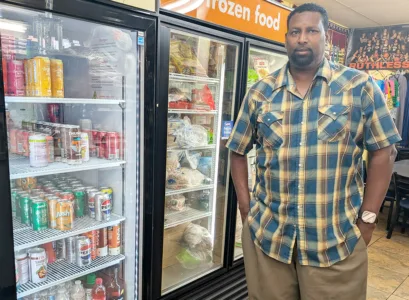
Ahmed Omar is proud of his family store in downtown Marshall.
"If you look at Google I have close to five stars," Omar told me.
I walked into the Hindi Grocery Deli store for the first time this week.
I remember when he spoke to the Marshall Noon Rotary Club, which I'm a member, a few years ago. He spoke of his family's migration from Somalia when he was just 8 years old to a Kenya refugee camp and eventually to Minnesota. Most of his immediate family eventually moved on from Marshall. But he and his wife, Sadia Salah, stayed raising eight children and operating their store.
Two of his boys followed in his footsteps when it comes to athletics at Marshall High School. Omar was a center on the basketball team.
"I was all right because I’m not gonna say I was the best or I’m not gonna say I was really good. I was coming from the bench, but still I was making my points," he said with a smile.
However, two of his boys were big-time Marshall High School athletes. The proof is plastered with newspaper clippings on a bulletin board in the front of the store.
"My son, he was a star, he was really good. Better than me," he said. "Every kid, they follow dad. You know what dad do?"
One of his boys eventually played football at Southwest Minnesota State University.
He also spoke of cultural foods he sells at his store and invited Rotary members to visit sometime and try out some of his deli cuisine.
While I didn't stay long enough to try any of those foods, I did learn a lot about the food from India, Pakistan and Asia.
First of all, the store entrance is kind of hidden in the back of the corner buildings along Main Street and College Drive. But come to find out, when it comes to these cultural foods, it's a hidden gem for a lot of customers.
"I sell, kind of culture -- different ethnic cultures -- you know, because we sell like Indian (foods). Most of our products (are) Indian, Pakistani, Asian. Most is like Asian food," he told me. "Back home they use the same ingredients. All Africa and Asia -- they kind of similar-type foods. They came from India or Pakistan that’s why all seasoning is similar. Even Middle East the same. Even the Somaliland, they use Indian stuff. All Africa they use it. Egypt, everybody use it. Same spice."
In America, of course, beef is No. 1. But Omar points out, in his culture, goat is No. 1.
"In Africa or Middle East, you know, goats are number one, so we sell more goat than beef. A lot of people they like goat meat. They cannot find at Hy-vee or Walmart," he said. "Most international students of West, you know, or other people who live in Ethiopia, West African, they usually come here to buy when other store doesn’t have it."
Omar gets his products from wholesalers in the Twin Cities.
Our conversation did tiptoe in politics of today. But he had nothing but praise for the people of Marshall.
"People, they complain. You know, people is people, no matter if you do good or bad, they still complain," he said. "One thing is, I care. Whoever is doing the country good, that’s all I care. I belong here. I want to be see good things. That’s all I care. I cannot be judge for other people."
Omar says his family is very religious in the Islamic faith. That faith, he said, is similar to Christianity.
When it comes to the current immigration enforcement movement in the U.S., Omar is more concerned with the summer-long construction project on College Drive.
"(I) lost customers to road construction. It hurt me so bad. That’s number one. It killed me," he said. "Even I talk to the city. They say it's not us, it's the state."
Before I left, I asked if he wanted to say something to the community of Marshall.
"Marshall, they treat us like family. And they help us like their own, you know like family So I will say Marshall people, everybody, I would say thank you very much,” he said.
With that, he poured me a small cup of tea to go which kind of tasted like chocolate milk. I’ll have to come back to try some of his food on the deli menu.