
Jones grew up community-focused; expects higher education changes
Trending
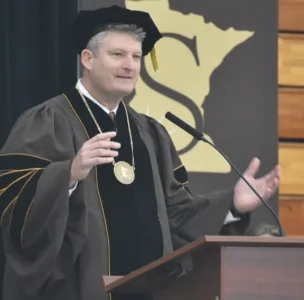
Back in late August I attended the Marshall Area Chamber of Commerce Business After Hours event at the suite level of the Schwan Regional Event Center. The event was hosted by the Southwest Minnesota State University Athletics Department.
After all the speeches and updates by athletic officials and athletes, everybody in attendance had the opportunity to mingle and enjoy some snacks and beverages. I spotted Dr. David Jones at one of the small tables set up for the event. At the time he was the interim president of SMSU. He has since been inaugurated as president. I walked up to him to introduce myself. After a short conversation I asked if I could have a sit-down interview with him. He handed me his business card and told me to contact his office.
Several weeks went by before I finally shot off an email to Jones. I received a prompt reply and the meeting was set up, which was held three weeks ago.
Our conversation addressed a lot of important topics. But before diving into those issues, I took the lighter side approach to find out who is David Jones and were did he come from.
While he spent a lot of his growing up years in Oswego, New York, Jones was born in Oregon. His father was a research professor and was working on a grant project to help school districts figure out curriculum in elementary school.
"Ultimately, that grant dried up. So he got a job in Council Bluffs, Iowa, working for the Area Education Agency in Iowa that helps school districts with curriculum. He's always worked in education K-12. He was a math teacher. My mom was a Spanish teacher. My grandma was an elementary school teacher," Jones told me.
He spent ages 5 to 12 in western Iowa, where he played soccer and basketball as a kid.
"In that part of the state, you're more likely to run into Cornhusker fans than Hawkeye fans," he said.
His father was an assistant school superintendent. After his parents divorced, his father moved Jones and his sister to New York, close to family.
"I remember it being a little bit of a culture shock from Iowa to New York," he said.
Taking into account his family's strong educational background, I asked him if he was a brain or an athlete?
"Definitely not the brain. I was maybe slightly above average, but not super smart. I've always had supportive parents. To your point, education was important. But I played sports year round, and just kind of love that. I've always been an outside kind of person. Soccer was my passion. I love that sport and basketball -- probably the two biggest," he said.
He was also active in Boy Scouts.
"Kind of community service focused," he said. "I worked at Boy Scout camps growing up and going through college. It was fun," he said. "Every Memorial Day weekend we'd go put flags in the cemeteries and we'd walk in parades, do highway cleanups .. It was just a natural thing you did. But that's not unlike any small community. Everybody pitches in."
Jones revealed more of his past, especially his path into his own educational career, but I'm saving those details for a part two to follow next week. There are just too many important issues that we discussed to fit in one column.
One of those issues is maneuvering through the budget challenges that most educational institutions face in this day and age.
"I was in a conversation with a president at a two-year school last week in the board of trustees meeting during lunch. It wasn't that long ago, where the state spent about 6% of its operating budget on higher education between the system and the University of Minnesota. Now it's closer to 3%," he said. "The pressures are different. Also, I think the state, we've changed what we value."
Jones said that for years the state was often looked as a beacon across the country.
"The K-12 system is always at the top and their higher education system is really strong. That's why so many schools come into Minnesota and recruit high school students out because they do really well. They got a hard work ethic and they're bright," he said. "And of course I want those in my school too."
Jones still believes in higher education as a pathway to successful life.
"We know from research that individuals who graduate with a college degree pay more taxes. They're more civically engaged. They tend to live longer. They tend to be more healthy. They cost less because of health insurance. Almost every measure you can think of is going to be a positive outcome," he said.
Jones is hoping newly elected officials will taken those positive outcomes when making budget decisions. But at the same time, he understands "a bit of a reckoning” needs to happen on what the future looks like for SMSU.
"I do think there is also a technology moment here," he said.
Classroom needs are different from when the campus was built, he said.
"It was overhead projectors. And we now have the ability to reach anywhere in the world through our phones or through whatever. So, I do think it makes sense that our system pauses and look at do we need 54 locations anymore? What makes sense and what can be taught remotely. The reality is, as we look at retraining people, almost everybody's not quitting their job and going to school. They're doing their job and getting a degree," he said.
"It's interesting in talking to most of these students. They almost all have part-time jobs, and they're a huge part of the local economy," he said. "Which is great because you start to build a work ethic from it, but I don't know what the real truth is. There's some who have some financial need. Others are doing it because everybody else is doing it. So if that's the case, then you need to provide classes that work with a work schedule. We gotta get better at doing that."
While the amount of students taking online classes is growing, Jones believes there will also be a need for the traditional on campus option.
"You know, the 18-year-old, 19-year-old coming to campus because their family did the same thing. They got either the means and the support to be able to do that," he said.
Next week I will share our discussion on the plans to build a dome on campus for athletic and recreation events, hopes to update campus housing and the decision to move the Homecoming parade to the campus.