
Vietnam War – Norman Teigen – Working with Chaplain Huebner in Vietnam
Trending
We have been learning about Norman Teigen, who grew up on the campus of Bethany College in Mankato, graduated from Mankato State College in 1964, and accepted an English teaching position at Marshall High School in January 1965. When his local draft board notified him in 1968 that he would be drafted, he enlisted in the Army and worked as a chaplain assistant at Fort Benning, Georgia, before being deployed to Vietnam in October 1970 where the Army assigned him as chaplain assistant to Lt. Col. Reginald Huebner, chaplain to the 1st Aviation Brigade, at Long Binh Post.
Norman described Chaplain Huebner's roles as brigade chaplain.
"The commander of the 1st Aviation Brigade was Brigadier General Jack Hemingway. Chaplain Huebner had an important role in the 'Commander's Program for Operational Stress Control.' As a staff officer he was responsible for advising the general on religious, spiritual, and moral matters. Chaplain Huebner's responsibility as brigade chaplain included looking after all of the chaplains and their work. He also performed religious rites and was available for confidential counseling. Chaplain Huebner answered to General Hemingway on Army matters and to his denominational (Lutheran) supervisor on ecclesiastical (church) matters."
Norman explained his roles as Chaplain Huebner's assistant.
"I was responsible for keeping the chaplain's office tidy and the paper flow going. He'd have requests for which chaplains in the brigade received awards and had to prepare a report. Chaplain Heubner conducted Protestant services every Sunday in the chapel. I mimeographed the bulletins, gathered the elements, and deposited the collection. It was an Army Protestant church. There had been Lutheran services at Fort Benning, but none at Long Binh. As a Lutheran, I was happy to be working with a fellow Lutheran and I believe he had the same feeling about me."
Norman chuckled as he described another duty in supporting Chaplain Huebner's mission.
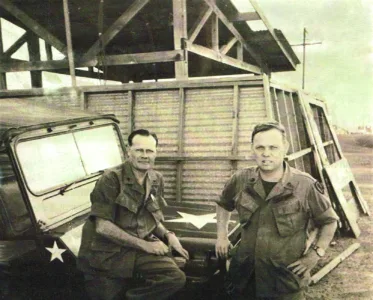
"I didn't know what to think when Chaplain Huebner first told me to take the Jeep in for service. I had no idea what was required, but I did as I had been ordered and went to the Motor Pool. Chaplain Huebner had assured me that the Motor Pool sergeant was a pretty good guy and that I could count on him for help. I was to change the oil, grease everything that needed to be greased, and check the tires. Changing tires was a problem in part because Army contractors were careless about cleaning up nails from work sites and we had tires with tubes. It was also a problem for me because I didn't know what a wrench was at the time."
Norman explained there were other reasons why changing tires was a problem.
"Tires and tubes were in short supply at U.S. Army motor pools. The reason for that is that Vietnamese (black marketers) would steal the stuff from the dock at Saigon and then re-sell it in these little, mini-stations along the road."
He explained how he became a relative expert at repairing the Jeep's tires.
"There were many times when I had to patch up the chaplain's inner tubes. I'd remove the inner tubes from the tires and then locate the leak by putting the inner tube in water. I'd scrape and dry the area around the leak and apply a patch that looked like a giant Band-Aid. Then I'd re-insert the tube into the tire, pump it up, and drive off."
He also explained his favorite duty days with Chaplain Huebner.
"I spent most of my days interacting with the chaplain, taking care of my minimal duties, and reading a lot. He was gone frequently, as his job was to get around the brigade and see what was going on. A real highlight of my time in Vietnam was when Chaplain Huebner told me to post a note on the office door that the office was closed for the rest of the day. He regularly invited me to fly along with him to various 1st Aviation Brigade units on business as a 1st Aviation Brigade staff officer. Maybe it was a change of command ceremony. I really didn't care. I was happy to get out of the office and see the country. Of course, we were never in a combat situation. We mostly flew in UH-1 Utility Helicopters or 'Hueys.' I probably had a couple hundred hours of flight time, none of it recorded. Chaplain Huebner and I saw bomb crater patterns from 1,000 feet. It was amazing to see what a pattern of bomb craters looked like from B-52 strikes. We also saw the flattened trees and large segments of vehicle tracks from earlier battles."
One such away trip brought Norman close to enemy soldiers.
"The only time I was near the enemy was once when I was in Pleiku. The only reason I knew they were enemy is because they were wearing a light blue uniform. They were working on a waterway like a drainage ditch because under the Geneva Conventions, we couldn't have them filling sandbags or things like that which could assist our military effort, but we could require them to work on civil support projects like water drainage."
Another away trip with Chaplain Huebner exposed Norman to some of the costs of the war.
"I remember going to a Field Hospital with Chaplain Huebner. It was somber. Those poor guys. From this experience I learned to value the care of Army medical personnel. I remember an Army nurse comforting a heavily-bandaged, delirious soldier who was calling for his mother. How sad."
Norman occasionally pulled extra duties in the barracks areas and made many relief trips to a nearby orphanage.
©2026 William D. Palmer.