
Vietnam War – Norman Teigen – Teaching and the draft
Trending
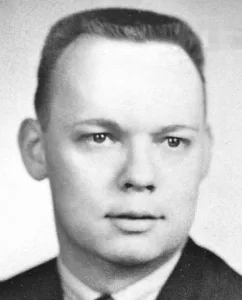
We have begun learning about Norman Teigen, the third of four children born to Elna (Tjarnagel) Teigen and Bjorne Wollen "B.W." Teigen. The Teigens' four children lived on the campus of Bethany College in Mankato, where their father served as college president. They also attended Lutheran schools on campus.
Norman completed an associate's degree at Bethany College before finishing a bachelor's degree at Mankato State in 1964, intending to pursue a teaching career. He completed his student teaching in the fall of 1964 and soon found a teaching position.
"Marshall High School had a teaching opening when a beloved teacher became pregnant. At that time if a woman teacher got pregnant, out the door she went. I interviewed for that position and began in January 1965."
Norman taught high school English courses during his teaching tenure at Marshall. He recalled teacher colleagues at Marshall High School that included Gerald Sletten, a history teacher, and Neil Engebritson, who was a librarian. He listed Lowell Zieman, Elmer Sorenson, and Fred Wikstrom as other teaching colleagues. He reported that the teachers had a Thursday night poker club, and although he didn't know how to play, he would occasionally join them.
But Neal was a young, single man who remained subject to the military draft in place to support the Vietnam War effort.
"I grew up in Blue Earth County, Minnesota, and was subject to a local draft board there. I got deferred multiple times for college and then got an occupational deferment for teaching. I took a mid-year position at Marshall High School and taught there for 3-½ years. By 1967 the war in Vietnam was going on heavily and the Selective Service System discarded automatic deferments for education and critical employment, giving local draft boards the discretion whether to extend or deny them."
The Blue Earth County draft board reached out to Norman about his eligibility for upcoming draft calls.
"When it became clear that my continued employment at Marshall High School might be in jeopardy, two local administrators, Stan Kroon and Duane Clites, wrote letters to my draft board on my behalf explaining that my role was essential. But they took me anyway and I was gone."
Norman chaperoned a student activity during that time of jeopardy with the draft board and that event seems strangely prescient in hindsight.
"Around 1967 and 1968 I had to appear before the Draft Board regarding my teacher deferment and students must have become aware of this because of what happened on a student bus to a basketball game. I was a chaperone on this student bus as the single guys took this duty to give the married teachers a break. I didn't mind it and enjoyed being with the kids. They were singing on the bus and one of the songs was this 'Hey Loddie, Loddie, Oh.' song. One of the kids joined on the verse by singing, 'I know a teacher whose name is Teigen, Hey Loddie, Loddie, Oh. He will soon be in Saigon, Hey Loddie, Loddie Oh.' I went to a Marshall class reunion once and shared that story with them. The boy who sang that verse was there and said, 'That wasn't me!' I told him, 'Oh, yes it was!' And they all had a big laugh."
He described his route into the Army.
"I got caught up in the machinery of the Selective Service and was drafted three weeks shy of my 26th birthday. (Early September of 1968) I feared becoming an infantryman so I became a DIV, a draft-induced volunteer. When asked what I would do besides being an infantryman, I said that I didn't care. I was assigned a Supply MOS (Military Occupational Specialty) 76Y and that was that. After basic combat training at Fort Campbell, Kentucky, I was assigned to Fort Benning, Georgia, where I didn't have anything to do. I just occupied space and breathed Georgia air."
But he did not realize that change was in that Georgia air.
"I received an order from Personnel to see Chaplain Barnett. I thought this meeting was for the chaplain to welcome a new person to come to church on Sunday. Chaplain Barnett and his deputy, Chaplain Miller, had other plans. They needed a chaplain assistant. My Personnel record had been flagged that I could read and write and was the son of a Lutheran pastor. I had been a high school English teacher for three-and-a-half years, so presumably I could type. I identified myself as a believing Lutheran, so Chaplain Miller dropped the bomb. Would I consider becoming a chaplain assistant?"
Norman was nonplussed, but the stars had aligned for him.
"I was stunned. I recalled the Biblical account of the angel telling Mary that she would be the mother of the Savior. 'How can this be?' she asked. My thought was something like: 'How can it be, Chaplain Miller, that I become a chaplain assistant when I am already a 76Y, supply specialist?' The chaplain told me not to worry about Military Occupational Specialty numbers and that he would arrange everything. So, I became a chaplain assistant, MOS 71M."
Norman began serving as a chaplain assistant at Fort Benning, learning the ropes of how to support the Chaplains in their mission of serving the troops and military families. Then his name came down on a fall 1970 levy for deployment to Vietnam. He departed the United States on an airliner full of replacements for units already in Vietnam and arrived in-country on Oct. 15, 1970.
©2026 William D. Palmer.