
Vietnam War – Norman Teigen – A new chaplain assistant in Vietnam
Trending
We have been learning about Norman Teigen, who grew up on the campus of Bethany College in Mankato, where his father served as college president.
Norman graduated with a bachelor's degree from Mankato State College in 1964, intending to pursue a teaching career. He accepted an English teaching position in January 1965 at Marshall High School. He enjoyed teaching at MHS for three-and-a-half years before receiving notice in 1968 that Blue Earth County was going to draft him into the Army. He volunteered for enlistment to avoid service in the Infantry and became a Supply Specialist at Fort Benning, Georgia. While at Fort Benning, a Lutheran chaplain recruited him to serve as a chaplain assistant.
Norman began serving as a chaplain assistant at Fort Benning, learning how to support the chaplains in their mission of serving troops and military families. He received overseas deployment orders to Vietnam in fall 1970 and departed the United States on an airliner full of replacements for units already in Vietnam. He arrived in-country on Oct. 15th of 1970.
He recalled one of his first impressions of Vietnam.
"The whole place stunk of fish, garbage, and JP-4 (jet fuel). I noticed it when I got off the plane."
Norman identified his unit of assignment in Vietnam and his individual duty assignment.
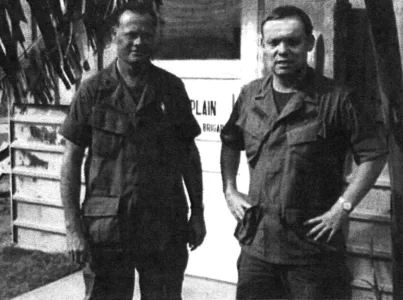
"I was assigned to Headquarters and Headquarters Company, First Aviation Brigade, at Long Bihn, Republic of Vietnam. Long Binh was about 12 miles north of Saigon and had been built early in the war. This assignment was at the top of the pole for the 1st Aviation Brigade, one of the largest combat units in Vietnam. My assignment was as chaplain assistant to the chaplain of the 1st Aviation Brigade, Lieutenant Colonel Reginald Huebner."
Norman described his barracks and living conditions at Sanford Army Airfield, part of the massive, Long Bihn Post.
"It was a wooden building. Inside were eight or 10 cubicles with two men in each cube. There was a bunkbed and a place to hang our clothes. There was a mini-refrigerator we shared for Cokes, beer, and whatever. Dirty clothes were washed by Vietnamese people brought into the base each morning. My turn came about once a week. My jungle fatigues wouldn't be pressed, but they'd be clean and dry. We had great food. I never had a bad meal (at the unit mess hall) in my time there. There was a common latrine. I think it served a couple of buildings. There were clean showers. When the Vietnamese civilians came on base each morning the women would do laundry and the men would clean the latrines. So, we didn't have to clean our latrines and didn't have to do KP (Kitchen Patrol)."
Although excused from KP, Norman and his colleagues had other extra duties.
"Every morning all the enlisted men in the area would go across the helipad to the offices. The first thing we had to do was line up and walk across the helipad to pick up cigarette butts and whatever else. The NCOs, whom we called 'lifers,' sometimes expressed dissatisfaction because we were all college educated and worked staff jobs."
Norman explained that, while he was a soldier and wore the standard duty uniform, his individual duty assignment limited the times he carried his assigned weapon.
"I wore jungle fatigues, a (green) baseball cap, and jungle boots. My weapon was locked in the Company arms room and I carried a card. I drew it (his assigned M-16 rifle) twice in nine months. Once we had an alert and I had to draw my weapon and some ammo. There were a couple of VC (Viet Cong insurgents) outside the perimeter. Two helicopters were looking for them. One was a Huey with a big searchlight and the other was a Cobra [gunship] higher overhead. I never saw the enemy, but at times I heard the Cobra firing its big gun. The other time I drew my weapon was for rifle practice. The company commander said there were many clerks around who hadn't had rifle practice for a long time."
Norman's duty days focused on supporting Chaplain Huebner's mission of providing religious support to the soldiers of the 1st Aviation Brigade and oversight of the other chaplains in the brigade who were scattered throughout South Vietnam with the Brigade's subordinate commands.
"The chaplain and I worked in a small building behind a much bigger office where others handled Brigade administration. Chaplain Huebner had a private, inner office with a door separating his office from my work space. I had a desk, a typewriter, a telephone, and file drawers. This office was across the street from a pad where helicopters landed at all hours of the day. I was working in an aviation unit, so I always attended to the sounds of helicopters. Today I can recognize a helicopter when I hear one in the distance. Across the street from the pad was the enlisted men's quarters."
Norman quickly developed great respect for Chaplain Huebner.
He was an outstanding officer and all the other officers respected him. The enlisted men always spoke respectfully about the chaplain and he always made it a point to talk to the men. I answered the phone, sorted the mail, prepared the chaplain's reports, and surprise, was responsible for the maintenance of Chaplain Huebner's beloved Jeep. How he loved his Jeep. He loved it because it was a means of getting out and about."
Norman soon settled into a work rhythm with Chaplain Huebner, but also began accumulating new and often interesting, experiences.
©2026 William D. Palmer.