
Trending
William Gieseke (Alt. Gieske) Sr. was born in Hanover, Germany, in September of 1831. He came to the United States when he was 17 years old. In 1861, he moved to New Ulm, where he lived for 22 years. During his residence in New Ulm, he served as sheriff of Brown County for nine years. In 1883, he moved to Sleepy Eye with his family, and the next year he and his partners founded the Sleepy Eye Milling Company. In 1892, he became interested in the mill in Marshall and then moved to Marshall. In 1901, he and his wife, Matilda (Roternund) Gieseke, moved to Los Angles, California. William Sr. died in L.A. on Feb. 23, 1905.
William's oldest son, William F. Gieseke, was born in New Ulm in 1869. He received his college education from Shattuck College located in Faribault. After graduation, he worked with his father at the Sleepy Eye Milling Company until 1892 when he moved to Marshall, and became a founding officer of the Marshall Milling Company with his father. He would later become president of the company. William F. and Ethel R. Paige were married in Marshall on June 11, 1894. Their home is on the National Register of Historic Places and is located on Sixth and W. Lyon (The house also served as the Cowin Hospital 1938-1940 and the Anna Maria Memorial Hospital from 1940-1950). Hugo Gieseke, the son of William Sr. and the brother of William F., worked at the milling company as a bookkeeper and cashier.
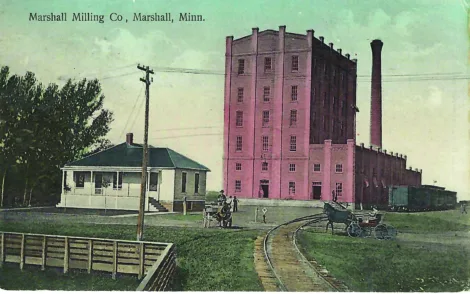
The Marshall Milling Company was organized as a corporation in 1893. The founding officers were William Gieseke (president), W.F. Gieseke (secretary), and A. Blanchard (treasurer). In 1900, the mill had a capacity of 400 barrels of grain daily, in which the chief brands were Marshall's Best and White Lyon. The mill shipped products to Iowa, Illinois, Wisconsin, Missouri, Nebraska, and Wyoming, besides supplying local trade. According to the Souvenir Book of Marshall, published in 1900, "A 200 horse power compound condensing Corliss engine furnishes the motive power, the condensation for which is effected, without the use of a pump by the natural pressure of an artesian well located on the premises and supplying approximately 600,000 gallons of water per day. The plant is also supplied with 50,000 bushel steel storage tanks supposed to be fire proof, and the whole mill from cellar to roof, is equipped with all the modern devices known to the trade." In 1928, the mill was sold to Swift and Company, a poultry plant.
The photograph featured this week is a colorized photograph postcard of the Marshall Milling Company, circa 1900.
The Lyon County Historical Society (LCHS) is a nonprofit, member-supported organization. LCHS operates the Lyon County Museum at 301 West Lyon Street in Marshall. The Lyon County Museum is open year-round to visitors. To contact us, visit our website: www.lyoncomuseum.org, call: 507-537-6580, email: director@lyoncomuseum.org, or on our Facebook page.