
Finding Laura
Trending
I've been reading the book "Prairie Fires" by Caroline Fraser.
I chose it for a couple of reasons. First was that it involves Laura Ingalls Wilder who, along with her family, lived at De Smet, South Dakota for many years. De Smet is about 40 miles west of our farm, so it feels like a direct connection.
Second was that some outfit called "Pulitzer" deemed the book good enough to be awarded one of their prizes. Whatever that's worth.
"Prairie Fires" - which has approximately the same word count as the Oxford English Dictionary - contains atomic-level details about Laura and her family including her parents, Charles and Caroline, Laura's sisters Mary, Carrie, and Grace, and Laura's husband, Almanzo Wilder. Rose Wilder Lane, Laura and Almanzo's daughter, was once the highest-paid female author in America.
Laura's childhood was nomadic. Charles moved his young family from Wisconsin to Kansas to Iowa to Minnesota and, finally, De Smet. Charles frequently risked his family's physical and financial wellbeing. While living in Walnut Grove, Minnesota, a locust plage left Charles so destitute that he applied for and received two half-barrels of flour from the state government.
"Prairie Fires" is thoroughly engaging. One thing that bothered me about the tome is that the author seemed to think that the Ingalls family should never have homesteaded in De Smet. The town lies perilously close to the 100th meridian; west of that imaginary line, according to Fraser, the land is too arid for agriculture.
I decided to drive to De Smet and investigate the validity of this perception.
The area around De Smet is freckled with numerous lakes, sloughs, and creeks. These features might have indicated to prospective homesteaders that the area receives adequate precipitation.
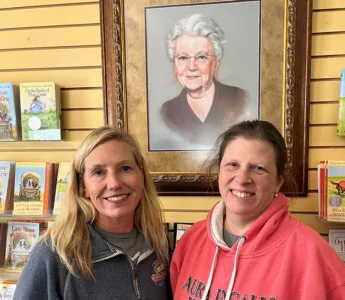
I went to the Laura Ingalls Wilder Memorial Society and visited with its Executive Director, Mary Jo Wertz.
"I fell in love with the 'Little House on the Prairie' TV show when I was a girl," said Wertz, who moved to De Smet from Pennsylvania three years ago. "Then I read Laura's books and fell in love with them."
I asked about the impact that Laura has had on De Smet, a prairie town with a population of about 1,000.
"We receive more than 10,000 visitors per year," Wertz said. "They come from all 50 states and 40 countries. We recently had visitors from Nigeria and Spain. It seems that India has just discovered Laura, and she has a huge fanbase in Japan. That began when Eisenhower sent a trove of 'Little House' books to Japan after the war."
I wanted a local farmer's point of view, so I chatted with Anne Aamot. Aamot and her family own a diversified farming operation located about a dozen miles north of De Smet. The Aamots grow corn and soybeans, have beef cattle and a flock of sheep.
I pointed out that Charles Ingalls had struggled to make living as a farmer.
"Charles was actually a good farmer," Aamot replied. "He was very successful in Wisconsin. The land here looks similar to Wisconsin, but the soil types and rainfall patterns are vastly different. Charles couldn't see below the soil's surface. He didn't have access to modern farming tools such as soil mapping, herbicides, and tillage methods that conserve soil moisture. The only thing he had for weed control was a plow."
"Charles was a skilled carpenter," Wertz said. "He never took their furniture along when they moved. He would simply build new furniture after they arrived at their destination."
I asked Aamot about Almanzo and Laura's homestead, which is located a short jog north of De Smet.
"Almanzo homesteaded on a gravel pit," Aamot said. "Nobody could make a go of it farming that gravelly ridge. Almanzo and Laura should have run sheep on their land. They managed to turn a modest profit the one year that they had sheep."
What about local land values and crop yields? Is the area's agricultural situation as bleak as Fraser seems to think?
"Kingsbury County land prices and crop yields can vary widely depending on soil types," Aamot said. "I've seen cropland sell for up to $7,500 an acre. On an average year, corn yields can range from 140 bushels per acre on the lighter soils to 200 bushels an acre on the better ground."
Laura and her family endured blizzards, fires, droughts, floods, dust storms, and countless financial hardships. But they always persevered.
"Laura's books reminds us of what we are made of and where we came from," Wertz said. "She teaches us about resilience and the importance of family and community, that we can make it through if we work together. Her message is something that everyone can relate to. And that's why she remains so popular."
-- Jerry's book, "Dear County Agent Guy," is available at Amazon.com and in bookstores nationwide.