
Uncovering war stories
Trending
The bulging white canvas bag arrived at my Nelson grandparents' farmhouse in late February 1946. On one side is Grandpa's address; on the other is scrawled "L.A. Nelson S1/c, U.S.S. Washington, 9th Div., FPO New York, NY."
Dad's Navy uniforms had come home.
My father, Leonard, joined the Navy in 1943 at age 17. I never asked Dad what motivated him.
Was it patriotism?
A sense of duty?
Or did he simply long for adventure?
Dad didn't share much about his war experiences. That was the way of his generation, but I think he was also shielding his children from the horrors he had witnessed.
He told us that during basic training at Bremerton, Washington, naval recruits who couldn't swim were told to step forward. The deepest water Dad had ever experienced was our farm's stock tank, so he stepped forward.
The supposed non-swimmers -- those who needed swimming lessons would miss out on the joys of marching in formation -- were herded to a swimming pool and shoved into the water. The men who sank to the bottom were hauled out and told to stay for lessons while those who bobbed to the surface were ordered back to the parade ground.
Dad told us things about his battleship, the Washington, that beggared the imagination. For instance, he related that the ship's armor plating was 16 inches thick. We kids didn't know much, but we knew that steel doesn't float. Dad was clearly pulling our collective legs.
He also said that the battleship's 16-inch guns could hurl a 2,700-pound projectile 24 miles. That had to be made up.
Dad described a special ceremony that was conducted for sailors who were crossing the equator for the first time. The transition from a pollywog to a shellback sounded like a hazing from hell.
During the Washington's operations in the Central and South Pacific, Dad manned a 20-millimeter antiaircraft autocannon. He brought home one of the gun's dummy rounds. It's the size of a bratwurst.
The Washington's antiaircraft fire was credited with downing numerous Japanese airplanes. No wonder Dad didn't want to talk about the war.
The Washington and other ships shelled Iwo Jima to soften up the island for invading American forces. Dad said that he later heard that the enemy had sat back in their tunnels and laughed at the futility of the bombardment.
I've lately been refurbishing my parents' farmhouse, which has been empty for some years. The most difficult part has been dealing with our family's memorabilia.
In a dusty shoebox I found the pages of a booklet that helped sailors identify Axis and Allied ships. Each page has a photo of a ship and includes detailed information about its armor and armament. At the top right corner of every page is a thumbnail denoting the ship's nationality: a rising sun emblem for Japanese vessels, a swastika for German boats.
Dad stayed on after the war ended and took part in Operation Magic Carpet, which ferried U.S. servicemen from Europe to America. During the return from England, the Washington encountered a ferocious storm. Dad said that the waves were 30 feet high, as tall as our windmill. This seemed like yet another unbelievable yarn.
The Washington and the aircraft carrier it was escorting were thought to be lost at sea. After making port, Dad went to a movie and was startled to see his "lost" ship featured in the newsreel.
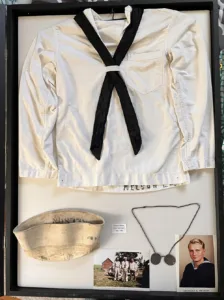
Dad's seabag had languished, undisturbed, in an upstairs closet for 80 years. I pulled his uniforms from the bag -- his undress whites and his dress blues -- and spread them on the floor. It was striking to see how small the clothing was. The waistband of the pants couldn't be more than 28 inches.
But Dad was only 17 at the time, not a boy and not yet a man. He was 5-foot-6 and weighed perhaps 120 pounds.
I agonized over what to do with these artifacts. There were two of everything, so I archived one white uniform and one dress blue uniform in shadow boxes. I decided to donate the other uniforms to the Brookings County Museum.
Dad would have said that he didn't do anything special, that there are thousands of other servicemen that deserved recognition more than he. But that's precisely the point.
Dad was raised on our family farm and knew more about how to rig a horse's harness than a ship's rigging. He was just an ordinary farm kid who became a tiny cog in a ginormous machine that defeated totalitarianism and made the world safe for democracy. His sacrifice and those of millions of other service people secured the freedoms that we take for granted.
And for that they should all be honored and remembered.
-- Jerry's book, "Dear County Agent Guy," can be found at Amazon.com and in bookstores nationwide.