
Country School Kids – Larry Van Moer – The Van Moer farm of Amiret Township
Trending
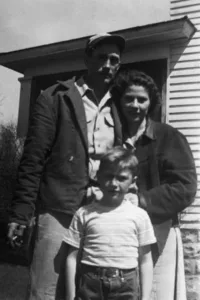
Larry Van Moer was born to Marie (Marcotte) and Herbert Francis Van Moer at the Tracy Hospital in Tracy on April 12, 1940. Larry was the second of the Van Moer's five children. The eldest, Joan (Halverson) was three years older than Larry. Charles Edward was four years younger than Larry. Like Larry, they were born in the Tracy Hospital. Larry's two younger sisters, Linda (Johnson) and Julie (Leese) were both born in Marshall hospitals. Linda was eight years junior to Larry and Julie 13 years younger.
Larry explained how his parents first met.
"They grew up in Amiret Township about two miles apart. They met when my dad played baseball on a team in Amiret as a young farmer. My mom would go with her sisters and others to watch those games. That's where Dad spotted her in the crowd (Larry chuckled) and that's how they started out."
He described the Van Moers' family farm.
"My dad and mother's farm was in Amiret Township, Sections 7 and 8. They had 200 acres. There were 160 acres where the buildings were and 40 acres across the road. It consisted of a farm site with a house and barn. It was a nice, big, five-bedroom house. My grandfather built that house in 1918. There was no electrical service to the place, but he had enough foresight that he had that house wired and plumbed."
His grandfather's foresight came in handy despite rural electrification not coming to area until after WWII.
"When I was a little kid, we had no electrical service and no running water. But the house was ready for electric so, they had a Delco, 32-volt plant with batteries in the basement on a rack, all connected to a little generator. My dad said that every so often they'd start a little gas motor and charge those batteries. They'd be good for a week or two. The 32-volt lightbulbs were better than candles or lanterns. Water got put in in 1949 when I was 9 years old."
Larry described more of his parents' farm operation.
"We had a barn, chicken house, hog barn, sheep barn, and a machine shed. When I left home, we were milking 25 cows. My dad had built a new barn in 1953, so we had a pretty nice barn. A cream truck came out of Marshall and picked up eggs and cream. They farrowed sows, probably 25 or 30 sows, and he'd market the piglets."
He explained that his folks put the sheep barn to good use in a livestock rotation system that maximized the value from every corn field.
"We had a few sheep. They'd keep the grove clean, and in the winter, we'd feed them a little. But in the fall, there weren't any combines, it was corn pickers. They weren't as clean a harvester as a combine, so a lot of corn shelled off the cobs in the field. All our farm fields were fenced. So, as soon as the first cornfield was done, my dad would order about 300 head of yearling lambs. They'd come in and he'd kick them out in that corn stubble if it wasn't snowing, and it usually wasn't. They'd clean those fields out. By the time they were done there, we'd have another field done and we'd move them into that field. So, not much corn went to waste. After that, we'd bring them into the yard and feed them shelled corn and some hay to get them through the winter. They'd sell them in the spring and do it all over again the next year with another load of lambs."
Larry's dad raised other field crops beside corn.
"He raised corn, oats, alfalfa, for hay for the cows, and flax. Flax was a good cash crop for a few years, so he put in a lot of flax. My dad also rented 240 acres a mile away, so he actually farmed 440 acres."
Larry's dad employed a farm dog to help on the farm operation.
"My dad had an old, white dog when we were kids. Dad would say, 'Rover, go get the cows.' Rover would take off for the pasture; find the cows; and bring them back. If we were doing something where we had to have gates open between the driveway yard and the barnyard and we didn't want to always open and shut that gate, like if we were going in with hay to put up in the barn, Rover would lay in that gate and we'd leave it open all day. No cows were going to come out. He was a good dog. Hopefully every farmer had a good dog because ours surely was good."
He employed other work animals as well when Larry was young.
"He was using horses, as I remember, until 1950. He sold them after 1950."
That year Larry's dad made major investments in mechanized equipment.
"When I was 10 years old, he bought a new tractor, a four-row corn planter, a two-row cultivator, a two-row corn-picker, and a small combine. This was because the guys he'd thresh with, going from farm to farm, were getting tired of that. They had trouble finding help, so they decided to buy a little combine and quit threshing. That's what my dad did. So, he went from a two-row corn planter, pulled with slow horses, to a four-row corn planter pulled with his tractor, which was much better than what he had previously.
Naturally, Larry the farm kid grew up with his share of farm chores.
©2026 William D. Palmer.