
Country School Kids – Larry Van Moer – Growing up on the Van Moer farm
Trending
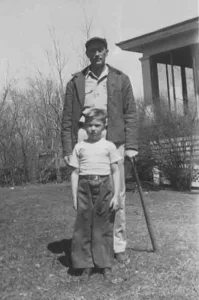
We have begun learning about Larry Van Moer, who was the second of five children born to Marie (Marcotte) and Herbert Francis Van Moer. Larry and his siblings grew up on their family farm north of Amiret
As a farm kid, Larry grew up with his share of farm chores. He described his earliest responsibilities.
"I started picking eggs. Those were my mom's chickens, so she had us kids pick eggs. You got pecked once and a while, but not if you were careful. Then we'd take them in the basement, wash them, and put them in cases. The grocery store in Amiret bought eggs. I think (Mom) bartered for groceries because he had a nice, little grocery store."
Larry's responsibilities grew as he grew older.
"As soon as I got old enough, I helped milking cows and feeding pigs. We had two milking machines, so you'd milk two at a time. They'd haul the milk to the house and into the basement where they separated the cream. We'd haul the whole milk back out and feed it to the pigs. The corner of the basement had a cement tank where cream cans would sit in cold, circulating, well water."
Larry's dad built a new barn in 1953 that significantly changed their dairy operation.
"When Dad built the new barn, he built a nice milk house on it. It had hot and cold water, a drain, and heat. A 250-gallon bulk tank was in there for the whole milk. Twice a week a truck would come from Russell and pump that milk out."
He enjoyed working with the milk cows.
"Those cows were pretty smart. We had 13 stanchions in the barn, so every cow would go in the same stanchion. There were 12 or 13 cows on the other side of the barn, so when these got milked, they'd have to go outside. You'd open the door and let the other ones come in and they'd go in their own stall every time. The other ones would go to that other section of the barn so they'd be warm. They'd stay outside in the summer."
Larry's first field work responsibility came early and illustrated both the value of draft horses and the slower pace of working with them.
"When I was six or seven my mother used to take a quart jar of coffee, wrap it in a towel, and say, 'Take this to the field where Dad's working.' Planting corn with horses was pretty slow. I'd come out to him and he'd say, 'Take it and set it in the grass by that fencepost about six fenceposts down. By the time I get there, (Larry laughed) I'll drink some coffee.'"
He described his first season of serious field work.
"When I was 10 years old in 1950 I thought I had the world by the tail because he bought a new tractor and cultivator and I cultivated all summer. (Larry chuckled) I loved it. It was a good machine and I'd cultivate two rows at a time. You had to cultivate three times. You had to go this way (Indicating going with the rows with his hand) and then this way (Indicating going across the rows) because they didn't have herbicides to get the weeds. The third time, you'd go the long way again because you wanted the rows smooth for when you had to go through with the corn picker. I'd run the corn picker, too. He had me doing a lot of jobs."
He also helped with baling hay. They used a skid behind the baler to help organize the bales.
"It had long teeth and you'd pull it behind the baler. It'd hold about six or eight bales and it had a rope trip. So, you'd be bailing and every time you'd come to this one spot, you'd pull that rope and all those bales would slide out. It had a spring and the door would slam shut and you'd just keep going. So, instead of stopping and picking up bales all over the field, there were small rows across the field. That saved time."
Larry also remembered some low-tech, field chores.
"When the farmers started soybeans, Dad planted soybeans. They had no chemical that you could use on soybeans, so you had to walk the beans. My younger sisters, Linda and Julie, would walk beans, too, chopping or pulling the weeds."
He was quick to acknowledge his least favorite field chore.
"Picking rock -- that was the worst! It had to be done, but every year it was the same -- more rocks. It was usually hot and a lot of rocks. If you didn't pick rocks, that's not good farming."
Larry was also quick to point out growing up on the farm involved more than chores and field work.
"Dad had a nice saddlehorse. It was a pretty, bay horse with a black mane and tail. My brother and I rode that horse a lot and we always had our bicycles. We had a creek running through the farm. We'd play in that creek a lot; my brother, my older sister Joan, and I. And when my dad built the barn, he let us put a basketball hoop up there. When we'd put up hay bales, we'd leave a (room-size) space by that basket so we could play basketball in the wintertime. The neighbor kids would come over. We also had a big hill out in the pasture that was great for sledding."
The Van Moer kids had other social outlets as well.
©2026 William D. Palmer.