
Country School Kids – Karen Drury Rafson – Moving to nearby Clifton Township
Trending
We have been learning about Karen (Drury) Rafson, who was born to Bertha (Weidauer) and Edwin A. Drury as the youngest of five children. Karen's early childhood was on a rented farm, the Herring place, in Stanley Township, east of Marshall. Her family later moved to a farm in nearby Clifton Township when the first farm owner's son, Roy Herring, returned from military service and wished to operate the farm.
"I would have been eight because it was in '49 and I was wasn't nine until November. We moved to (a farm) about 5-6 miles (east of Marshall) on Highway 19. It was the Voss farm at that time. My brother, George, bought the farm."
George owned the new farm, in a role reversal with his father, but their parents still lived with George and his sisters and helped on the farm.
"On the other farm my dad was (the principal operator), but George and Ed helped. They just went through 8th grade and didn't go to high school. They wanted Ed to, but he did not. So, they all farmed. Then (George and Ed) went into the service in '43 into WWII. When George came back, he farmed. Ed and Rose got married before he went in the service, but she lived with us the whole time that he was in the service. Then (Ed and Rose) bought a house on E Street and each of them got jobs."
Although her dad helped George on the new farm, physical challenges limited his assistance.
"My dad helped with some of the tractor driving and stuff. Then he got glaucoma. He was driving a tractor across the highway one time, but didn't really see and got hit by a car or truck. So, although he wasn't injured, he didn't do any more driving after that."
Karen described George's livestock operation.
"We had feeder cattle. We had pigs for a few years and after that, George just had all cattle."
She described their new home and explained how it was a work-in-progress for some years.
"It was just a plain, little, old house, but they built onto it. There was a bedroom down and three bedrooms upstairs. They had Heinie Miller put in a basement. They jacked up the house and put in a basement under it. But we still had the outhouse. It was a few years before we had a bathroom inside and then it was in the basement. Later we finally got one upstairs."
Karen is surprised that house is still on that farm place today.
"That same house -- that's there now. (Karen laughed) But they built a new one, too."
She explained her mother's and older sister, Grace's, roles at the new farm.
"We always had a kitchen garden and Mother had a flower garden, so she did that. Grace did all the cleaning and cooking. Mother also was a sewer -- I've got quilts, quilts, quilts. I learned how to sew from her."
Karen recalled that their new farmhouse abutted a tree-covered hill that overlooked Highway 19, which ran east and west immediately north of their farm.
"Many times, I'd go out and sit on top of the hill, just watching all the cars and trucks going by on the highway."
Karen was still young when the family moved to the new farm place, but her social opportunities, outside of family, remained limited to school and church.
"Mother didn't want me to be in 4-H, so I didn't get to be in 4-H. The Cauwel girls were in it and I would often help them with a few things. They had a hayrack party one time, but (Mom) did not want me to go. I ended up going anyway. I came back and she was pretty upset because they came and got me. But, oh, I wanted to go so bad, (Karen chuckled) so I disobeyed."
Her family also continued their occasional visits with extended family in the area and annual, Wiedauer family reunions.
"I remember going over to Aunt Emma and Alfred Anderson's or August Weidauer's and they'd come to our place at the farm. Every year Mother's side, that would be the Weidauers, would have a get-together in Okoboji, Iowa. We went year after year until it got to the point where a lot of them didn't come anymore and we quit."
Karen's family roles changed when she gained responsibilities on the new farm. She described one of her early chores.
"I picked a lot of asparagus from the ditches along the township roads." Karen laughed and added, "People would drive all the way up our driveway to harvest asparagus they saw growing on our place."
Her farm responsibilities changed as she grew older.
"I did a lot of mowing around the place, but it was only much later that they got a riding lawn mower. That made that regular job easier. I also drove the pickup pretty regularly, particularly during the sweetcorn harvest, when I'd drive it out to the sweetcorn lot and they'd fill it with sweetcorn. I did not get my actual driver's license until I was 17, but, like most farm kids, we were all driving around the farm much earlier than that. I'd also drive the tractors pretty regularly. I'd drive the tractor during baling season."
Moving to the farm in Clifton Township meant Karen would attend a different school which was located a few miles southwest of their farm. The District 28 school was south of Highway 19 on Lyon County 9, also known as the Amiret Road.
©2026 William D. Palmer.
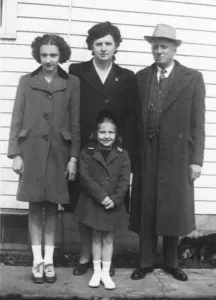
Pictured is Karen (Drury) Rafson, her older sister, Marian, and their parents outside their home on the Clifton Township farm, circa 1949.