
An airborne joyride
Trending
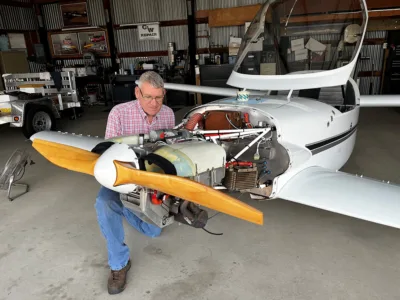
The exotic-looking gizmo sat on the tarmac, its bone-white paint gleaming in the summer sun. It's a peculiar gadget, with two wings that are roughly the same length. Oddly, its elevator is located at the front of the fuselage instead of on the tail.
It seemed out of place sitting on the ground. It looked like it belonged up in the air.
The aircraft, aptly named Dragonfly, is owned and piloted by Wayne Ulvestad. But he isn't just its owner; he also built the airplane, piece by meticulous piece. Not from a kit, but by following a set of instructions in a construction manual.
"I got interested in flying when I was a kid," Wayne said. "I began with building model airplanes, then graduated to remote-controlled aircraft."
Three local men jointly owned a Cessna 172 when Wayne was a youngster. They often used the grass runway located on what was then the outskirts of Wayne's hometown of Volga, South Dakota.
"Whenever we heard the Cessna coming in for a landing, my brother George and I would hop on our bikes and rush to the airstrip," Wayne said. "We'd talk to the guys who owned the plane and they often asked if we wanted a ride. I got a lot of plane rides that way."
A deep love of flying blossomed. By 1979, Wayne had earned his private pilot license.
Wayne's father, Marv, owned and operated a repair shop called Marv's Garage.
"My brother Clyde and I began to help Dad around his shop when we were kids," Wayne said. "We started out washing parts and were soon disassembling engines."
Clyde and Wayne eventually took over the business, renamed it C & W Repair, and shifted their focus to small engine repair. Marv continued to work in the shop with his sons.
"In 1980 Dad and I went to the EAA airshow in Oshkosh, Wisconsin," Wayne said. "We saw a Dragonfly sitting on the tarmac and knew that we had to build one."
Wayne purchased a set of plans as soon as they became available, in 1981. The Ulvestads launched themselves into a plane-building odyssey that would last for more than six years.
Wayne's Dragonfly is composed almost entirely of extruded polystyrene foam that has been covered with multiple layers of fiberglass and epoxy. Special templates had to be constructed to form the aircraft's structure. Specific types of fiberglass and foam were procured.
"We spent two years on the finish alone," Wayne said. "A local auto body guy painted the plane with 1966 Chevy truck white. I built a rotisserie for the fuselage to make it easier for him to paint it."
I asked Wayne how the F.A.A. fit into the picture.
"The Dragonfly is an experimental aircraft, so the F.A.A. issued me a repairman certificate," Wayne replied. "I'm authorized to conduct repairs on my Dragonfly and perform its annual inspections."
At first, Wayne's Dragonfly used a modified Volkswagen engine to spin its wooden propellor. That powerplant has been subsequently replaced by two different versions of a Jabiru engine, which is made in Australia. For each engine swap, Wayne had to reconfigure the aircraft's engine mounts and recalculate the center of gravity.
"The Dragonfly weighs 650 pounds empty, but its tailwheel carries just 17 pounds," Wayne noted.
I asked Wayne if he was nervous when he flew his Dragonfly for the first time.
"Its first flight was on April 15, 1988," Wayne replied. "A friend in Arizona owns a Dragonfly, and he let me practice with it for a few hours."
Wayne invited me to take a ride in his Dragonfly. He didn't have to ask twice.
Boarding the two-seat, side-by-side aircraft was a bit of a challenge. For a person of average height, getting over the cockpit's waist-high sill might involve a running start and a small trampoline. This isn't an issue for Wayne, who is quite tall.
The Dragonfly's seats resemble recliners and are quite comfy.
After a preflight check, Wayne pushed a button and the Jabiru sprang to life.
"This engine has the same ignition system as a lawnmower," Wayne smiled.
Following a short takeoff roll, the Dragonfly soared gracefully skyward. We were soon viewing the planet from 500 feet above. The ride was silky smooth.
At one point Wayne asked, "Do you want to fly it?" That was about like letting a blind man drive a racecar, but I replied, "You bet!"
I gingerly grasped the auxiliary control stick located beside the righthand seat and quickly discovered that just thinking about nudging the stick would change our altitude.
All too soon our airborne joyride was over, and the Dragonfly settled onto the runway.
Afterward, as I walked around the Dragonfly, I realized something. This isn't just an aircraft. It's a piece of art.
-- Jerry's book, "Dear County Agent Guy," can be found at www.workman.com and in bookstores nationwide.