Country school kids – Charlie Hettling – growing up on the family farm
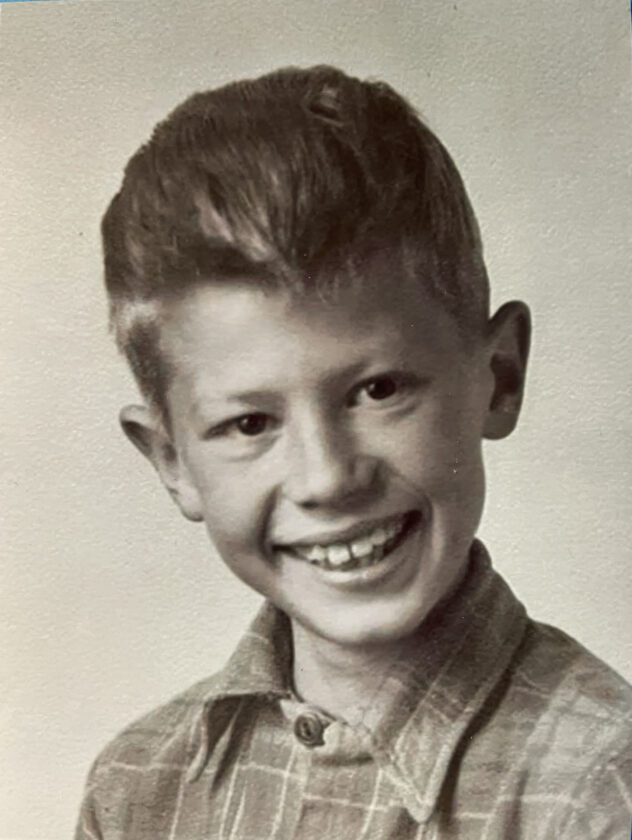
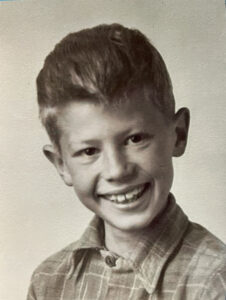
Charlie Hettling as a youngster, circa 1950.
We have begun learning about Charlie Hettling, the firstborn of five children born to Agnes (Jacobson) and Floyd Hettling, and his life on their farm between Minneota and Taunton. Charlie described the farm’s buildings.
“(It had) two big barns. They used loose hay, then, and you needed a bigger barn for loose hay because you couldn’t store so much in it. When you went to bales, you couldn’t fill them very full because it was too heavy. It was maybe only half full when you started baling because that was all you’d dare put up there. It was built for loose hay, not for bales.”
He continued his tour of the farm’s outbuildings.
“We had a granary and some corn cribs; a chicken house; and a pig house. There was a car shed and a shed for corncobs to burn in the stove. We always had plenty of cobs from shelling corn and we’d put them in there to keep them dry. Whenever we’d run out of them for the furnace, we’d just go out to get more cobs or wood. Our main heat was from cobs. Once the cob furnace started going haywire in the ’50s, we put in an oil furnace.”
Beyond their field crops of corn, oats, and hay, the Hettlings raised livestock.
“We had 15 to 17 beef cows, so we’d have about that many calves every year. Once we weaned the calves, we’d fatten them up. We’d raise 200 to 300 pigs; 300 to 400 chickens; and 30 or 40 sheep. Later on, we had a few geese. It wasn’t anything too big, but a little bit of everything.”
Charlie recalled he became a part of the farm workforce at an early age.
“I started picking eggs and feeding the cows just about right away, throwing hay down from the barn’s upstairs. You had to throw hay down three or four different chutes. Then, if it was nice, I helped clean the manure from the barn on Saturday afternoons. Dad backed the manure spreader in and we’d clean out the barn. I was often helping with something. We used to herd the cows in the road ditch because if we’d make use of that, we didn’t have to cut it. So, we usually herded the cows in the road ditch in the mornings.”
He explained that some of his earlier chores were closer to the house.
“Mom had a vegetable garden. We helped there a bit, weeding and picking stuff. We learned from her how to do those things.”
But Charlie’s young years also involved play and other activities. Fishing a local creek was a preoccupation.
“That was big. We’d walk there. We’d ride a bike to one that was a little further. Mom said, ‘If you want to clean it, I’ll cook it for you.’ So, if there was a big enough fish, we’d clean it. We’d always bring them home in a pail. The little ones that died we’d give to the cats. If little ones were still alive, we’d put them in the water tank. Some of the cats found out and they’d be sitting on top of the tank. (Charlie chuckled) You’d always see a cat sitting on the edge of the water tank, waiting for a minnow to come up so they could grab it. I either went fishing by myself or with my neighbor friend (Wayne Tellefson). We’d cut across country to the river. There was a big cottonwood tree so, if we were cutting across a corn field, we could always see the cottonwood tree and walk right to it. It was about a mile as the crow flies.”
Other childhood adventures centered around farm groves.
“We’d let our imaginations go. Sometimes we’d play cowboys and Indians. One of us would be the cowboy and a couple of us would be the Indians and then we’d switch off. We’d be chasing each other around the grove. One would hide and try to sneak up on the others. Sometimes we’d fix up an old wagon like it was a covered wagon. We’d be driving down and be attacked by Indians. We also made a bunch of slingshots. We practiced finding the right kind of inner tube for making them. We tried hunting gophers or birds with our slingshots. We never got anything, but it was fun going (in the grove) and pretending we were frontiersmen. My neighbors had a bunch of walnut trees, so we’d throw walnuts at each other. We found the stain from walnuts really got in your hands. That was when they still had the outside shell.”
He and his friends were also farm grove construction contractors.
“We built little houses out of scrap wood. My dad or grandpa would sometimes have carpenters fix a building. Some of their wood wasn’t good enough for the barns, so they’d throw it in a wood pile. We’d take those boards into the grove where we had a dugout and built our little house. You didn’t want to be in it when it rained, but we thought we really had something. We could barely get in the dugout, so we dug down to make it deep enough. So, it was maybe three feet above the ground and two feet below the ground. It was hard to dig because there were tree roots. But we thought we had a little play house we could go in. We had some old cans in there that were our dishes.”
But as Charlie grew, so did his farm responsibilities.
©2026 William D. Palmer.
Local Columns
How GreenCorp affects our region
This past September, Lyon County was awarded a GreenCorp member from the Minnesota Pollution Control Agency. ...
Five ways to reprioritize your finances this spring
For many, spring is the chosen time to clean out your home from the winter, so you can start fresh in the summer. ...
Marshall’s Little Dairy Queen treasured by several generations
It won’t be quite the same this summer on Country Club Drive next to the National Guard Armory. I learned this ...
School budget cuts should be equitable
Reading the Feb.19 Marshall Independent article about the final Marshall gymnastics meet was heartbreaking. Not ...
On the Porch