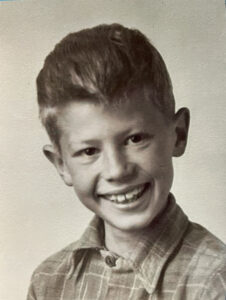
Country School Kids – Lois Paine Widmark – WWII service in the WAVES
We have been learning about Ivanhoe’s Lois Paine Widmark and her early life in western South Dakota and how the Great Depression and Dust Bowl drove her family back to her father’s home community of Lyons, Nebraska.
Lois graduated from high school in Lyons, Nebraska, in 1941 and found employment in Lincoln with family help.
“My Aunt Sadie was a big shot in the Republican Party. Through her, I got a job working at the state Capitol in Lincoln. Six of us changed the Health Department and the Motor Vehicle Department to a different filing system. After that, we had to find work elsewhere.”
Lois found employment in a defense plant.
“One of my girlfriends and I were working at the Elastic Stopnut factory, which produced nuts with a washer embedded in the bottom for making airplanes. We got a little tired of it because we had to work three shifts — rotating shifts. We went to the post office in Lincoln to enlist in the Marines, but they weren’t accepting anybody that day, (Lois chuckled) so we went across the hall and joined the Navy.”
Lois described her first steps toward becoming a part of the Navy WAVES (Women Accepted for Voluntary Emergency Service).
“When they called, we went to Omaha where we had our first physical. Then they put us on a train in a boxcar. You could see mail places on it and we sat on suitcases. One of the sliding doors on the boxcar was open. (Lois laughed) I don’t know what kept us from falling out that door.”
The Navy found the young women better accommodations in Iowa where they transferred to a train that had sleeping berths. The new recruits had memorable experiences aboard their troop train to New York.
“We went by Pittsburgh where they had Bessemer (steel) furnaces and we could see all these flames. None of us had seen anything like that! We went through Canada because they didn’t want anybody to know where the troop trains were. (Lois chuckled) We finally got there and they put us on buses to Hunter College in the Bronx.”
The Navy had converted Hunter College to an initial training station for WAVES. Lois was assigned to a training company of about 110 new recruits.
“They issued uniforms when we got there. It was like a big store. They asked us what size we wore and then pushed it through a window. (Lois chuckled) A lot of the clothes didn’t fit some of the girls. Mine wasn’t too bad. We had dorm rooms and had to share showers. We were late getting to muster once, (Lois laughed) but you can’t all get into that one shower. We didn’t do too bad at marching, though! (Lois laughed again) We learned fast.”
Initial training lasted a few weeks. Then the Navy sent Lois to Washington, D.C.
“Our barracks were WAVES Quarters D on Nebraska Avenue. Eleanor Roosevelt visited our barracks twice and we got to see her. I worked at the Naval Communications Annex across Nebraska Avenue from our barracks. Marine guards checked our IDs when we entered.”
Lois worked in a code-breaking operation, so security was tight.
“We were trying to break messages. I sat at a desk and helped other girls with these (decoding) disks. We broke one message and received a commendation for saving a ship. I didn’t really know what we were doing because it was so secret.”
Lois recalled a somber day in Washington and, later, a service highlight during a flag officer visit.
“I was there for President Roosevelt’s funeral procession. The most exciting moment was when I was chosen to “Pipe the Admiral Aboard.” I got to salute Admiral Halsey when he came to visit our workplace.”
The WAVES worked regular hours and had off-duty time to bond and explore the city.
“We used to sit around and (share) what we thought about one another. The most frequent comment about me was that I was quiet and shy. On our days off, we visited places like Mount Vernon and Lee’s Mansion. There was the zoo to visit; we went to movies; and we roller-skated. We’d ride the bus as far as it would go and then turn around and come back, just to see things. We saw the White House and the Capitol. We always wore our uniform, whatever the uniform of the day was.”
Lois visited home twice on leave.
“I came home when my brother came home from the Marines. And then I went home to see my baby sister when she was born in ’46.”
Lois reflected on her time in service.
“I enjoyed every bit of it and I would do it again, if I could. (Lois laughed) I thought everything I did was important. I learned I was able to talk to people. It was the first time I had any contact with Black people, Black girls. That’s the first time I even had to be aware that there were people of any color other than white. It didn’t bother me. I don’t care what color people are. They can be green, if they are nice people.”
When the war ended Lois continued to serve until her discharge in July 1946.
“After I was discharged, I could have gone back as a Civil Service employee. But I was from the Midwest and wanted to come back. That’s what I did and I went to two years of college on the GI Bill.”
Lois opened a new life chapter with greater confidence from her time in service.
©2025 William D. Palmer.
Local Columns
How GreenCorp affects our region
This past September, Lyon County was awarded a GreenCorp member from the Minnesota Pollution Control Agency. ...
Five ways to reprioritize your finances this spring
For many, spring is the chosen time to clean out your home from the winter, so you can start fresh in the summer. ...
Marshall’s Little Dairy Queen treasured by several generations
It won’t be quite the same this summer on Country Club Drive next to the National Guard Armory. I learned this ...
School budget cuts should be equitable
Reading the Feb.19 Marshall Independent article about the final Marshall gymnastics meet was heartbreaking. Not ...
On the Porch