
Ranchers last holdout against industrial animal ag
Is their future at risk?
Trending
In western Nebraska, where cattle outnumber humans, years of drought have battered the shortgrass prairie and Sandhills so relentlessly that the land is struggling to feed all of its cattle.
The seemingly unending dry spell, which has plagued much of the Midwest, is contributing to a historic cattle shortage that is pushing beef prices to record highs. A developing El Niño is currently bringing some relief, but drought persists in parts of the region.
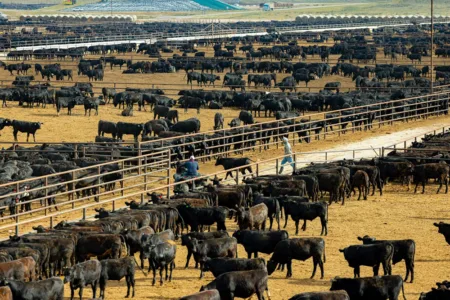
And yet, in the same parched landscape, hidden behind hills near Nebraska's border with Colorado and Kansas, the country's largest cattle feedlot -- Blackshirt Feeders -- is under construction.
A feedlot is where many cattle go after grazing on pasture and nursing from their mothers at the ranch. It's where they spend the final months of their lives, eating grain-based feed to put on weight before they are slaughtered.
Blackshirt Feeders, founded by three veterinarians and other investors, began operating in 2024 and continues to expand. Once completed, the facility could house up to 200,000 cattle from anywhere in the country. Annually, it would draw more than 1.5 billion gallons of water from the Ogallala Aquifer, which is currently facing record-low levels, and generate manure equivalent in weight to approximately 1 million pickup trucks. The project's scale has galvanized local residents, who have tried unsuccessfully to stop its development.
But there is another, less discussed feature of the operation: almost all of Blackshirt's cattle are born on dairy farms, not ranches.
A breeding practice that once played a limited role in beef production is gaining momentum. Known as "beef-on-dairy," the practice involves breeding dairy cows, typically Holstein, with beef bulls such as Angus. Rather than breeding all their cows for milk production, dairy farmers can inseminate selected cows with semen from beef bulls, producing calves raised for beef. While this practice is not new, genetic selection has significantly improved the quantity and quality of beef these crossbred calves can yield.
For now, beef-on-dairy is helping ease the cattle shortage. But its explosive growth in recent years has some ranchers worried that beef production will increasingly shift toward industrial dairy farms and away from ranches.
"This is a tremendous danger to the industry," said Bill Bullard, CEO of Ranchers-Cattlemen Action Legal Fund United Stockgrowers of America (R-CALF USA), an organization of independent ranchers. "It threatens the independence of U.S. producers, and it is going to further erode rural areas that are dependent on a vibrant and widely dispersed cow-calf sector."
In just a decade, beef-on-dairy calf production grew from 50,000 head in 2014 to 3.22 million in 2024, according to industry estimates. Beef-on-dairy cattle now make up an estimated 26% of the feedlot population. For consumers, this means that more steaks on store shelves may come from beef-on-dairy cattle, though there is usually no way of knowing from the label.
Despite this rapid growth, experts in the field insist that beef-on-dairy production will never replace traditional ranching, since there aren't enough dairy cows to meet demand. But projects like Blackshirt and other developments reveal that the industry is increasingly betting on the beef-on-dairy model -- a model that also comes with animal health and welfare concerns. Beef-on-dairy cattle typically live in confinement instead of grazing on pasture, while research shows that these animals are more prone to certain health problems.
"It's a confinement model from birth to plate," Bullard said. "It is going to facilitate the vertical integration of the industry by the largest beef packers and companies like Walmart."
The beef industry's vertical integration
In the U.S., ranchers own their cattle. Calves at the ranch graze on pasture and nurse from cows until weaning, typically at three to seven months old. Ranchers then sell their weaned calves, usually at live auctions scattered across rural America.
Some calves go to "stockers," who raise them for several more months on pasture or forage-based diets before sending them to feedlots. Others go directly to feedlots, where "feeders" put the animals on grain-heavy diets designed to fatten them up. Once the cattle reach the desired market weight, feeders sell them to meatpacking companies, or "packers," which slaughter the animals.
Ranchers, stockers, feeders, packers. The many ways these factions buy, sell and negotiate with one another -- and with retailers, distributors and other players in the industry -- has been described by economists as one of the most complex supply chains in the world.
For meatpackers, the system leaves much of the supply chain beyond their control, making it difficult to secure a consistent, uniform supply of cattle at stable prices.
Beef-on-dairy is changing that.
"The beef-on-dairy model closely resembles the vertical integration of the pork and poultry industries," said Mike Callicrate, a prominent Kansas rancher and business owner whose ranch is about 35 miles south from the Blackshirt feedlot. "This is exactly what the meatpackers want. They want to be able to control it all."
By removing ranchers from the equation, the beef-on-dairy model could open the door to the vertical integration of the beef industry -- or as ranchers often call it, the "chickenization" of the beef industry.
It is a system of control over the entire supply chain that Tyson Foods pioneered in the chicken industry in the 1950s and 1960s, and the pork industry adopted more widely in the 1990s. It gave meatpackers control over how animals are raised, transforming animal agriculture into a highly industrialized, standardized system in which companies coordinate production and animals typically live in confinement from birth.
The model is simple: The meat company usually owns the animals and controls every stage of production, from breeding and feed production to processing and distribution. The farmer owns the farm and equipment, assumes substantial debt and bears the financial risk. Companies can produce as many animals as the market demands and rely on farmers, bound by strict contracts, to raise them. By keeping the animals in confinement, companies eliminate the impact of unpredictable weather that is part of raising animals outdoors.
"The cattle industry remains the last frontier in terms of vertically integrating the industry," Bullard, from R-CALF, said. "It takes vast areas of forage to raise the mother cows and the calves."
The four largest meatpackers -- Tyson Foods, JBS, Cargill and National Beef -- wield enormous power in the beef industry, controlling about 85% of beef processing, shaping policy and influencing prices. But, so far, they cannot directly dictate when or how ranchers raise their cattle, or how much they are paid for them.
The open cash market of live auctions gives ranchers the opportunity to receive the highest possible price for their calves, a degree of leverage that commercial poultry and pork farmers do not have. That independence from meatpacking giants makes ranchers one of the last bastions of traditional American agriculture.
"There's barely any or basically no independent hog feeders currently," said Corbitt Wall, a well-known cattle market analyst who has built a following among American ranchers through his daily commentary on the cattle market. "I'm afraid that's going to be the way of the cattle, too."
The dairy industry offers meatpackers a way to bypass ranchers, live auctions and open pastures.
Most dairy farms already keep cattle in confinement from birth, and beef-on-dairy allows them to use the same infrastructure and supply chain to raise crossbreed animals for meat. The scale of modern dairy farms makes them a natural fit for the beef industry's growing demand.
Many of today's dairy farms are large industrial operations that use sophisticated technology and genetic breeding programs. The average dairy farm is now more than eight times larger than it was in 1978, according to the latest available Census of Agriculture data. Farms with 2,500 cows or more are increasingly common, as smaller farms continue to disappear.
-- Investigate Midwest is an independent, nonprofit newsroom. Our mission is to serve the public interest by exposing dangerous and costly practices of influential agricultural corporations and institutions through in-depth and data-driven investigative journalism. Visit us online at www.investigatemidwest.org