
Trump holds tense meeting with Senate Republicans after calling off bill signing
Trending
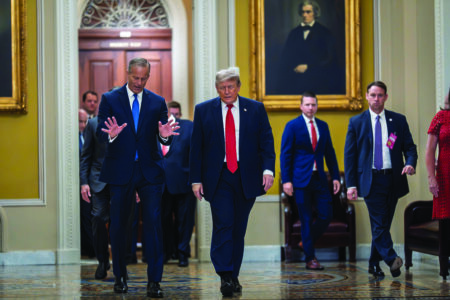
WASHINGTON (AP) -- President Donald Trump held a tense meeting with Senate Republicans at the Capitol on Wednesday after he abruptly canceled the signing ceremony for a bipartisan housing bill that GOP lawmakers have touted as a major election-year achievement.
Trump’s decision not to sign the bill capped weeks of friction with the Republican majorities in Congress. The president made it clear that, for now at least, he’s in no mood to compromise as he pressures the Senate to move forward with the voting bill, which lacks the support to pass.
Trump called it a “great meeting” as he left the Capitol, but noted his frustration with some of the Republican lawmakers.
“We like our leader. We like everybody, really, in the room,” Trump said. “I don’t like a few people but that’s okay, I think you know who they are.”
Republican senators were eager for a conciliatory meeting with the president after escalating tensions in recent weeks. But Trump upended their plans when he declared on social media that he won’t sign the legislation until they send him his bill to require proof of citizenship for all voters.
North Carolina Sen. Thom Tillis says he doesn’t know why Trump is holding the housing bill “hostage” for the voting bill that “will never pass in this Congress.”
“It makes no sense to me,” Tillis said as he walked into the luncheon.
Trump has pressed Republicans for months to kill the Senate filibuster and focus on the proof-of-citizenship voting bill even though Senate Majority Leader John Thune, R-S.D., has repeatedly told him that neither has the votes.
Asked about Trump’s post on the housing bill, Thune told reporters, “That was his call to make.”
“What I would say is that the bill is a bill that has been worked on for a long time,” Thune said. “It’s a great piece of legislation that increases the supply of housing and the availability of credit for people to afford homes. So it’s an affordability issue and eventually I hope he finds a way to sign it.”
The White House did not immediately respond when asked whether Trump would veto the legislation. But his apparent reversal on the measure that Republicans have touted ahead of the election is likely to only aggravate the deepening split between the president and his Republican majorities on Capitol Hill.
At the news conference, House Speaker Mike Johnson said he had spoken to the president for about 20 minutes earlier on Wednesday and expected the housing bill would still be signed.
Trump’s move on the housing bill is his latest reversal after weeks of being at odds with Senate Republicans.
Trump has blocked the Senate from confirming one of his own nominees, asked them to fund parts of his White House ballroom project despite opposition and forced them to defend his Iran war even as they question the strategy and endgame. And by rejecting a public bill signing, Trump is also indicating a level of indifference to voters’ affordability concerns heading into November’s midterm elections.
Trump has also helped whittle down his own support in the Senate after endorsing primary challengers to two GOP incumbents who were previously reliable votes for his agenda -- Texas Sen. John Cornyn and Louisiana Sen. Bill Cassidy. Both men lost their primaries and have since become more critical of the president.
“If we’re going to win the midterm elections, we need to get on the same page,” Cornyn said. “We’re not on the same page now, and that I think is dangerous.”
Adding to the tension is Trump’s increasingly distant relationship with Thune. While Thune remains popular in his conference and cordial with the president, he has spent much of his time lately telling Trump what he doesn’t want to hear.
Thune said Tuesday that while Trump and some in their conference want to see the voting bill pass, “it’s just not realistic.”
Trump has also demanded that they add a ban on mail-in ballots to the bill as well as unrelated provisions to block sex reassignment surgeries on some minors and prevent transgender women from playing in women’s sports.
Thune devoted weeks of floor time to the voting bill earlier this year and has said he supports it. But he has repeatedly said there aren’t enough votes to scrap the filibuster that triggers a 60-vote threshold to pass most bills in the 53-47 Senate. And Democrats are uniformly opposed to the bill.
“Those are just hard realities,” Thune said. “And I think people at some point have to come to grips with that.”
Johnson said Wednesday that he had talked through a different approach with Trump in his call on Wednesday morning -- putting the voting bill on a budget reconciliation measure that would only need a simple majority to pass. But the process is long and complicated, and Republicans are divided over how to proceed.
What Johnson has proposed is a federal grant program that would provide funding to states if they implement various SAVE Act provisions.
“We’re willing to invest heavily in that,” Johnson said.
But certain rank-and-file Republicans who want the SAVE America Act to become law panned that approach.
“I’m not saying I’m opposed,” said Rep. Chip Roy, R-Texas, a leader of the Freedom Caucus. “But let’s not kid ourselves that it would be full SAVE. It wouldn’t be.”
Only a handful of senators have questioned Thune’s rationale that the Senate can’t pass the voting bill. The most vocal in that group is Utah Sen. Mike Lee, a Republican who has amassed a large following on X with daily posts about how they should kill the filibuster and pass the bill.
“The push to pass the SAVE America Act is not a ‘fantasy,'” Lee posted over the weekend. “It’s a plan to avoid a nightmare -- one that’s coming soon unless we act.”