
Mellenthin farm survives 150 years of good and hard times
Trending
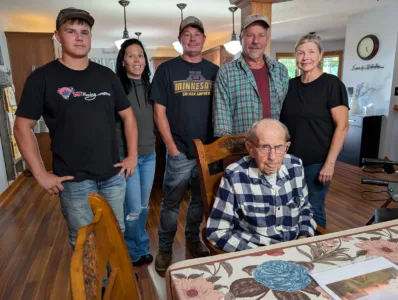
One-hundred-year-old Harold Mellenthin sat at the head of the dining room table inside the house on the family farm that is also 100 years old located in Lynd Township in Lyon County.
Younger members of the Mellenthin family sat along the table listening to the patriarch of the Mellenthin farming family share stories and history -- often times with a sense of humor.
Harold talked about the two German Lutherans "who didn't know any better" and came out from Wisconsin to stake out land in southwest Minnesota near the community of Marshall more than 150 years ago. And then stared at his family members in front of him.
"Now what I'm enjoying, is this vast bunch like them. They all got families. They're all growing in 100 different directions. They're all doing real good," he said.
His son Jon, and his wife, Pat, sat next to him, while their son, Cody, his wife, Mandy, and son Tate also shared stories about living on the farm and keeping the agricultural operation going. There are no plans of slowing down, according to them. Cody plans to slowly take over farming operations from his dad, while Tate has farming plans as well.
"I'm the happiest probably to say that using the name (Mellenthin), it was the name that stayed the same for almost 152 years. It was always a piece of Mellenthin ground. And all of these families I'm talking about took their share of it," he said.
A printed page of family history kept protected in plastic was on the table in front of him.
"In 1878 Fred and August Mellenthin signed a contract to purchase two 80-acre parcels of land located in the SW quarter of Section 9 in Lund Township in Lyon County, Minnesota," it stated. "Each brother established farms and added additional acres of land over the next several years and in about 1910-13, August decided to sell his interest to Fred, who accumulated enough acres so that in about 1915-20 each of Fred's children were provided 240 acres to start their families, who farmed their parcels until the 1950s when the individual families went their own ways. Ernest Mellenthin's land included the acres originally purchased by Fred and August.
"In 1950, Harold and Elaine Mellenthin began managing the land held by Ernest. Jon and Pat Mellenthin began farming the 240 acres held by Ernest Mellenthin in 1980. In 1988, Jon and Pat purchased the 80 acres that was part of the original homestead from Harold and Elaine. They continued to farm this land and the two other 80-acre parcels owned by Ernest Mellenthin and now owned by Matt and Joel Mellenthin (sons of Arthur Mellenthin) and Sean Maloney, son of Arlene Mellenthin. Along with their youngest son Cody, Jon and Pat have purchased and rent additional land in Lynd Township now down as "Farms by Mellenthin."
"Jon, Pat and Harold continue to live on the farm site, originally homesteaded by Fred and August Mellenthin back in 1879, and where Harold was born in 1925."
Harold continued to share his stories at the dining room table, expanding on the story of the two German brothers from Wisconsin.
"Those two 80s of land are here today. They were then and ever since they have been infested by Mellenthins. The story goes through probably six generations. But in the years ahead of me, my parents were both born right here where we can see this. One was born right there," Harold said pointing one way. "And the other was born over there where we can see this."
Elaine died at the age of 81 in 2012. In an Independent article about his 100th birthday, Harold was quoted as saying he and Elaine had 62 "real happy years" together.
Besides Harold, Elaine was survived by her four children, Deborah, who lives in Wyoming; Jon; Polle of Marshall and Scott of Marshall.
"Let's go back to when I was born," Harold said while still sitting at the head of the table.
"I get up on the farm here, just like we're talking about. But then here comes that crises of 1950. Married, this and that, and they let me out of the service (National Guard during Korean War and stationed in Georgia). Come back on the farm, got married and here comes the family. Had to do something to keep food on the table. The farm wasn't that big necessarily. Never provided a tremendous amount of cash. So I was forced -- not forced -- doing about 20 years with the soil district as an aide," he said. "Never leaving the farm was always the key and it grew this whole family. And they all did very well."
Harold also continued to show his sense of humor.
"As the got along, but these two (pointing to Jon and Cody) are dumb enough to keep on farming," he said.
And actually, Harold was a soil conservation district board member for 22 years, from 1962 to 1995.
Independent columnist Bill Palmer has written about Harold. In one of the columns, Palmer wrote:
Harold shared one survival method farm families used, "We all had cows and we had some chickens. For a little grocery money, you took a crate of eggs in. The grocery man bought the cream and he bought the eggs and he transferred it into the things you needed that you didn't have. This generally happened on Saturday."
He also wrote: Harold also described a government program that brought some relief, "In 1933 (the government) came with a corn and hog program ... gave them permission to come out on the farm and ... buy a hog and farmer got paid. My dad sold I think five or six that way. He could document it and go in and ... get reimbursed for that. The fellow that came out from town signed a paper and he actually got the hog for ... I think it was a dollar.
In the 100th birthday story in the Independent, Harold described those years as "difficult times."
During the years of drought and the Great Depression, Harold was quoted as saying "You couldn't even sell corn."
Back at the dining table, Harold recalled that growing rutabagas and turnips kept the cows alive.
"He sat in the basement of this house, he told me many times," Jon said. "And sliced rutabagas."
In the years that followed, Harold said wheat was grown.
"He was nearly middle aged and soybeans were not heard of," Jon said.
"I've got soybeans sprung up in that 100 years. We've somewhat went back to feeding cattle with grass and alfalfa and this and that. Whereas the first farmers that was here needed pasture for the few cows they had," Harold said.
"And you had Herefords, right?" Pat asked.
"Dairy wasn't the name of the game probably here, but it was a matter of survival," Harold said.
While large, modernized tractors are presently parked in the barn behind the house, Harold recalled the days horses were used to farm.
"What were the horses names," Pat asked.
"Prince and Charlie," Harold said. "Prince always led the way."
Jon shared how technical farming has become today.
"We're all getting into tech," Jon said. "It's all auto steer and precision. And he's (Cody) really good at IT (information technology). But the grandson (Tate) is probably going to go into that as a sideline career. Because it changes so fast and keeping up with the technology."
Cody says keeping with the inputs is "insane."
"We used to worry about yield, yield, yield. We want it to yield and now it's ROI (return of investment). If we can't pencil that out, we can't do it because it's just there's so much money dollars involved compared to 2 cents a bushel. We get a bump in prices once in a while, but then all the inputs go up. The chemicals, the fertilizer, the seed, the rent, the fuel -- everything eats it up."
But Cody adds that farming is in the family's blood.
"Even if weren't making money. Like I always was taught and I've tried to teach my kids. If you can make money three out of 10 years, you're doing pretty good. The rest is just kind of building equity and hanging out and waiting for that opportunity."
Despite all the challenges, Pat said the farm is important to the whole family.
"Number one priority is keeping this sixth generation farm a Melenthin farm," she said.
Harold's grandson, Tate, says he's up to the challenge.
"I grew up in it, so it's all been kind of that's how it is for me," he said. "I guess to any other person, it's something special they can't relate to. I love doing it and I think that's why I'm still here. Otherwise, be just like my brothers and cousins. Doing their own thing."
While Harold no longer participates in the Mellenthin farming operation, he can watch from his "in-law" suite connected to the main house.
"They gave me the best part of the house," Harold was quoted in an Independent story on his 90th birthday. "I can see everyone working."
And actually, Harold is pretty much located in the spot he was born inside his boyhood home that was built in 1917, but demolished more than 10 years ago.
"He almost literally sleeps in the same place where he was born," Jon was quoted in the article.
In that article, Harold said he lived through good times and hard times.
"All I can think of is, I'm a survivor."
And the Mellenthin farm and it's history survives as well.