
‘It’s about memory’
Ghost Shoes art project marks ICE arrests in Marshall
Trending
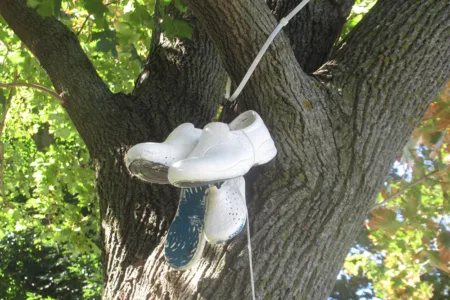
MARSHALL -- You might see them as you pass down a street in Marshall - a pair of painted white sneakers hanging from a tree, or fastened to a light pole. Each pair of shoes represents a person detained by U.S. Immigration and Customs Enforcement (ICE), Laura Migliorino said.
"It's about education, and memory," said Migliorino, a Minneapolis-based artist and photographer. This year, she has been working with volunteers across Minnesota on ICE Ghost Shoes 26, an art project bearing witness to ICE detentions and acts of violence.
This week, Marshall became one of the communities around the state where "ghost shoes" have been installed.
Migliorino said the idea for the ICE Ghost Shoes 26 project had a few different influences. During the surge of ICE operations in the Twin Cities last winter, many local artists were finding ways to respond or bear witness to what was going on, she said.
"I thought about the remembrance part of it. A lot of my work is about history and remembrance," Migliorino said. She thought of a Holocaust memorial in Hungary that was made up of bronze shoes representing people killed, as well as of "ghost bike" roadside memorials used to mark the sites of fatal cycling accidents. Those ideas came together as "ghost shoes," marking sites where people were taken or harmed by ICE in Minnesota.
Migliorino was awarded an Artists as Witness grant from FORECAST Public Art, to place 150 pairs of ghost shoes around the Twin Cities. She later received a grant from Springboard for the Arts, to place an additional 50 pairs of shoes in greater Minnesota.
While the Twin Cities ICE surge received a lot of attention, "The stories coming out of outstate Minnesota were just as egregious," she said. One example that got media attention was an incident in Willmar, where ICE agents visited a Mexican restaurant for lunch and then later returned to detain restaurant workers.
While Migliorino said she believed there were proper ways of enforcing the law, the actions of ICE agents were hard to fathom.
"I don't understand why somebody would want to do this to another person," she said.
Migliorino researched incidents where ICE detained or harmed people in Minnesota, using sources including media coverage and People Over Papers, an online tool that tracks crowdsourced information of ICE sightings across the U.S.
Marshall area residents used the online tracker to report ICE arrests in the area of South Fourth Street and South Fifth Street in January, when ICE activity was confirmed in the city. Another arrest, of two people, was reported on the tracker in April outside the Stone Meadow Apartments. Ghost shoes were installed near all three locations in Marshall.
Migliorino said she held shoe-painting events, and reached out to friends and other artists around the state to find local volunteers to install pairs of shoes.
"A lot of it is word of mouth," she said.
Each set of shoes is marked with a tag saying who was taken from that location, and a QR code leading to the project's Instagram page.
Migliorino said she hopes to have ghost shoes in place in Minnesota communities like Worthington, Willmar and Mankato, "before the snow flies." Tags on the shoes ask cities to contact the project if the displays are against local ordinances, but so far there hasn't been resistance to the art project, Migliorino said.
She said she'd like for the shoes to stay up for a while, but "What will live on is all the photographs," of the project.
More information on the ICE Ghost Shoes 26 project is available online, at https://iceghostshoes26.com/. Photos of the project are also posted on Instagram.