
Why Marshall?
\\\'That\\\'s where the good people\\\\\\\' are, former exchange student recalls
Trending
MARSHALL -- When Argentinian high school student Belen Olmedo Guerra signed up for the exchange student program through Rotary International during the mid-1990s, she was envisioning a journey that would take her to Thailand, Australia or Bangladesh.
"I wanted to ride on elephants. I wanted to be in the jungle. I wanted to just be in the wild," Guerra said.
But after going through the application process, Guerra was told by the program's chairman that she wasn't going to the jungle.
"He said, 'No, you’re going to District 5610.' I was like, OK, where is that? He said, 'it’s in the United States.' I was like, ‘in the U.S. I’m like, I can always go to Disneyland.’ He said, 'well, you’re going to a different place. You’re going to Marshall.' I said, 'OK, where is that?'” Guerra said.
The chairman said the map he had didn't even show Marshall.
"So he took a pen and he drew a dot. He’s like, 'That’s where you go.' I said, 'OK.' Little did I know what that would mean," Guerra said.
She stood before members of the Marshall Noon Rotary Club last month and shared what that exchange student chairman told her when she asked him why Marshall?
"Because you are a good person and so you have to go where the good people in the world are," he said to her.
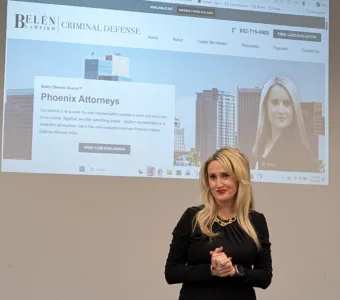
Guerra, who is now a criminal defense attorney in Phoenix, Arizona, returned to Marshall and addressed the Noon Rotary Club on Aug. 4. Two of the club's members, Chuck Lindeman and Paul Stoneberg, were her hosts back in 1995-96. She lived with their families at different times as an exchange student. She also attended the weekly Rotary meetings with her hosts.
"I went to Marshall Senior High School," Guerra said. "My first host family was Paul and Joanne Stoneberg. My second family was Carol and Rodney Tholen and my third family was Chuck and Monica Lindeman. Each family was incredible and welcoming. They never made me feel like an outsider. Everybody integrated me in every way possible."
Guerra recalls that she did have to adapt to a different climate, but her host families helped her in every way possible.
"Joanne Stoneberg and I went shopping. We got a lot of things that I needed, so that gapped the bridge pretty quickly. I love the snow and love snowshoeing. I learned a lot about hunting from Paul because he's an avid hunter,” she said.
Guerra said her mother patiently waited for her return after the student exchange year finished. However Guerra received scholarship offers to attend Southwest Minnesota State University.
"I had to go back and convince my mom," she said. "My undergrad, I wanted to be in paleontology. I always wanted to study dinosaurs and go into digs. Because in fifth grade, I read a book about Darwin and evolution and all that stuff. I was like, I want to dig up bones. So I went home. I had some ugly discussions with my mom. She said, 'Well, you said it was a year.' I said, 'Well, it’s four more. I’m coming back.' So I came back to to SMSU, but then my very first day when I went to class, they didn’t have any paleontology classes. So the very first class they signed me up was for anthropology.
"This is what I was supposed to be studying. It wasn’t animal bones. It was humans and humans alive, and so it all clicked," she said.
Guerra also worked as a victims of domestic violence counselor at New Horizons Crisis Center in Marshall.
She continued her education at the University of Arizona in Tucson and looked for similar work that she did with New Horizons. She worked with victims of domestic assault and later became interim director of the organization.
She decided to pursue her master’s degree in education. She later took a job as teacher at a middle school known for "great violence."
"It's probably not safe for you to work here," she recalled being told.
"I literally had my binder of like the social resources that I took to my classroom. So the kids were hungry; they were not able to shower, and it was a school that was out in the county, kind of forgotten geographically, out of sight, out of mind," she said. "It was in between two Native American reservations and a local small community. So I’m always up for a challenge. So I was like, 'OK, the school right before I arrived had been in the front page of the newspaper as quote unquote, the worst school in the state. The reading scores, were down. It was terrible. It was underperforming. So we created some committees. Committees of everything: literacy, culture."
Eight years later, the school was again in the newspapers, Guerra said.
"Yours truly was in the front covers, and we went from underperforming to performing to excelling," she said.
She returned back to school to get a law degree and eventually worked as a public defender in Phoenix and later worked for private firm and later opened her own law firm.
"I’ve been doing criminal defense. So if you’re ever in Arizona and you have a murder case, any kind of sex case, ... I’m very respected in the community, and there are not that many women who do criminal defense. My office is open 24 hours a day. It started with just me. Now I think I have nine full-time employees looking for another lawyer. And so we work 24 hours a day. Major crimes, anything that’s white collar, misdemeanors, anything like that. I personally handle only felony work. My other lawyers handle the other cases,” she said.
Guerra told the Rotarians that her journey was not easy.
"I’ve been on my own since I was 17. Sometimes people say, 'Oh, the American dream. People come and take our jobs and yada yada,' But it has been very hard. I only became a citizen in 2014, after almost 20 years. I put myself through three college degrees of my own. No financial help from my parents. I took loans and paid them off. All my loans are paid off, including my law school. There have been very difficult times. It’s been a great success, but it has taken a lot of sacrifice. There were times that I even had to sell my furniture to buy my groceries, but I don’t regret a single thing at all,” she said.
Guerra said she made many friends among the other exchange students who arrived in southwest Minnesota.
"They were in Slayton, they were in Luverne and Worthington -- they were in all the small towns around. And they all went back to their countries and they’re all doing incredible things and they’re still in touch," she said.
Guerra also encouraged the Noon Rotary members to consider hosting an exchange student.
"I'm still in touch with the (host) families and I hope we get more (exchange students) years to come and hope to inspire other people to take the chance to host another student," she said.