
Internet program for schools, libraries under review
Federal E-rate program helps with funding
Trending
MARSHALL -- Internet access has become a vital resource for public school districts and libraries. It's something that goes beyond the classroom too, Marshall Public Schools staff said last week. Everything from communications and security systems to HVAC systems in schools also use internet connections.
"It's not just about the internet. It's the connectivity," said MPS Director of Operations Tricia Stelter.
Education and technology workers said that's a major reason why they're concerned that the Federal Communications Commission is reviewing the federal E-Rate program, which gives schools discounts on internet service. Earlier this summer, the FCC said it will take comments on ways that the program can be updated - including whether it should be reformed or eliminated.
In a June statement, FCC Chairman Brendan Carr said the proposal was "aimed at empowering parents and ensuring that our E-Rate program produces the great educational outcomes stakeholders have intended." In his statement, Carr also said increased screen time for children may be linked to negative performance at school.
"It's a little bit of an uneasy time," said Josh Sumption, chief technology and information officer at Southwest West Central Service Cooperative. Sumption is also the state E-Rate coordinator. He said he was concerned about the comments trying to link E-Rate cuts to reducing screen time for kids.
Sumption said about 32 school districts across southwest Minnesota, and most of the libraries in the Plum Creek regional library system, are affected by the E-Rate program. On average, they receive a total of about $2.24 million a year in E-Rate funding, he said.
Sumption said the E-Rate program has been "an equalizer" for schools and libraries around Minnesota.
"It's just helped level the playing field, and gives everyone the chance to connect up," he said.
Staff from both Marshall Public Schools and SWWC said E-Rate funding has a big impact on area schools.
MPS Technology Director Todd Pickthorn said that, in the 27 years he has been with the school district, "E-Rate has been an integral part of making sure we have internet access."
The federal E-Rate program was started in 1996, and is funded through the Universal Service Fund, Pickthorn said. Program funding goes toward two major categories. Category 1 funding gives school districts discounts on the cost of internet service, based on the percentage of students in the district receiving free or reduced-price meals, Sumption said.
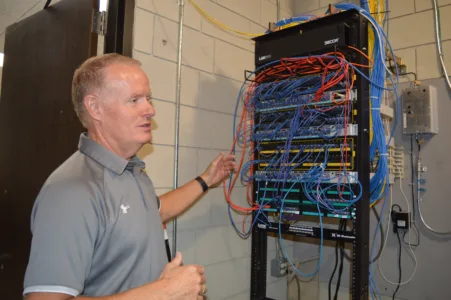
Category 2 funding focuses on internal connections within a school district. Cabling, switches, and wireless access points within a school building would fall under this category, Pickthorn said. Category 2 funding is allocated on a five-year budget cycle, while Category 1 funding is annual.
Sumption said the amount of E-Rate funding school districts receive for Category 2 may fluctuate from year to year, depending on when districts update their technology.
E-Rate funding has a major financial impact for MPS, Pickthorn said. The district received a discount of more than $27,000 for Category 1 in the past year. The Category 2 allocation over a five-year term came to about $588,000, he said. The Category 2 funding broke down to about $201 per student at MPS, he said.
MPS Superintendent Jeremy Williams said internet access had important educational uses in the school district. "A lot of our curriculum is online now," he said. For example, the Career and Technical Education programs at MPS use online textbooks and curricula.
Pickthorn said E-Rate also goes a long way in helping schools with the "behind the scenes" work of keeping their technology and networks up to date and secure.
"If the funding were to go away, that network infrastructure will age," he said. "I really feel it's a necessary thing, for schools to keep current."
Marshall-Lyon County Library Director Michele Leininger said the Marshall library location receives its internet access through the city of Marshall's internet franchise agreement, and does not use E-Rate funding. However, she said, MLCL does receive E-Rate funding for its Balaton and Cottonwood library branches, through the Plum Creek library system. They also receive Regional Library Telecommunications Aid through the Plum Creek system, she said.
"We are really grateful," Leininger said. Internet access can be an expensive cost for libraries.
All together, schools and libraries in southwest Minnesota receive an average of about $2.24 million per year in E-Rate funding, Sumption said. Sumption said that total included both the annual Category 1 allocations for the schools and libraries, and their average five-year budget allocation allocations.
Sumption said there could be some positive ways to update the E-Rate program, after 30 years. But eliminating the funding would hurt schools' ability to pay for internet access and equipment.
The FCC said comments on the E-Rate program are due Oct. 13, and replies are due Nov. 12. Advocacy groups like the Schools, Health & Libraries Broadband Coalition have online resources, and steps on how members of the public can comment on the FCC proposal or contact their elected officials, at saveourerate.com.