
Farmers dealing with ‘tight margins’
State of Ag panelists report ‘mix bag out there’
Trending
MARSHALL -- What is the state of agriculture in southwest Minnesota? It depends, speakers at an event in Marshall said Tuesday.
"I think it's a mixed bag out there. But overall it's very tight margins in corn and soybeans," said farm management analyst Kent Thiesse. Farmers raising livestock would probably have a different perspective, he said.
Panelists at the ninth annual State of Agriculture event in said a variety of factors, from input costs and crop prices to changes in markets, have had different effects on southwest Minnesota farmers.
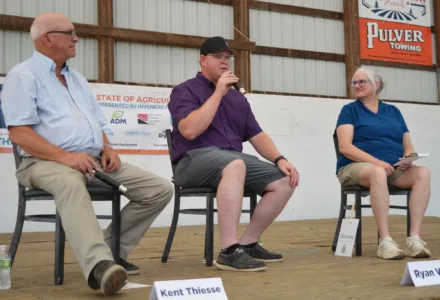
The State of Agriculture panel was held at the Lyon County Fairgrounds on Tuesday. Panel moderator Ken Franzky, of Centrol Crop Consulting, led a discussion with speakers including Thiesse, area farmers Ryan Vos and Carolyn Olson, and Jack Long, agricultural legislative assistant with U.S. Rep. Michelle Fischbach's office.
Thiesse said corn and soybean farmers in the region have been going through a difficult few years.
"Basically, if you took out all the government support payments that we have, we've really been on a track of negative cash flow, negative profitability, for about three years. And the input costs have surpassed what we've been able to take in," he said. "Even last year when we had, in much of the region of southern Minnesota, some of the best yields we've ever had, we still, especially on corn, had a hard time kind of pulling things together."
Corn and soybean farmers have had to rely on help from government payments, as well as supplemental and disaster payments, he said.
Thiesse said costs for fuel, fertilizer, parts and repairs are still going to be a challenge for farmers looking ahead. But there was possibly a little hope in the marketplace for corn and soybeans, he said.
"The last few reports that have come out, we've seen a little stronger export markets, as well as some increased usage," he said.
Vos said he would speak mainly from the perspective of a livestock farmer, but he agreed that factors like lower prices had been challenging for crop farmers. In southwest Minnesota, he said, "If it wasn't for the bumper-crop yields we had last year, people would be in a much, much different frame of mind right now . . . With the good yields, we were able to keep our head above water."
On the livestock side, Vos said, "Right now the cow-calf industry is obviously where the money is at. A lot of people are selling their calves for a lot of money."
"When you go to the feedlot side, they had to buy more expensive cattle, and luckily we were able to keep those markets on the higher end," Vos said.
He said it didn't hurt that corn and distillers' grains for cattle feed were cheaper than they were a few years ago.
Vos said having diverse farm operations would be an asset to farmers in Minnesota, and help them survive.
"Anybody who really puts their eggs in one basket could be hurting, depending on where they put it," he said.
Olson said organic farmers, like she and her husband, were looking at a different set of market factors.
"The organic markets are not tied to conventional markets, but they tend to have a rubber-band effect," Olson said. "If conventional markets are going down heavy, we might be a little bit slower. But that also means that sometimes we're a little bit slower to recover prices as well."
Olson said an increase in organic livestock being raised has been positive for organic corn, which can be used as feed. Organic corn prices have also been going up due to a shortage of corn grown in the U.S.
"We're probably one of the parts of the agriculture industry that has not been hurt as badly by tariffs, and that is because organic imports of grain have been slowing," Olson said. It created an opportunity for sales of domestically-grown organic grain.
However, Olson said, organic soybeans are still lagging.
Long said factors like input and labor costs continue to be a concern for farmers, and for federal legislators.
"Introducing legislation is obviously a great way to combat that, but economic assistance is something that is often brought up in a multitude of conversations we have," Long said.
"The House released their budget resolution, which has about $12 million in regards to ag economic assistance," he said.
In September, members of Congress will need to work to figure out more specifics about how that assistance would be divided up, he said.
"I know that this $12 million in economic assistance is really great right now, but we need some more long-term solutions," Long said. "As of right now, we're seeing some ease in the marketplace when it comes to pricing, but I don't think that's going to do enough to kind of create that balance that we see with high input costs."
Factors like extreme drought in the Great Plains, and the presence of New World screwworm along the southern border, could also create volatility for U.S. cattle producers, Long said.
Marshall Area Chamber of Commerce President Brad Gruhot said the State of Ag event takes a closer look at a key part of the local economy.
"Agriculture is truly the lifeblood of a community like Marshall. When agriculture does well, the economy does better," Gruhot told the audience. "It's important for ag-related businesses, and businesses in general, to hear from panelists from different ag backgrounds."