
Small wind turbines offer Minnesota farmers path to energy independence
Bergey Windpower’s 15-kilowatt systems are generating up to $450 in monthly savings for agricultural operations across the state
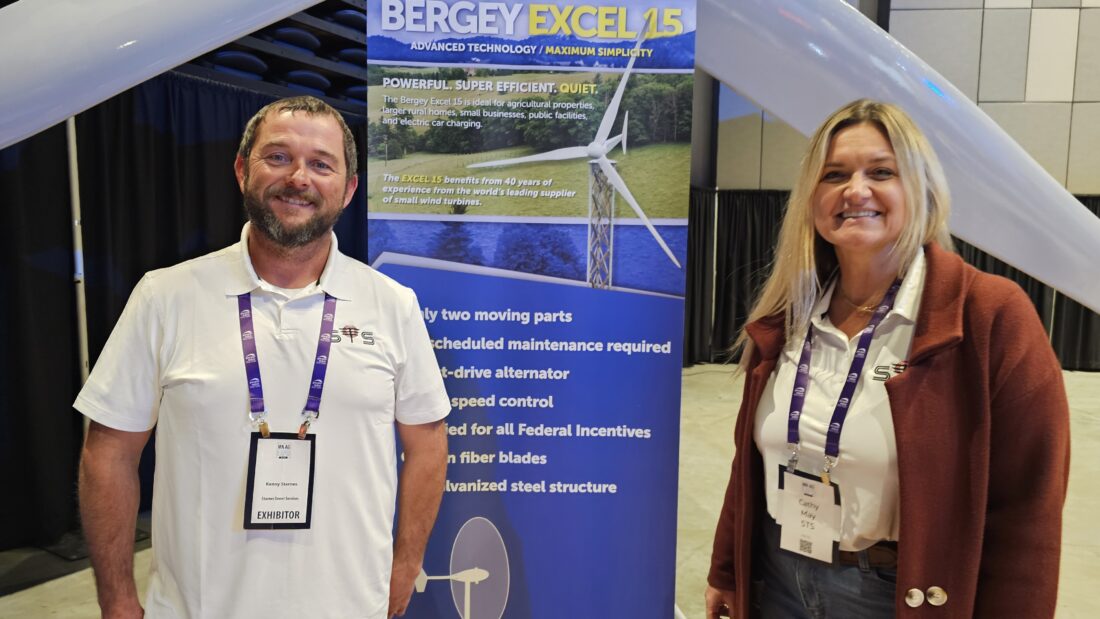
Photo by Amy Zents Exhibitors Kenny Starnes and Cathy May stand near a Bergey Excel 15 small wind turbine display during the Minnesota Ag Expo. The Oklahoma-based manufacturer specializes in small-scale wind turbines designed for agricultural, residential and small-business use.
MANKATO.– As energy costs continue to challenge agricultural operations across Minnesota, some farmers are turning to small-scale wind turbines as a solution for reducing expenses and achieving greater energy independence.
At the 2026 Minnesota Ag Expo, Bergey Windpower showcased wind turbine systems designed specifically for agricultural and residential use.
The Oklahoma-based manufacturer has been producing small wind turbines since 1977.
Unlike massive commercial wind farms, these turbines integrate directly into existing farm electrical infrastructure.
“It connects directly into your breaker box,” said Cathy May, sales representative for Bergey Windpower.
The system feeds generated power into the grid, allowing farmers to offset their electricity consumption.
The company’s 15-kilowatt turbine model uses a direct-drive alternator with only two moving parts, eliminating the need for a gearbox or regular oil and grease maintenance.
The simplified design reduces upkeep requirements, a practical consideration for busy farm operations.
Minnesota’s open plains and consistent winds make the state well-suited for small-scale wind energy generation.
Bergey Windpower has installed more than 20 turbines in the Luverne area alone, with hog operations among the most frequent adopters.
“We have over 20 in the Luverne area,” May said, noting that hog barns have been particularly receptive to the technology.
The financial arrangement proves favorable for farmers. Minnesota electric utilities are required to match customer generation dollar-for-dollar under state renewable energy policies.
Net metering programs allow turbine owners to receive credits for any excess power they generate, effectively reducing or eliminating monthly electricity bills.
Farmers typically can install up to two turbines per operation, maximizing their energy production potential.
A single 15-kilowatt turbine in Minnesota can generate between 33,000 and 40,000 kilowatt-hours annually, depending on wind conditions.
This translates to average monthly savings of $350 to $450 on energy costs for typical farm operations.
The ownership model differs from commercial wind farm arrangements that often involve complex land leases.
“You own it,” May said, emphasizing that farmers maintain complete control over their energy asset.
The turbines are designed for a 40-year lifespan.
Bergey Windpower points to installations from the 1980s that remain operational today as evidence of the systems’ longevity and durability.
The turbines require little ground space, with a base footprint just 12 feet in diameter.
Tower height reaches approximately 100 feet, but the narrow profile allows farming activities to continue uninterrupted around the installation.
Farmers can cultivate crops and manage livestock near the turbines without disruption to yields or animal welfare.
The systems are designed to coexist with ongoing agricultural operations rather than displace productive land.
Environmental concerns sometimes associated with larger wind installations have not materialized with these smaller systems.
The 15.5-foot blades have resulted in minimal bird impacts.
“We’ve had no issues with birds or anything,” May said, adding humorously that “more cats kill birds than turbines do.”
The turbines produce a slight “swish” sound as blades rotate. A sound-reducing kit is available to minimize noise and prevent vibrations from traveling down the tower, addressing potential concerns from nearby residents.
Kenny Starnes of Starnes Tower Services handles installations throughout the Midwest region as the installation owner for Bergey Windpower’s distribution network.
The company also maintains installation crews based in Oklahoma and New York to serve customers nationwide.
The company services its wind turbines and also builds and maintains radio towers, leveraging expertise in tall structure installation and maintenance.
At the end of their service life, turbine components contribute to a circular economy. Blades are recycled and repurposed into materials used for roads and sidewalks. Some older parts are refurbished and reused in other applications.
While Bergey Windpower describes itself as small compared to major renewable energy corporations, the company has remained active in the wind energy sector for nearly five decades.
The company continues exploring improvements to meet evolving customer needs. Development work includes larger turbine models designed for high-electricity operations such as dairy farms, which have substantial energy demands for milking equipment, cooling systems and other infrastructure.
Electronic components receive regular updates to enhance efficiency and performance, while the core alternator design has remained largely unchanged since the 1980s, a testament to the original engineering.
For farmers skeptical about wind energy, May recommends a straightforward approach:
“Talk to my other customers.”
Real-world experiences from existing turbine owners provide prospective buyers with practical insights into performance, maintenance requirements and actual cost savings.
The company’s message centers on empowerment. Wind energy allows farmers to be “independent and provide their own sources” of electricity, May said.
Some farmers pursue complete energy independence, going “off the grid” and storing electricity in battery systems for true self-sufficiency.
While solar energy might appear to compete with wind power, May views the technologies as complementary.
“Wind and solar are brother and sister,” she said, noting that both benefit from similar net metering policies and contribute to diversified, resilient energy systems.
The combination of wind and solar allows farmers to generate power during different conditions, solar during sunny days and wind during overcast or nighttime hours when turbines may perform better.
As energy markets remain unpredictable and operational costs challenge agricultural profitability, small-scale wind turbines offer Minnesota farmers tangible benefits: reduced electricity expenses, greater operational control and decreased vulnerability to utility rate increases.
For rural communities seeking sustainable solutions, on-farm wind generation represents a proven technology that supports both economic stability and environmental stewardship.
Local News
Lyon Co. board discusses battery disposal
MARSHALL — Rechargeable batteries from items like laptops have started a half-dozen fires at the Lyon County ...
Lyon Co. Museum honored for storage improvements

Tiger Spotlight celebrates Marshall student success

Welcoming the troops home
Small wind turbines offer Minnesota farmers path to energy independence
Two SD 15 candidates talk about Jan. 6
One of the three candidates running for Minnesota state Senate in District 15 said Monday that he wasn’t the only ...