Organic farming brings variety and challenges for Olsons
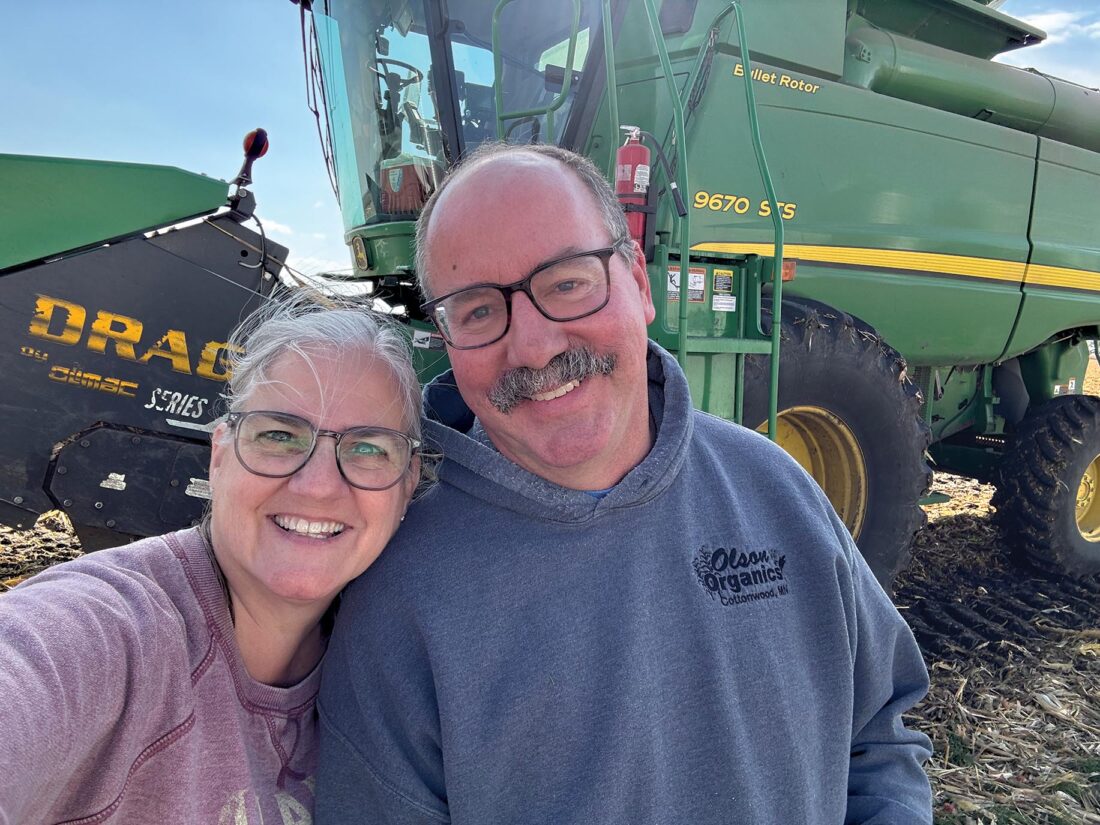
Photo courtesy of Carolyn Olson Carolyn and Jonathan Olson have been farming together in rural Cottonwood since 1988. Starting in 1998, the Olsons changed over to raising organic crops, including corn, soybeans and small grains.
COTTONWOOD — Jonathan and Carolyn Olson’s family farm has been going for more than a century. But within the past 30 years, they’ve made some changes, focusing on raising organic crops.
“It brings us different opportunities, and it’s something we enjoy, the diversity and the challenges,” Carolyn Olson said.
Olson recently spoke about her and Jonathan’s experiences with organic farming at a talk in Marshall.
The Olsons have 1,100 acres of land near Cottonwood, Olson said.
“We have been farming together since 1988,” Olson said. “Our farm has been in Jonathan’s family since 1913, so we have been a century farm for more than a few years.”
Starting in 1998, the Olsons made a significant change, transitioning over to organic farming.
“I got asked on some food-grade soybeans, ‘Are these organic?’ And we had no idea what that meant,” Olson said. “So we started exploring what that meant, and decided in 1998 that we were going to give it a shot.”
Raising organic crops means following a lot of different rules, Olson said. “We started our transition in 1998, but the National Organic Program did not go into effect until 2001, so we lived under a hodgepodge of different certification standards for the first few years,” she said. Now, she said, “We know that it is valuable to have a concrete set (of rules) and a baseline that everybody has to meet if they’re wanting to be certified organic.”
Part of the work of organic farming includes undergoing inspections, and keeping documentation for inspectors, Olson said.
Today, the Olsons primarily raise crops like corn and soybeans, as well as small grains. The Olson family have raised seed on their farm since the 1930s.
“So the soybeans and the small grains that we grow, they are for seed production,” Olson said. “Because we are now organic farming, all of those seeds that we raise go to Albert Lea Seed for other organic farmers to use.”
Today, the Olsons have an extended crop rotation, including corn, soybeans and small grains like wheat, barley or oats.
“Mostly we always have wheat, but the other grains are as needed,” she said. “So if the seed house needs somebody to grow a certain variety or certain type of grain, we can do that.”
“After the small grain comes off, we plant cover crops on those acres. And then sometimes, when we’re feeling crazy, we might plant some alfalfa as well,” Olson said. The Olsons don’t raise animals that eat alfalfa, so they need to have a market for it before they plant any. Other cover crops they plant include tillage radishes, which help break up compaction in the soil.
The Olsons also raise pigs at two 2,400-head finishing sites. The pigs are not raised organically, but the manure they produce can be used for fertilizer on the organic fields, Olson said. She said that they also spot spread turkey litter to help increase phosphorus in their fields.
Ag technology has become a valuable tool for tasks like spreading manure, and field cultivating, Olson said.
“We do a lot of mechanical tillage because we do not have the advantage of using the chemical means of weed control,” she said.
There used to be a bigger yield gap between organic and conventional crops, but that’s changing, Olson said. “This last year, we were right in the neighborhood of our farm friends, and the neighbors who would share their yields,” she said. “But organic soybeans in particular, we breed them for different properties, we’re not just looking at yield.” For example, the Olsons look at the beans’ protein content, and other factors.
Marketing organic crops is also a different process, Olson said. Instead of selling grain to a local elevator, she said, the Olsons sell seed to the seed house, or to individual buyers. A lot of those buyers are in Minnesota or Nebraska, but they can be from other places too, she said. One major use for organic corn and soybeans is animal feed.
“Marketing for organics is much more relational,” and involves meeting with potential buyers, Olson said. That aspect of the Olsons’ work is a fun one, she said.
“Jonathan really enjoys visiting with all the buyers, and getting to know them as well,” Carolyn said. “It’s probably one of the things we enjoy the most.”
A variety of factors can impact the market for organic grains, including consumer demand and animal health concerns for livestock producers, Olson said. For example, she said, “Right now, there’s a huge market for organic dairy.” As organic dairy farmers produce more milk, there’s an increased need for organic corn and soybeans to feed cows. At the same time, factors like avian influenza outbreaks can decrease demand for soy meal from poultry producers.
The number of farmers who have tried organic farming has ebbed and flowed over the years, Olson said. There have been some years where premiums have encouraged more people to try organic farming. In others, tightening margins lead people to transition back to conventional farming.
In the past, organic farmers in the U.S. have faced pressure from imported organic grains, Olson said. “We were probably one of the few sectors not bothered as much by tariffs,” she said. However, there are still challenges producers face. For example, some input costs had increased “quite a bit,” especially because organic farming requires more human labor.
While organic farming is a lot of hard work, Carolyn Olson said she and Jonathan enjoy it. They also appreciate working with their neighbors and customers.
“Doing what you love is freedom, loving what you do is happiness. And I’ve been blessed to be able to do this for close to 39 years. Jonathan and I still enjoy farming together,” Olson said.
Local News
Two SD 15 candidates talk about Jan. 6
One of the three candidates running for Minnesota state Senate in District 15 said Monday that he wasn’t the only ...
Yep appointed interim CEO of CJ Schwan’s
Organic farming brings variety and challenges for Olsons
MN Senate candidates talk positions
Nosbush goes Beyond the Call
NEW ULM – New Ulm native Brittany Nosbush has had a long career working with the Department of Natural Resources ...