
MPS District shares technology update
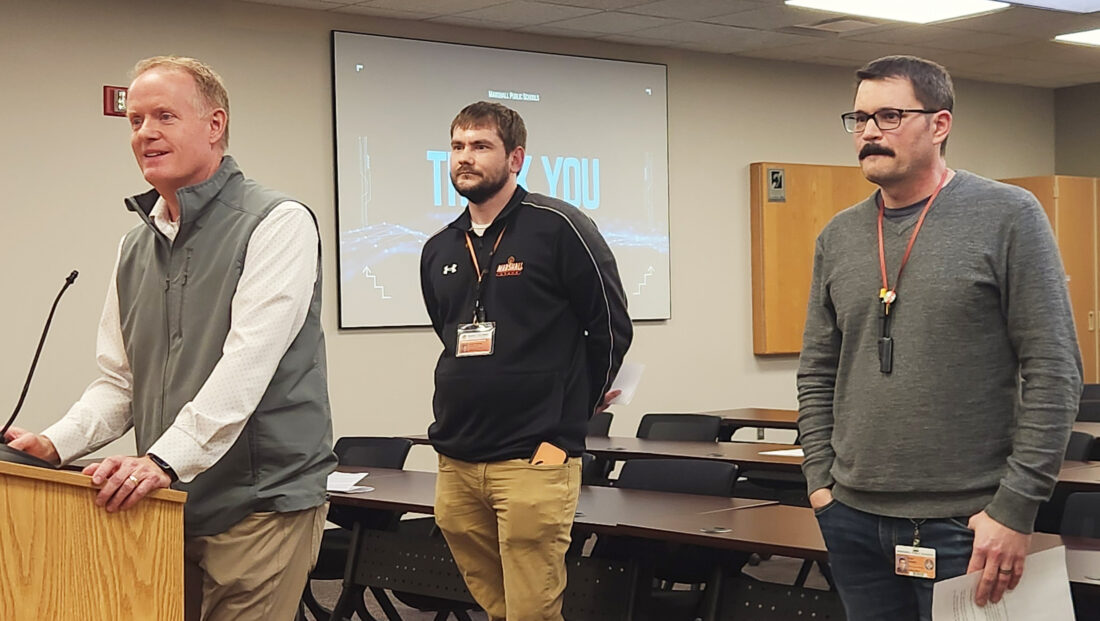
Photo courtesy of Marshall Public Schools: District Technology Coordinator Todd Pickthorn (left) and District Technicians Nicholas Esping (middle) and Kent Powell (right) present to the school board last Monday an update on district technology.
MARSHALL — The Marshall Public School District’s technology team provided an update at last week’s school board meeting regarding the district’s educational technology, classroom support, cybersecurity and more.
District Technology Coordinator Todd Pickthorn and District Technicians Nicholas Esping and Kent Powell each spoke to the board regarding the work that goes on in the background to support staff and students.
“Every day, this team works behind the scenes to ensure systems are reliable, secure and responsive to the needs of students, staff and community,” Pickthorn said. “This collective experience and dedication directly enable our district’s ability to innovate, operate efficiently and ensure that technology is a strength, not a barrier.”
Pickthorn notably mentioned that cybersecurity continues to remain a top priority for all school districts across the nation.
“Over the past year, we have fortified our defenses in four crucial areas,” Pickthorn said. “In August, we held a Cyber Incident Tabletop Exercise with all of the administrators and the district office staff to plan out a cyber incident, and what we would do in the event of a cyber incident. That was a first for us, and one that I think we need to do again, because practice makes perfect.”
Pickthorn also shared that the technology team has enhanced endpoint protection on all district devices, and has expanded phishing resistance training for staff, both initiatives of which further continue to make district systems more secure.
“While no system can be completely risk free, we are in a much stronger position than we were a year ago,” Pickthorn said. “Our objective is clear — To protect the data of students and staff while ensuring consistently safe learning environments.”
Regarding infrastructure, Pickthorn said the network’s uptime continues to read high in usage, to which the team has continued to complete upgrades to strengthen the district’s wireless performance, specifically in high-density areas like gyms and cafeterias.
The team also talked about the role technology plays in school safety, and how the district works behind the scenes to manage safe practices.
“Technology also plays a major role in student staff safety … Much of this work happens quietly in the background, but it directly affects building security and daily operations,” Powell said. “We manage camera systems, bell schedules, first-alert systems, door-lock schedules and traffic cross-walk warning lights. As our job requires us to be in multiple buildings daily, we are often the first to notice when systems aren’t functioning correctly, and are usually among the first to affect solutions for these issues.”
Powell said the team manages a fleet of over 3,000 devices across the district, each of which are tracked, maintained, updated and secured. They also work with repairs and replacements, noting that they try to manage and handle most repairs in-house for cost-saving measures.
“Our role is to make sure that technology works reliably, safely and efficiently for our students and staff members every single day,” Powell said. “Our daily tasks typically focus on troubleshooting (and) problem solving. This can include software and hardware, websites, email, computers, tablets, networks, digital signage, phones, classroom audio systems, building, WiFi, printers, TVs, PA systems, projectors, interactive panels.”
There is digital signage throughout the buildings of each school site, which is used to share announcements or alerts with students, staff and visitors. Digital signage allows the district to communicate quickly and consistently.
“These systems can be used during emergencies to display important information or alerts. One aspect of the system is that it’s designed, maintained and managed entirely in-house,” Esping said. “By building and supporting the system ourselves, the district avoids the significant licensing and service costs that often (go) with commercial digital signage platforms, while providing flexible and reliable communication for our schools behind the scenes.”
The team also ensured that while schools rely on a multitude of systems like email and learning platforms, that account automation and system management continues to be closely controlled such as granting access, removing accounts when no longer needed and scheduling frequent maintenance updates.
Local News
Marshall Council approves bond sale
MARSHALL — This week, Marshall City Council members approved the sale of a total $6.62 million in general ...

Hennen announces run for House Dist. 15A
Adult Community Center plans summer kickoff
MARSHALL — The Marshall Adult Community Center is planning to host an event for senior citizens to kick off the ...

‘One step closer’
MPS District shares technology update
Rollover crash reported near Ghent on Monday
A rollover crash on Minnesota Highway 68 on Monday afternoon is under investigation, the Minnesota State Patrol ...