Using a herd mentality to clearing weeds, brush
Grazing goats available for hire; Sweetie is ‘the head boss’
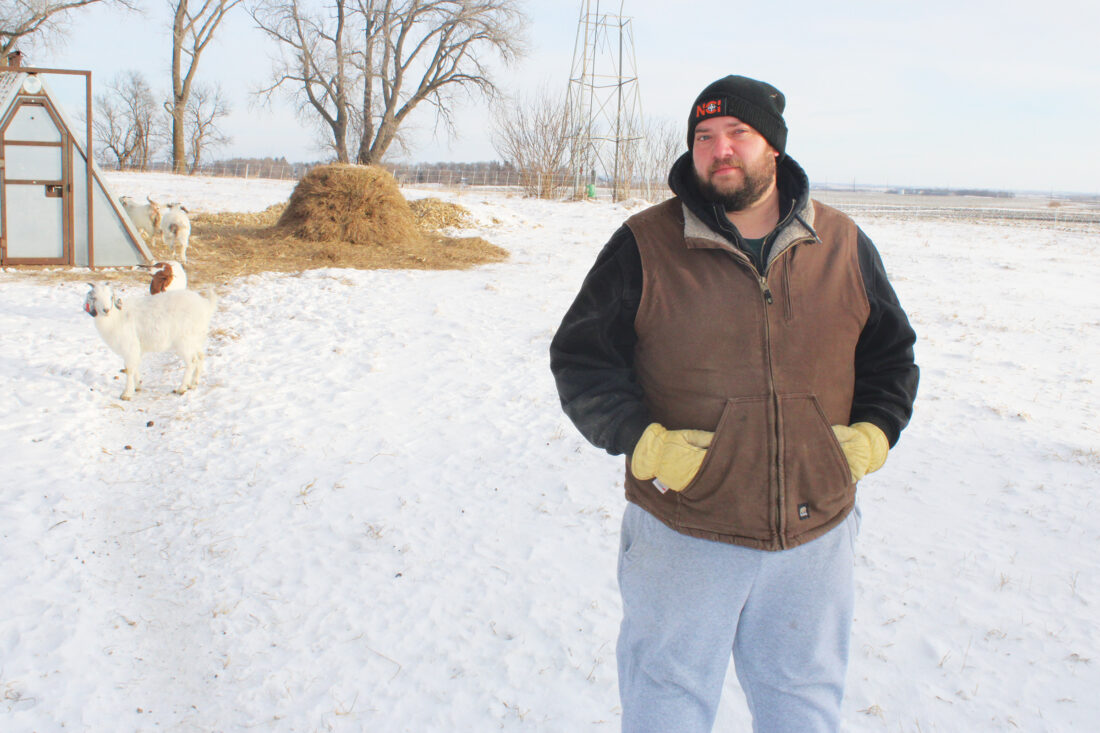
Photo by Jim Tate Grant Moorse is shown with a couple of goats that are part of his goat grazing operation, now entering its third season.
It’s a practice that’s been around for a long time, but it’s pretty rare in southwest Minnesota.
What is it?
Using goats to clean up overgrown areas of weeds and brush — goat grazing.
That’s where Grant Moorse comes in. He lives with his family between Minneota and Ivanhoe and is preparing for his third season of the venture, which has seen steady growth since its beginning. Its formal name is Moorse Livestock Targeted Goat Grazing.
He has a herd of 30 goats — all but two females — and “by the time we go on the road this year we will have between 40 and 45,” he said.
By “on the road” he’s referring to trailering his goats and traveling to various jobs. He’s already got several lined up — “way ahead of last year” — and is expecting more.
He does small areas, and large, and finds that although he does do some advertising, it’s word-of-mouth that brings customers his way on a consistent basis.
He has a Facebook page — Moorse Livestock Targeted Goat Grazing — and has made several TikTok videos, as well.
“Our season runs from May 1 to about the first of November,” he explained. “Obviously, weather plays a part in that.”
Grant grew up on the rural Minneota farm of Greg and Becky Moorse. They had a dairy and feedlot operation, he explained, and that’s where he first learned about goats and their potential. He and his wife, Denaca, are the parents of two children: Melah, 4, and Myah, 1.
Moorse had the business in the back of his mind for some time, percolating, and met a man from New Mexico online who does the same thing in that state, on a larger scale. They began to communicate and that’s when Moorse decided to jump in.
His full-time job is with Davis Equipment, a fertilizer equipment company based in Des Moines, Iowa.
“I work remotely and the flexibility has really been helpful in this grazing business,” he said.
His herd consists of two breeds: Savanna and Boers. “Savannas are good mothers — “I doin’t have to worry about them too much” (during kidding season) and are parasite resistant. Boers, he said, is a South African breed known for their good muscle structure. Those are the ones he anticipates his children will be showing at fairs once they’re older and hopefully active in 4-H, he said.
He’s been involved with the State Farm Bureau organization, having served as the Young Farmers and Ranchers chair. He’s currently on the Yellow Medicine County Farm Bureau board.
When Moorse is contacted for a job, there’s several factors that go into the price he quotes. “How far away it is, how big of an area, and whether there’s water on site,” he said. “There’s no set rate.”
The length of the job also varies, he said. “We did six weeks in Willmar last year, and three weeks in Ward, S.D. A typical acre, like a grove, will take 4-5 days,” he said. His grazing business covers southwest Minnesota and eastern South. Dakota, he said. “We do have a large job in Ortonville this summer, too, for the city,” he said.
Moors likes to use his own portable, electric fencing, and also uses several cameras to keep an eye on things. He likes to check progress personally every other day, he said.
Goats take care of weeds and brush and don’t eat the grass, said Moorse. “I can’t guarantee every little thing,” he said. “There’s things they may not like. The goats’ bodies tell them what they need.”
He augments their diet with protein and vitamin feed, moreso in the winter. They don’t touch the grass, “I may add sheep into the mix for that.” Goats stand on their hind legs and can reach up to 6-7 feet, he said.
There’s also a pecking order. His herd is led by “Sweetie. “She’s the head boss,” he said. “If you mixed a couple of herds you’d have a battle that lasts for a couple of hours.”
Moorse just recently moved to his current location from Minneota. He’ll have all of the goats there soon. Formerly, he had them at his father-in-law Greg DeVos’ farm, but the barn they were held in north of Marshall was destroyed in a recent fire, and a dozen of the goats were lost. He’ll replenish those that were lost.
Moorse said there’s no one in the area with a similar business, and he’s happy with its growth so far. “It’s my niche right now,” he said. “I’ve always been a livestock guy, and it’s fun to see what the goats are capable of, it’s impressive.”
Local News
Using a herd mentality to clearing weeds, brush
Bluepeak announces $35 million fiber expansion in MN
MARSHALL — A high-speed internet provider in southwest Minnesota announced this week that it will be making some ...
Library meeting addresses law enforcement in public places
MARSHALL — As activity from Immigrations and Customs Enforcement increased in Minnesota, area residents had asked ...
Lynd fire department continues to grow through community support

RTR One Act earns starred performance at state festival